
1 The glory of these forty days
we celebrate with songs of praise,
for Christ, by whom all things were made,
himself has fasted and has prayed.
2 Alone and fasting Moses saw
the loving God who gave the law.
And to Elijah, fasting, came
the steed and chariots of flame.
3 So Daniel trained his mystic sight,
delivered from the lion’s might.
And John, the Savior’s friend, became
the herald of Messiah’s name.
4 Then grant, O God, that we may, too,
return in fast and prayer to you.
Our spirits strengthen with your grace,
and give us joy to see your face.
Source: Voices Together #305
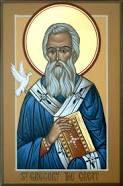
Gregory I., St., Pope. Surnamed The Great. Was born at Rome about A.D. 540. His family was distinguished not only for its rank and social consideration, but for its piety and good works. His father, Gordianus, said to have been the grandson of Pope Felix II. or III., was a man of senatorial rank and great wealth; whilst his mother, Silvia, and her sisters-in-law, Tarsilla and Aemiliana, attained the distinction of canonization. Gregory made the best use of his advantages in circumstances and surroundings, so far as his education went. "A saint among saints," he was considered second to none in Rome in grammar, rhetoric, and logic. In early life, before his father's death, he became a member of the Senate; and soon after he was thirty and ac… Go to person page >| First Line: | The glory of these forty days |
| Title: | The Glory of These Forty Days |
| Latin Title: | Clarum decus jejunii |
| Author: | Pope Gregory I |
| Translator: | Maurice F. Bell (1906) |
| Meter: | 8.8.8.8 |
| Source: | Latin, 6th cent. |
| Place of Origin: | Italy |
| Language: | English |
| Copyright: | Public Domain |
Clarum decus jejunii, p. 236, i. There does not seem to be any reason for ascribing this to St. Gregory. Additional translation: The glory of these forty days, by M. F. Bell, in The English Hymnal, 1906, No. 68. [Rev. James Mearns, M.A.]
--Excerpt from John Julian, Dictionary of Hymnology, New Supplement (1907)
My Starred Hymns