You help make Hymnary.org possible. More than 10 million people from 200+ countries found hymns, liturgical resources and encouragement on Hymnary.org in 2025, including you. Every visit affirms the global impact of this ministry.

If Hymnary has been meaningful to you this year, would you take a moment today to help sustain it? A gift of any size—paired with a note of encouragement if you wish—directly supports the server costs, research work and curation that keep this resource freely available to the world.

Give securely online today, or mail a check to:
Hymnary.org
Calvin University
3201 Burton Street SE
Grand Rapids, MI 49546

Thank you for your partnership, and may the hope of Advent fill your heart.

Person Results

Tune Identifier:"^malvern_mason$"
In:people

Planning worship? Check out our sister site, ZeteoSearch.org, for 20+ additional resources related to your search.
Showing 21 - 29 of 29Results Per Page: 102050

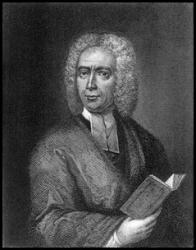
Isaac Watts

1674 - 1748 Author of "Far from my thoughts, vain world, begone!" in The Seventh-Day Adventist Hymn and Tune Book Isaac Watts was the son of a schoolmaster, and was born in Southampton, July 17, 1674. He is said to have shown remarkable precocity in childhood, beginning the study of Latin, in his fourth year, and writing respectable verses at the age of seven. At the age of sixteen, he went to London to study in the Academy of the Rev. Thomas Rowe, an Independent minister. In 1698, he became assistant minister of the Independent Church, Berry St., London. In 1702, he became pastor. In 1712, he accepted an invitation to visit Sir Thomas Abney, at his residence of Abney Park, and at Sir Thomas' pressing request, made it his home for the remainder of his life. It was a residence most favourable for his health, and for the prosecution of his literary labours. He did not retire from ministerial duties, but preached as often as his delicate health would permit. The number of Watts' publications is very large. His collected works, first published in 1720, embrace sermons, treatises, poems and hymns. His "Horae Lyricae" was published in December, 1705. His "Hymns" appeared in July, 1707. The first hymn he is said to have composed for religious worship, is "Behold the glories of the Lamb," written at the age of twenty. It is as a writer of psalms and hymns that he is everywhere known. Some of his hymns were written to be sung after his sermons, giving expression to the meaning of the text upon which he had preached. Montgomery calls Watts "the greatest name among hymn-writers," and the honour can hardly be disputed. His published hymns number more than eight hundred. Watts died November 25, 1748, and was buried at Bunhill Fields. A monumental statue was erected in Southampton, his native place, and there is also a monument to his memory in the South Choir of Westminster Abbey. "Happy," says the great contemporary champion of Anglican orthodoxy, "will be that reader whose mind is disposed, by his verses or his prose, to imitate him in all but his non-conformity, to copy his benevolence to men, and his reverence to God." ("Memorials of Westminster Abbey," p. 325.) --Annotations of the Hymnal, Charles Hutchins, M.A., 1872. ================================= Watts, Isaac, D.D. The father of Dr. Watts was a respected Nonconformist, and at the birth of the child, and during its infancy, twice suffered imprisonment for his religious convictions. In his later years he kept a flourishing boarding school at Southampton. Isaac, the eldest of his nine children, was born in that town July 17, 1674. His taste for verse showed itself in early childhood. He was taught Greek, Latin, and Hebrew by Mr. Pinhorn, rector of All Saints, and headmaster of the Grammar School, in Southampton. The splendid promise of the boy induced a physician of the town and other friends to offer him an education at one of the Universities for eventual ordination in the Church of England: but this he refused; and entered a Nonconformist Academy at Stoke Newington in 1690, under the care of Mr. Thomas Rowe, the pastor of the Independent congregation at Girdlers' Hall. Of this congregation he became a member in 1693. Leaving the Academy at the age of twenty, he spent two years at home; and it was then that the bulk of the Hymns and Spiritual Songs (published 1707-9) were written, and sung from manuscripts in the Southampton Chapel. The hymn "Behold the glories of the Lamb" is said to have been the first he composed, and written as an attempt to raise the standard of praise. In answer to requests, others succeeded. The hymn "There is a land of pure delight" is said to have been suggested by the view across Southampton Water. The next six years of Watts's life were again spent at Stoke Newington, in the post of tutor to the son of an eminent Puritan, Sir John Hartopp; and to the intense study of these years must be traced the accumulation of the theological and philosophical materials which he published subsequently, and also the life-long enfeeblement of his constitution. Watts preached his first sermon when he was twenty-four years old. In the next three years he preached frequently; and in 1702 was ordained pastor of the eminent Independent congregation in Mark Lane, over which Caryl and Dr. John Owen had presided, and which numbered Mrs. Bendish, Cromwell's granddaughter, Charles Fleetwood, Charles Desborough, Sir John Hartopp, Lady Haversham, and other distinguished Independents among its members. In this year he removed to the house of Mr. Hollis in the Minories. His health began to fail in the following year, and Mr. Samuel Price was appointed as his assistant in the ministry. In 1712 a fever shattered his constitution, and Mr. Price was then appointed co-pastor of the congregation which had in the meantime removed to a new chapel in Bury Street. It was at this period that he became the guest of Sir Thomas Abney, under whose roof, and after his death (1722) that of his widow, he remained for the rest of his suffering life; residing for the longer portion of these thirty-six years principally at the beautiful country seat of Theobalds in Herts, and for the last thirteen years at Stoke Newington. His degree of D.D. was bestowed on him in 1728, unsolicited, by the University of Edinburgh. His infirmities increased on him up to the peaceful close of his sufferings, Nov. 25, 1748. He was buried in the Puritan restingplace at Bunhill Fields, but a monument was erected to him in Westminster Abbey. His learning and piety, gentleness and largeness of heart have earned him the title of the Melanchthon of his day. Among his friends, churchmen like Bishop Gibson are ranked with Nonconformists such as Doddridge. His theological as well as philosophical fame was considerable. His Speculations on the Human Nature of the Logos, as a contribution to the great controversy on the Holy Trinity, brought on him a charge of Arian opinions. His work on The Improvement of the Mind, published in 1741, is eulogised by Johnson. His Logic was still a valued textbook at Oxford within living memory. The World to Come, published in 1745, was once a favourite devotional work, parts of it being translated into several languages. His Catechisms, Scripture History (1732), as well as The Divine and Moral Songs (1715), were the most popular text-books for religious education fifty years ago. The Hymns and Spiritual Songs were published in 1707-9, though written earlier. The Horae Lyricae, which contains hymns interspersed among the poems, appeared in 1706-9. Some hymns were also appended at the close of the several Sermons preached in London, published in 1721-24. The Psalms were published in 1719. The earliest life of Watts is that by his friend Dr. Gibbons. Johnson has included him in his Lives of the Poets; and Southey has echoed Johnson's warm eulogy. The most interesting modern life is Isaac Watts: his Life and Writings, by E. Paxton Hood. [Rev. H. Leigh Bennett, M.A.] A large mass of Dr. Watts's hymns and paraphrases of the Psalms have no personal history beyond the date of their publication. These we have grouped together here and shall preface the list with the books from which they are taken. (l) Horae Lyricae. Poems chiefly of the Lyric kind. In Three Books Sacred: i.To Devotion and Piety; ii. To Virtue, Honour, and Friendship; iii. To the Memory of the Dead. By I. Watts, 1706. Second edition, 1709. (2) Hymns and Spiritual Songs. In Three Books: i. Collected from the Scriptures; ii. Composed on Divine Subjects; iii. Prepared for the Lord's Supper. By I. Watts, 1707. This contained in Bk i. 78 hymns; Bk. ii. 110; Bk. iii. 22, and 12 doxologies. In the 2nd edition published in 1709, Bk. i. was increased to 150; Bk. ii. to 170; Bk. iii. to 25 and 15 doxologies. (3) Divine and Moral Songs for the Use of Children. By I. Watts, London, 1715. (4) The Psalms of David Imitated in the Language of the New Testament, And apply'd to the Christian State and Worship. By I. Watts. London: Printed by J. Clark, at the Bible and Crown in the Poultry, &c, 1719. (5) Sermons with hymns appended thereto, vol. i., 1721; ii., 1723; iii. 1727. In the 5th ed. of the Sermons the three volumes, in duodecimo, were reduced to two, in octavo. (6) Reliquiae Juveniles: Miscellaneous Thoughts in Prose and Verse, on Natural, Moral, and Divine Subjects; Written chiefly in Younger Years. By I. Watts, D.D., London, 1734. (7) Remnants of Time. London, 1736. 454 Hymns and Versions of the Psalms, in addition to the centos are all in common use at the present time. --Excerpts from John Julian, Dictionary of Hymnology (1907) ================================== Watts, I. , p. 1241, ii. Nearly 100 hymns, additional to those already annotated, are given in some minor hymn-books. --John Julian, Dictionary of Hymnology, Appendix, Part II (1907) ================= Watts, I. , p. 1236, i. At the time of the publication of this Dictionary in 1892, every copy of the 1707 edition of Watts's Hymns and Spiritual Songs was supposed to have perished, and all notes thereon were based upon references which were found in magazines and old collections of hymns and versions of the Psalms. Recently three copies have been recovered, and by a careful examination of one of these we have been able to give some of the results in the revision of pp. 1-1597, and the rest we now subjoin. i. Hymns in the 1709 ed. of Hymns and Spiritual Songs which previously appeared in the 1707 edition of the same book, but are not so noted in the 1st ed. of this Dictionary:— On pp. 1237, L-1239, ii., Nos. 18, 33, 42, 43, 47, 48, 60, 56, 58, 59, 63, 75, 82, 83, 84, 85, 93, 96, 99, 102, 104, 105, 113, 115, 116, 123, 124, 134, 137, 139, 146, 147, 148, 149, 162, 166, 174, 180, 181, 182, 188, 190, 192, 193, 194, 195, 197, 200, 202. ii. Versions of the Psalms in his Psalms of David, 1719, which previously appeared in his Hymns and Spiritual Songs, 1707:— On pp. 1239, U.-1241, i., Nos. 241, 288, 304, 313, 314, 317, 410, 441. iii. Additional not noted in the revision:— 1. My soul, how lovely is the place; p. 1240, ii. 332. This version of Ps. lxiv. first appeared in the 1707 edition of Hymns & Spiritual Songs, as "Ye saints, how lovely is the place." 2. Shine, mighty God, on Britain shine; p. 1055, ii. In the 1707 edition of Hymns & Spiritual Songs, Bk. i., No. 35, and again in his Psalms of David, 1719. 3. Sing to the Lord with [cheerful] joyful voice, p. 1059, ii. This version of Ps. c. is No. 43 in the Hymns & Spiritual Songs, 1707, Bk. i., from which it passed into the Ps. of David, 1719. A careful collation of the earliest editions of Watts's Horae Lyricae shows that Nos. 1, 7, 9, 10, 11, 12, 14, 16, p. 1237, i., are in the 1706 ed., and that the rest were added in 1709. Of the remaining hymns, Nos. 91 appeared in his Sermons, vol. ii., 1723, and No. 196 in Sermons, vol. i., 1721. No. 199 was added after Watts's death. It must be noted also that the original title of what is usually known as Divine and Moral Songs was Divine Songs only. --John Julian, Dictionary of Hymnology, New Supplement (1907) =========== See also in: Hymn Writers of the Church

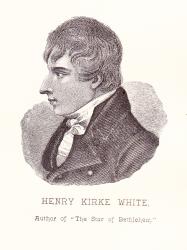
Henry Kirke White

1785 - 1806 Person Name: Henry K. White Author of "The star of Bethlehem" in The National Baptist Hymnal White, Henry Kirke, a gifted English poet who died early in life, was born in Nottingham, England, March 21, 1785. Very early he manifested a remarkable love for books and a decided talent for composition. But his parents were poor, and he was apprenticed in early boyhood to a stocking weaver, from which uncongenial servitude he escaped as soon as he could and began the study of law; but later he was converted and felt called to the ministry. The story of his conversion from deism to Christianity is briefly but beautifully told in the poem titled "The Star of Bethlehem." He entered St. John's College, Cambridge, in 1805 as a servitor; but died October 19, 1806, in the second year of his college course, when only twenty-one years of age. In 1803 he published a small volume of poems. Some of them are very fine, but no doubt he would have produced others far better if he had lived to the ordinary age of man. His rare poetic genius, his victory over skepticism and subsequent faith and piety, his hard struggle with poverty and early death invest the story of his life with more than ordinary pathos. His hymns, ten in number, appeared in Collyer's Collection, 1812. Oft in danger, oft in woe 412 The Lord our God is clothed with 99 When marshaled on the mighty 124 Hymn Writers of the Church, 1911 ============================ White, Henry Kirk, remarkable both for the early development of his genius and for the untimely termination of his brief life of splendid promise, was born at Nottingham, March 21, 1785. His father was a butcher, but his mother must have been a superior woman, since for a number of years she successfully conducted a boarding-school for girls. The writing-master in her establishment was for some time Henry's teacher, and under his instruction he made remarkable progress in Latin and other subjects. At the age of 13 he composed the lines "To an early Primrose," which were subsequently printed with his poems. At 14 he left school, and was put to the stocking-frame in order to learn prac¬tically the business of a hosier; but, disliking the employment, he was removed to an attorney's office in Nottingham, with a view to the legal profession. All his spare time was now devoted to literary pursuits, the acquisition of languages, and the composition of poetical and other contributions for the periodicals of the day. At the age of 15 he obtained from the Monthly Preceptor a silver medal for a translation from Horace, and a pair of globes for the best description of an imaginary tour from London to Edinburgh. When only 17 he was encouraged to publish his Clifton Grove and other Poems, which were certainly excellent as the compositions of a mere boy. About this time he was inclined to scepticism, but. through the perusal of Scott's Force of Truth and the arguments and appeals of a young friend, R. W. Almond (afterwards Rector of St. Peter's, Nottingham), he was led to earnest faith in Christianity. His well-known hymn "When marshall'd on the nightly plain" is understood to be a figurative description of his spiritual experience at this period. He now desired to become a Christian minister, and through the generosity of his employers he was released from his articles in 1804. With the help of the Rev. C. Simeon and other friends, he became a student of St. John's College, Cambridge. There he speedily distinguished himself, and the highest honours seemed within his grasp; but over application to study destroyed his health, and he fell ill and died Oct. 19, 1806, in the 22nd year of his age. Universal regret was expressed at his untimely end. Southey published his Remains, accompanied by a short memoir. Lord Byron composed some beautiful lines on the sad event. Josiah Conder and others wrote commemorative verses. The entire literary young manhood of England and America seemed moved with sympathy. A monumental tablet, with a medallion by Chantrey, was erected in All Saints Church, Cambridge, at the expense of a citizen of Boston, in the United States. Ten hymns are ascribed to H. K. White, which were printed by the Rev. Dr. W. B. Collyer in his Supplement to Dr. Watts's Psalms & Hymns, London, 1812. Of these four of the most popular are annotated as follows: "Awake, sweet harp of Judah, wake"; "Christians, brethren, ere we part"; "Much in sorrow, oft in woe"; “When marshalled on the nightly plain." These are all in extensive use. The rest, all in common use at the present time, are:— 1. 0 Lord, another day has flown. Evening. From this the hymn "0 let Thy grace perform its part" is taken. 2. 0 Lord, my God, in mercy turn. Penitence and Faith. 3. The Lord our God is full [clothed in] of might. Divine Sovereignty. 4. The Lord our God is Lord of all. Divine Sovereignty. 5. Through sorrow's night and danger's path. The Resurrection. Sometimes given as "When sorrow's path and danger's road." 6. What is this passing scene? Human Frailty. This hymn consists of selected stanzas from his “Ode on Disappointment." [Rev. W. R. Stevenson, M.A.] -- John Julian, Dictionary of Hymnology (1907)

Johannes Leon

1530 - 1597 Author of "O God, Thou righteous, faithful Lord" in Evangelical Lutheran hymnal Leon, Johannes, was a native of Ohrdruf, near Gotha. He was for some time an army chaplain, then in 1557 pastor at Königsee (Schwarzburg-Rudolstadt), in 1560 at Gross-Muhlhausen, and in 1575 at Wolfis, near Ohrdruf. He died at Wölfis about Easter, 1597 (Allg. Deutsche Biographie, xviii. 298; Wachernagel, i. pp. 466, 654; iv. p. 490, &c). Leon's hymns appeared principally in his (1) Handbüchlin, Frankfurt-am-Main, 1566, and (2) Trostbülein. The edition printed at Nürnberg, 161-1, has a preface of Dec. 9, 1588, so that the first ed. was probably 1589. His hymns are reprinted in Wackernagel, iv., Nos. 671-715. The only hymn ascribed to him which has passed into English is:— Ich hab mein Sach Gott heimgestellt. For the Dying. Wackernagel, iv. p. 519, gives this, in 18 stanzas of 5 lines, from the Psalmen, geistliche Lieder und Kirchengesäng, Nürnberg, 1589; with a long note, in which he traces all the stanzas save xi., xiv., xv., viii., to Leon's Trostbüchlein, and to his Leich-Predigten [i.e. "Funeral Sermons"], 1581-82. Mützell, No. 347, cites it as in the Psalmen, geistliche Lieder und Lobgesänge, Strassburg, n.d., but apparently before 1587. In the Berlin Geistlicher Lieder Schatz, ed. 1863, No. 1460.This hymn has been frequently ascribed to Dr. Johann Pappus [b. Jan. 16, 1549, at Lindau on the Lake of Constanz; 1571, professor of Hebrew at the University of Strassburg; d. at Strassburg, July 13, 3610]; but this ascription has not been traced earlier than about 1640, e.g. in the Cantionale sacrum, Gotha, pt. iii., 1648, No. 18, and the Königsberg Gesang-Buch, 1650, p. 530. Lauxmann, in Koch, viii. 609, thinks that Pappus may have arranged the hymn in its present form. It was probably suggested by a song beginning, "Ich hab meine Sach zu Gott gestellt," which Wackernagel iii., Nos. 1242, 1243, quotes from a Leipzig broadsheet of 1555, and other sources. This hymn has been translated as:— 1. My Life I now to God resign. By J. O. Jacobi, in his Psalter Germanica, pt. ii., 1725, p. 56 (1732, p. 199), omitting st. vii., xv., xvi. Repeated in the Moravian Hymn Book, 1754, pt. i., No. 313 (1886, No. 1242, beginning with the translation of st. viii., "Teach us to number so our days"), and in J. A. Latrobe's Collection, 1841 and 1852. In the Bible Hymn Book1845, it begins with st. iii., "What is this life? a constant scene." 2. My all I to my God commend. A very good translation of stanzas i., iii., vi., viii., x., xi., xiv., xvii., by A. T. Russell, as No. 246, in his Psalms & Hymns 1851; repeated, abridged, in Dr. Pagenstecher's Collection, 1864, and Kennedy, 1863, No. 156. Dr. Kennedy, also gives a cento, beginning with the translation of stanza x., "Few are our days and sad below." 3. My cause is God's, and I am still. A good tr. of stanzas i., xi.-xiv., xvi.-xviii., by Miss Winkworth, in her Lyra Germanica, 2nd Ser., 1858, p. 210; repeated, omitting the translations of stanzas xii., xvii., in her Chorale Book for England, 1863, No. 127. [Rev. James Mearns, M.A.] --John Julian, Dictionary of Hymnology (1907)

Anonymous

Author of "من فوق عن موتى الصلاح" in The Cyber Hymnal In some hymnals, the editors noted that a hymn's author is unknown to them, and so this artificial "person" entry is used to reflect that fact. Obviously, the hymns attributed to "Author Unknown" "Unknown" or "Anonymous" could have been written by many people over a span of many centuries.

Thomas Raffles

1788 - 1863 Author of "Blest Hour, When Mortal Man Retires" in The Cyber Hymnal Thomas Raffles was born in London in 1788. He studied at Homerton College, and in 1809 became pastor of a Congregational society at Hammersmith. In 1812, he removed to Liverpool, where he was minister in the Great George Street chapel. This position he held for forty-nine years. He died at Liverpool, in 1863. He published several sermons, letters of travel, poems, and hymns for the use of his congregation. --Annotations of the Hymnal, Charles Hutchins, M.A. 1872. ======================= Raffles, Thomas, D.D., LL.D., son of Mr. W. Raffles, solicitor, was born in Princes Street, Spitalfields, London, May 17, 1788. In 1803 he became a clerk in Doctors' Commons, but shortly after retired, and through the influence of Dr. Collyer, of whose church at Peckham he was for some time a member, he entered Homerton College in 1805. His stated ministry began at Hammersmith, where he was ordained as a Congregational minister on June 22, 1809. In 1812 he removed to Liverpool, where he succeeded the Rev. T. Spencer, and remained for 49 years the honoured pastor of the Great George Street Congregational Church. He died at Liverpool, Aug. 18, 1863. For upwards of fifty years Dr. Raffles was one of the most prominent ministers of the Congregational body. His labours outside of his own congregation were very great, his aid as a preacher on behalf of missions and other religious works, being eagerly sought after. The Lancashire Inde-pendent College owes its existence mainly to him; and to many religious works in Liverpool he gave great personal attention. His degree of LL.D. was conferred by the University of Aberdeen in Dec. 1820, and that of D.D. by Union College, Connecticut, in July 1880. His works include Memoirs of the Life and Ministry of the Rev. Thomas Spencer, 1813; A Tour on the Continent, 1817; and several Sermons, &c. He also edited the 1815 edition of Brown's Self-Interpreting Bible; was joint author with J. B. Brown and J. H. Wiffen, of Poems by Three Friends; and joint editor with Dr. Collyer and Dr. J. B. Brown, of the Investigator, a London quarterly. As early as March 8, 1813, he says, in a letter to his friend, Mr. Brown, "I am about to put to press a collection of hymns for the use of my chapel:" but this intention was not carried out until 1853, when he published his Supplement to Dr. Watts's Psalms & Hymns. His son's history of this Supplement is:— "Early in January, 1853, he published his long-expected Supplement to Dr. Watts's Psalms and Hymns, which he had in hand for many years. He would never have published it at all, but, in common with other Independent Ministers, would have used the Congregational Hymn-book [J. Conder's 1836 and 1842] had that book contained a fair share of his own hymns. In its original form, however, it did not contain one [yes, one, but given as Anonymous]; and Dr. Raffles might, without vanity—seeing that numerous hymn-books of modern date contained one or more of his hymns—-have expected that they would not have been wholly omitted from the hymn-book emphatically of his own denomination. But so it was, and he never would introduce it, though, with the greatest readiness, when the improved edition was contemplated [theNew Congregational Hymn Book, 1859], under the editorship of the Rev. Dr. Gr. Smith, Dr. Raffles contributed some of his hymns to its pages. His own collection is very good, but limited in extent; the hymns are selected with considerable Judgment; and the true versions, as written by the respective authors, are given, wherever the original source could be reached."— Memoirs, 1864, p. 419. Dr. Raffles contributed, in 1812, eight hymns under the signature "T. B." to the Collection of his old friend and former pastor, Dr. Collyer. Gradually other hymns came into notice. These, with others to the number of 46, were included in his Supplement, 1853. His hymns at present in common use include:— 1. Blest hour, when mortal man retiresPrayer. In the "R. MS." this is headed "The Hour of Prayer," and at the foot is written by Dr. Raffles, “Printed in the Amulet for 1829, and thence copied into the Christian Observer." It is dated " Jany. 26,1823," and is in 6 stanzas of 4 lines. 2. Cause of all causes, and the Source. Hymn to the Deity. Contributed to Dr. Collyer's Collection, 1812, No. 914, in 5 st. of 6 1. 3. Come, heavenly peace of mind. Peace of Mind. Pub..in Collyer's Collection, 1812, No. 915, in 3 st. of 10 1. In the "R. MS." this, in a revised and expanded form of 10 stanzas of 6 lines, is undated; but underneath Dr. Raffles has written "Printed in the American Xtian Keepsake for 1838." 4. Eternal Father, throned above. Doxology. In the "R.MS." this is in 1 st. of 8 1., and headed "Doxology." It is undated, and underneath is written by Dr. Raffles at a later date (the change in the ink proving this) "Published anonymously in the Congregational Hymn Book," i.e., J. Conder's 1836 and 1842. 5. Father of mercies, God of love, 0 hear a humble, &c. Lent. Appeared in Collyer's Collection, 1812, No. 909, in 6 st. of 6 1., and headed "The Penitent's Prayer." 6. Go, preach the Gospel to the poor Home Missions. In the "R.MS." in 7 st. of 4 1., headed "To the Agents of the Liverpool town mission," and dated "May 1849." At the foot is written "Printed at the Printing Office of the Liverpool Town Mission Bazaar, Lycaeum, Bold Street." 7. High in yonder realms of light. Heaven. Contributed to Collyer's Collection, 1812, No. 911, in 6 st. of 8 1. It was sung at Dr. Raffles's funeral, Aug. 24, 1863. It is the most widely known of his hymns, but is usually given in an abbreviated form. 8. Lord, like a publican I stand. Lent. Dated in the "R.MS." "Seacombe, Oct. 4th, 1831," and headed, “The Publican, Luke xviii. 13." It is in 5 st. of 4 1., and is in several collections. 9. No night shall be in heaven! No gathering gloom. Heaven. In 8 st. of 4 double lines, headed “And there shall be no night there," Rev. xxii. 5, and dated " April 4, 1857." ("R.MS.") 10. 0 God of families, we own. Family Worship. In the "R.MS." in 5 st. of 4 1., entitled "The God of the families of Israel," and dated, "Jany. 15th, 1823." It appeared in the New Song, 1859. 11. Rapid flows the stream of tune. New Year. The last but one of his New Year's hymns, in 6 st. of 8 1., entitled "Hymn for New Year's Morning," and dated, "Jany. 1st, 1861." ("R.MS.") 12. Saviour, let Thy sanction rest. Holy Matrimony. In the “R. MS." in 6 st. of 6 1. entitled “The Marriage Feast," and dated "November 3rd, 1852. On occasion of the marriage of the Rev. J. F. and Mrs. Guenett." Included in the New Congregational Hymn Book, 1859, with the omission of st. v., vi. 13. Sovereign Ruler, Lord of all. Lent. No. 813 in Collyer's Collection, 1812, in 6 st. of 4 1. 14. The cup which my Father hath given. In Affliction. In the “R.MS." in 2 st. of 8 1., but without date. In theMemoirs. 1864, p. 272, the history of the hymn from Dr. Raffles's Diary is this :— "Ashby-de-la-Zouch, 16th [Oct., 1828.] I preached to an immense congregation last night at Nottingham, and slept at Mr. Gilbert's. Mr. Rawson [of Nottingham Castle], a fine young man, and but recently married, has broken a blood-vessel, and with his wife and mother, and father and sister, set out yesterday for Devonshire, to pass the winter. Mrs. Rawson sent me her album, and begged me to insert something appropriate. As I dressed in the morning I composed the following lines, which I sent her just before they set out: ‘The cup, &c.'" Mrs. Rawson, soon left a widow, resided at Wincobank Hall, near Sheffield, nearly 60 years, and died there in 1887. 15. Thou art my Hiding-place, 0 Lord. The Hiding-place. In the "R.MS." in 4 st. of 8 1., and dated “Burnley, June 23rd, 1833." 16. What is life? A rapid stream. Life. In the “R.MS." in 6 st. of 4 1., and dated in pencil 1838. At the foot is written by Dr. Raffles "Originally published in the Investigator, and, anonymously, in Affection's Gift, a poetical selection published by Simpkin and Marshall, Hamilton, &c, London." The "Raffles MS.," from which we have annotated these hymns, was kindly lent by Mr. T. S. Raffles, B.A., Stipendiary Magistrate of Liverpool. Mr. Raffles is the author of his father's Memoirs, 1864, and of hymn 25 in his father's Supplement. Dr. Raffles's original Hymns were published in 1868, with a Preface by J. Baldwin Brown. --John Julian, Dictionary of Hymnology (1907)

John E. Hurlbut

Person Name: Rev. John E. Hurlbut Author of "No room for Jesus in the inn" in Mission Songs

John Dobell

1757 - 1840 Author of "How pleasing to behold and see" in New Christian Hymn and Tune Book Dobell, John, b. 1757, d. May, 1840, was a port-gauger under the Board of Excise, at Poole, Dorset, and a person of some local note. In 1806 he published:— A New Selection of Seven Hundred Evangelical Hymns for Private, Family, and Public Worship (Many Original) from more than two hundred of the best Authors in England, Scotland, Ireland, and America, Arranged in alphabetical order; Intended as a Supplement to Dr. Watts's Psalms and Hymns. By John Dobell. Lond., Williams and Smith, 1806. Subsequently this Selection was increased to "More than Eight Hundred" hymns, and the wording of the title-page was changed in several instances. Dobell's account of this work is:— "The hymns here presented to the public I have collected from more than two hundred authors; many of them are taken from Manuscripts which I deemed too valuable to be suffered to remain in obscurity, and some have been supplied by friends. As this work has been the labour of years, and the choice of many thousand hymns, it will, I trust, give satisfaction to the Church of God." Preface, p. iii. In addition to a work on Baptisms,1807, and another on Humanity, 1812, Dobell also published:— The Christian's Golden Treasure; or, Gospel Comfort for Doubting Minds, 1823. This work was in two vols., the first of which contained 124 hymns, several of which were by Dobell. Of this writer's hymns very few are found in modern hymn-books. We have from the 1806 book:—(1) "Come, dearest Lord, and bless this day" (Sunday Morning); (2) "Great Ruler of the earth and skies” (In time of War); (3) "Now is the accepted time," (Invitation) — in common use in Great Britain and America, out of twenty or more. It is not as a hymn-writer, but as a diligent and successful hymnologist, that J. Dobell is best known. -- John Julian, Dictionary of Hymnology (1907)

J. W. Cunningham

1780 - 1861 Person Name: John W. Cunningham Author of "As the sweet flower which scents the morn" in The Seventh-Day Adventist Hymn and Tune Book Cunningham, John William, M.A., was born in London, Jan. 3, 1780, and educated at St. John's College, Cambridge, where he graduated in honours, and subsequently became a Fellow of his College. In 1802 he was ordained to the Curacy of Ripley, in Surrey. The following year he removed to Ockham, and later to Clapham, where he was curate to the Rev. John Venn, who was the original of Berkeley in The Velvet Cushion. In 1811 he was presented by his family to the Vicarage of Harrow, which he held for fifty years. He died Sept. 30, 1861. He published, in addition to pamphlets on various subjects:— (1) World without Souls, 1805; (2) The Velvet Cushion, 4th ed. 1814; (3) De Ranee, a Poem, 1815; (4) Morning Thoughts on the Gospel of St. Matthew, 1824; (5) Morning Thoughts on the Gospel of St. Mark, 1827. The two series of Morning Thoughts contained hymns which were given without any signature. As there is an acknowledgment that with the verse, in the first case he was assisted by "a friend," and in the second “by friends," it is impossible to distinguish his work from that of his "friends." With his name and publications the following hymns are associated:— 1. As the sweet flower that scents the morn. Death of an Infant. This poem appeared in The Velvet Cushion (4th ed. 1814, p. 157), in 6 stanzas of 4 lines. ln1826 it was given in a revised form as a hymn in 3 stanzas of 4 lines in the American Episcopal Psalms & Hymns, No. 127. In the Unitarian Hymns for the Church of Christ (Hedge & Huntington), 1853, No. 762, it is increased to 4 stanzas. It has been attributed to Allan Cunningham, but in error. 2. Dear is the hallowed morn to me. Sunday Morn¬ing. This was given in Oliphant & Sons' Sacred Poetry, 4th ed., 1822, in 8 stanzas of 4 lines, and signed "Cuningham." In 1833 Bickersteth gave stanza i.—iii., vi., as No. 639 in his Christian Psalmody, beginning, "Dear is to me the Sabbath morn." This has been repeated in English and American collections. 3. From Calvary a cry was heard. Good Friday. Published in his Morning Thoughts on St. Matthew, 1824, p. 103, in 5 stanzas of 4 lines. It is in somewhat extensive use In America, and sometimes in 4 stanzas as in Dr. Hatfield's Church Hymn Book, 1872, No. 460. 4. How cheering the thought that the spirits in bliss. Ministering Angels. Published in his Morning Thoughts on St. Matthew, 1824, p. 15, in 2 stanzas of 4 lines. In Bateman's Sacred Melodies, the Scottish Presbyterian Hymnal for the Young, 1882, &c, and several American collections, it is given as "How [dear is] delightful the thought that the angels in bliss." 5. The God of Israel never sleeps. Watchfulness. Published in his Morning Thoughts on St. Mark, 1827, p. 103, in 3 stanzas of 6 lines. As No. 548 in Kennedy it is in an altered form. [William T. Brooke] --John Julian, Dictionary of Hymnology (1907)

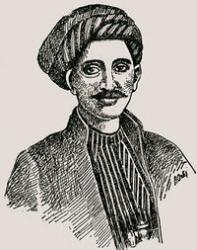
Nāşīf Yāzijī

1800 - 1871 Person Name: ناصيف اليازجي Translator of "من فوق عن موتى الصلاح" in The Cyber Hymnal Nasif al-Yaziji (March 25, 1800 – February 8, 1871) was a Lebanese author at the times of the Ottoman Empire and father of Ibrahim al-Yaziji. He was one of the leading figures in the Nahda movement. We was a poet, wrote and translated many hymns, and helped in translating the complete Bible into Arabic. ناصيف بن عبد الله بن جنبلاط بن سعد اليازجي (25 مارس 1800 - 8 فبراير 1871)، أديب وشاعر لبناني ولد في قرية كفر شيما، من قرى الساحل اللبناني في 25 آذار سنة 1800 م في أسرة اليازجي التي نبغ كثير من أفرادها في الفكر والأدب، وأصله من حمص. لعب دورا كبيرا في إعادة استخدام اللغة الفصحى بين العرب في القرن التاسع عشر، عمل لدى الأسرة الشهابية كاتبا وشارك في أول ترجمة الإنجيل والعهد القديم إلى العربية في العصر الحديث.

Pages


Export as CSV
It looks like you are using an ad-blocker. Ad revenue helps keep us running. Please consider white-listing Hymnary.org or getting Hymnary Pro to eliminate ads entirely and help support Hymnary.org.