

 My Starred Hymns
 My FlexScores
 My Hymnals
 My Purchased Files
Planning worship?
Check out our sister site, ZeteoSearch.org,
for 20+ additional resources related to your search.
- |
User Links
Search Results

O Holy Spirit, by Whose Breath
Author: Rabanus Maurus; John Webster Grant Meter: 8.8.8.8 Appears in 27 hymnals Text Sources: Latin hymn, Veni Creator Spiritus, 9th cent.
O Holy Spirit, by Whose Breath


VENI CREATOR SPIRITUS
Meter: 8.8.8.8 Appears in 162 hymnals Composer and/or Arranger: Richard J. Wojcik, b. 1923 Tune Key: G Major Incipit: 56545 65122 11561 Used With Text: O Holy Spirit, by Whose Breath
VENI CREATOR SPIRITUS
LASST UNS ERFREUEN
Meter: 8.8.8.8.8 with refrain Appears in 548 hymnals Tune Sources: Geistliche Kirchengesänge, Cologne, 1623 Tune Key: D Major Incipit: 11231 34511 23134 Used With Text: O Holy Spirit, by Whose Breath
LASST UNS ERFREUEN


O Holy Spirit, by Whose Breath
Author: Rabanus Maurus; John W. Grant Hymnal: Voices Together #53 (2020) Meter: 8.8.8.8 Topics: Commissioning Other; Heritage Before 1500; Holy Spirit; Holy Spirit gifts of; Peace Conflict and War; Peace Inner; Pentecost; Unity; Unity in Diversity Scripture: John 14:25-31 Tune Title: VENI CREATOR SPIRITUS
O Holy Spirit, by Whose Breath
O Holy Spirit, by Whose Breath
Author: Rabanus Maurus, 776-865; John W. Grant, b. 1919 Hymnal: Singing Our Faith #175 (2001) Meter: 8.8.8.8 Topics: Holy Spirit Languages: English Tune Title: VENI CREATOR SPIRITUS
O Holy Spirit, by Whose Breath
O Holy Spirit, by Whose Breath
Author: Rabanus Maurus; John Webster Grant; Pierre-Étienne Hymnal: Voices United #200 (1996) First Line: O Holy Spirit, by whose breath (Viens, Saint-Esprit, Dieu créateur) Topics: The Christian Year Pentecost; Christian Perfecction; Church Education; Guidance; Holy Spirit Power; Inspiration; Installation Services; Light; Love for Others; Peace (World); Petition; Renewal; Service Music Doxologies; Unity; Pentecost Year A; Proper 20 Year A; Easter 7 Year C Languages: English; French Tune Title: VENI CREATOR SPIRITUS
O Holy Spirit, by Whose Breath


Rabanus Maurus
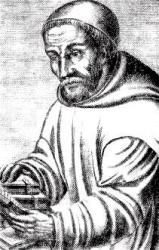
776 - 856 Person Name: Rabanus Maurus, c. 776-856 Author (attributed to) of "O Holy Spirit, by Whose Breath" in One in Faith Rabanus Maurus (c. 776-856) or Hrabanus Magnentius Maurus, was born of noble parents at Mainz, and educated at Fulda and Tours under Alcuin, who is reputed to have given him the surname, Maurus, after the saint of that name. In 803, he became director of the school at the Benedictine Abbey at Fulda. He was ordained priest in 814, spending the following years in a pilgrimage to Palestine. In 822, he became Abbott at Fulda, retiring in 842. In 847, he became archbishop of Mainz. He died at Winkel on the Rhine, February 4, 856. This distinguished Carolingian poet-theologian wrote extensive biblical commentaries, the Encyclopaedic De Universo, De Institutione Clericorum, and other works which circulated widely during the Middle Ages. Some of his poems, with English translations, are in Helen Waddell's Mediaeval Latin Lyrics. He is the author of:
O Come, Creator Spirit, come
Christ, the fair glory of the holy angels
Come, Holy Ghost, our souls inspire
Come, Holy Ghost, Creator blest
Creator Spirit, by whose aid
--The Hymnal 1940 Companion, New York: The Church Pension Fund (1949)
===========================
Hrabanus (Rabanus) Maurus, son of one Ruthard, was born probably at Mainz, about 776. At an early age he was sent to the Monastery of Fulda to receive a religious education. In 801 he was ordained Deacon, and the following year he went to the monastic school of St. Martin at Tours to study under Alcuin, a celebrated teacher of that time, who gave to Hrabanus the name of Maurus to which Hrabanus added Magnentius. On his return to Fulda in 804 he became the head of the school connected with the Monastery. Towards him Ratgar the abbot showed great unkindness, which arose mainly from the fact that Ratgar demanded the students to build additions to the monastery, whilst Hrabanus required them at the same time for study. Hrabanus had to retire for a season, but Ratgar's deposition by Ludwig the Pious, in 817, opened up the way for his return, and the reopening of the school In the meantime, in 814, he had been raised to the Priesthood. Egil, who succeeded Ratgar as abbot, died in 822, and Hrabanus was appointed in his stead. This post he held for some time, until driven forth by some of the community. In 847, on the death of Archbishop Otgar, Ludwig the younger, with whom Hrabanus had sided in his demand for German independence as against the imperialism of his elder brother Lothar, rewarded him with the Archbishopric of Mainz, then the metropolitan see of Germany. He held this appointment to his death on Feb. 4, 856. He was buried first in St. Alban's, Mainz, and then, during the early days of the Reformation, in St. Maurice, Halle, possibly because of the opposition he is known to have made to the doctrine of Transubstantiation.
With German historians Hrabanus is regarded as the father of the modern system of education in that country. His prose works were somewhat numerous, but the hymns with which his name is associated are few. We have the "Christe sanctorum decus Angelorum”; “Tibi Christe, splendor Patris”; and the "Veni Creator Spiritus”; but recent research convinces us that the ascription in each case is very doubtful; and none are received as by Hrabanus in Professor Dümmler's edition of the Carmina of Hrabanus in the Poetae Latini aevi Carolini, vol. ii. 1884. Dümmler omits them even from the "hymns of uncertain origin."
--John Julian, Dictionary of Hymnology, Appendix I (1907)
=======================
http://en.wikipedia.org/wiki/Rabanus_Maurus
Rabanus Maurus
Michael Praetorius

1571 - 1621 Adapter of "PUER NOBIS" in Lift Up Your Hearts Born into a staunchly Lutheran family, Michael Praetorius (b. Creuzburg, Germany, February 15, 1571; d. Wolfenbüttel, Germany, February 15, 1621) was educated at the University of Frankfort-an-der-Oder. In 1595 he began a long association with Duke Heinrich Julius of Brunswick, when he was appointed court organist and later music director and secretary. The duke resided in Wolfenbüttel, and Praetorius spent much of his time at the court there, eventually establishing his own residence in Wolfenbüttel as well. When the duke died, Praetorius officially retained his position, but he spent long periods of time engaged in various musical appointments in Dresden, Magdeburg, and Halle. Praetorius produced a prodigious amount of music and music theory. His church music consists of over one thousand titles, including the sixteen-volume Musae Sionae (1605-1612), which contains Lutheran hymns in settings ranging from two voices to multiple choirs. His Syntagma Musicum (1614-1619) is a veritable encyclopedia of music and includes valuable information about the musical instruments of his time.
Bert Polman
Michael Praetorius
Anonymous
Person Name: Anon. Author of "Veni, Creator Spiritus" in The Australian Hymn Book with Catholic Supplement In some hymnals, the editors noted that a hymn's author is unknown to them, and so this artificial "person" entry is used to reflect that fact. Obviously, the hymns attributed to "Author Unknown" "Unknown" or "Anonymous" could have been written by many people over a span of many centuries.
Anonymous