You help make Hymnary.org possible. More than 10 million people from 200+ countries found hymns, liturgical resources and encouragement on Hymnary.org in 2025, including you. Every visit affirms the global impact of this ministry.

If Hymnary has been meaningful to you this year, would you take a moment today to help sustain it? A gift of any size—paired with a note of encouragement if you wish—directly supports the server costs, research work and curation that keep this resource freely available to the world.

Give securely online today, or mail a check to:
Hymnary.org
Calvin University
3201 Burton Street SE
Grand Rapids, MI 49546

Thank you for your partnership, and may the hope of Advent fill your heart.

The lion that on Samson roared

Representative Text

1 The lion that on Sampson roar'd,
And thirsted for his blood;
With honey afterwards was stor'd,
And furnish'd him with food.

2 Believers, as they pass along,
With many lions meet;
But gather sweetness from the strong,
And from the eater, meat.

3 The lions rage and roar in vain,
For Jesus is their shield;
Their losses prove a certain gain,
Their troubles comfort yield.

4 The world and Satan join their strength,
To fill their soul with fears;
But crops of joy they reap at length,
From what they sow in tears.

5 Afflictions make them love the word,
Stir up their hearts to pray'r;
And many precious proofs afford
Of their Redeemer's care.

6 The lions roar, but cannot kill;
Then fear them not my friends;
They bring us, though against their will,
The honey Jesus sends.

Hymns and Spiritual Songs for the use of Christians, 1803

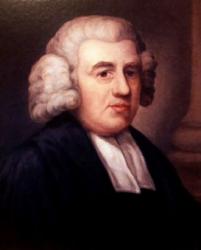
Author: John Newton

John Newton (b. London, England, 1725; d. London, 1807) was born into a Christian home, but his godly mother died when he was seven, and he joined his father at sea when he was eleven. His licentious and tumul­tuous sailing life included a flogging for attempted desertion from the Royal Navy and captivity by a slave trader in West Africa. After his escape he himself became the captain of a slave ship. Several factors contributed to Newton's conversion: a near-drowning in 1748, the piety of his friend Mary Catlett, (whom he married in 1750), and his reading of Thomas à Kempis' Imitation of Christ. In 1754 he gave up the slave trade and, in association with William Wilberforce, eventually became an ardent abolitionist. After becoming a tide… Go to person page >

Text Information

First Line: The lion that on Samson roared
Author: John Newton
Language: English
Copyright: Public Domain

Tune

DUNDEE (Ravenscroft)

DUNDEE first appeared in the 1615 edition of the Scottish Psalter published in Edinburgh by Andro Hart. Called a "French" tune (thus it also goes by the name of FRENCH), DUNDEE was one of that hymnal's twelve "common tunes"; that is, it was not associated with a specific psalm. In the Psalter Hymnal…

Go to tune page >


Timeline

Media

The Cyber Hymnal #4062
  • Adobe Acrobat image (PDF)
  • Noteworthy Composer score (NWC)
  • XML score (XML)

Instances

Instances (1 - 1 of 1)
TextScoreAudio

The Cyber Hymnal #4062

Include 8 pre-1979 instances
Suggestions or corrections? Contact us
It looks like you are using an ad-blocker. Ad revenue helps keep us running. Please consider white-listing Hymnary.org or getting Hymnary Pro to eliminate ads entirely and help support Hymnary.org.