Go Ad-Free
If you regularly use Hymnary.org, you will definitely enjoy all the perks of a Hymnary Pro subscription. Plus, your subscription supports our mission in a big way!
| 8701 | The Cyber Hymnal#8702 | 8703 |
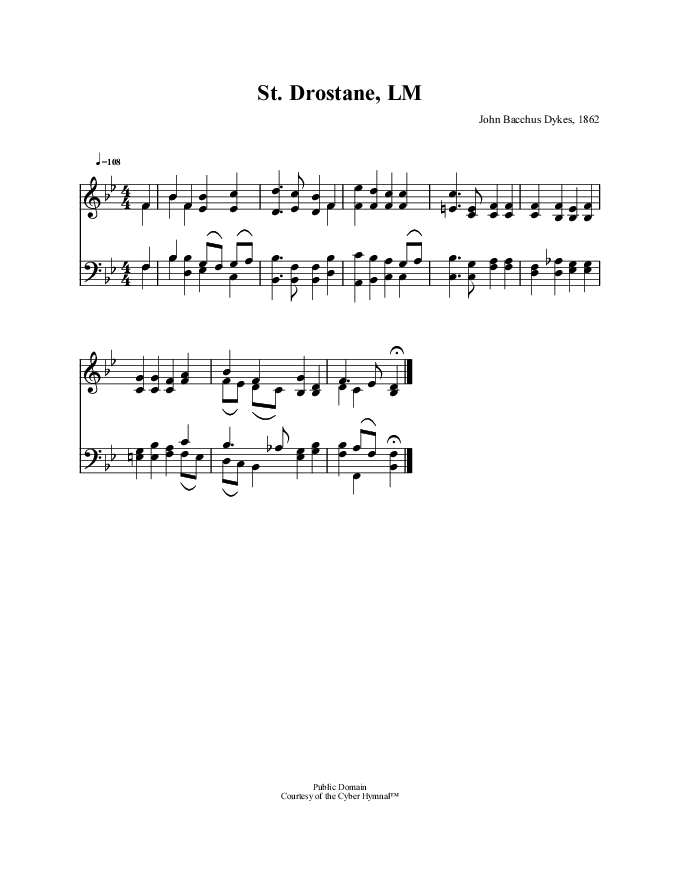
| Text: | Now Let Us Raise Our Cheerful Strains |
| Author: | Anne Steele |
| Tune: | ST. DROSTANE |
| Composer: | John Bacchus Dykes |
| Media: | MIDI file |
1 Now let us raise our cheerful strains,
And join the blissful choir above;
There our exalted Savior reigns,
And there they sing His wondrous love.
2 While seraphs tune th’immortal song;
O may we feel the sacred flame;
And every heart and every tongue
Adore the Savior’s glorious name.
3 Jesus, who once upon the tree
In agonizing pains expired,
Who died for rebels—yes, ’tis He!
How bright! how lovely! how admired!
4 Jesus, who died that we might live,
Died in the wretched traitor’s place—
O what returns can mortals give,
For such immeasurable grace?
5 Were universal nature ours,
And art with all her boasted store,
Nature and art with all their powers,
Would still confess the offerer poor!
6 Yet tho’ for bounty so divine,
We ne’er can equal honors raise,
Jesus, may all our hearts be Thine,
And all our tongues proclaim Thy praise.
| Text Information | |
|---|---|
| First Line: | Now let us raise our cheerful strains |
| Title: | Now Let Us Raise Our Cheerful Strains |
| Author: | Anne Steele |
| Meter: | LM |
| Language: | English |
| Source: | Poems on Subjects Chiefly Devotional, 1760, vol. 1 |
| Copyright: | Public Domain |
| Tune Information | |
|---|---|
| Name: | ST. DROSTANE |
| Composer: | John Bacchus Dykes (1862) |
| Meter: | LM |
| Key: | B♭ Major |
| Copyright: | Public Domain |
| Media | |
|---|---|
| Adobe Acrobat image: |  PDF PDF |
| MIDI file: |  MIDI MIDI |
| Noteworthy Composer score: | Noteworthy Composer Score |







 My Starred Hymns
 My FlexScores
 My Hymnals
 My Purchased Files