- |
User Links


 My Starred Hymns
 My FlexScores
 My Hymnals
 My Purchased Files
Edvard Grieg
www.hymntime.com/tch/
| Short Name: | Edvard Grieg |
| Full Name: | Grieg, Edvard, 1843-1907 |
| Birth Year: | 1843 |
| Death Year: | 1907 |
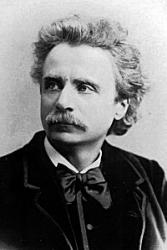
Edvard Hagerup Grieg Born at Bergen, Norway, of Scottish descent, son of a merchant and vice-consul in Bergen, his mother was a music teacher. He became a pianist and composer, with his standard classical repertoire known worldwide. He developed Norwegian folk music into his own compositions, helping to develop a national musical identity. As a child his mother taught him piano from age six. He attended several schools. His uncle, a Norwegian violinist, recognized his nephew’s talents at age 15 and urged his parents to send him to the Leigzig Conservatory in Germany. He enrolled there and concentrated on piano. He enjoyed the many concerts and recitals given in Leipzig. He disliked the discipline of the conservatory course of study, but he loved the organ, mandatory for piano students. In 1860 he survived a life-threatening lung disease, pleurisy and tuberculosis. Throughout life, his health was impaired by a destroyed left lung and disformity of his thoracic spine. He suffered numerous respiratory infections, and ultimately developed combined heart and lung failure. He was admitted many times for various spas and sanatoria in both Norway and abroad. Several of his doctors became close friends. In 1861 he made his debut as a concert pianist at Karlshamm, Sweden. He finished Leipzig studies in 1862 and held a concert in his hometown, playing Beethoven’s ‘Pathetique’ sonata. In 1863 he went to Copenhagen, Denmark, remaining there three years. There he met Danish composers and a fellow Norwegian composer, Rikard Nordraak, who wrote the Norwegian National Anthem. When Nordraak died in 1866, Grieg composed a funeral march in his honor. In 1867 Grieg married his first cousin, Nina Hagerup. Their only child, Alexandra, was born the following year. She died from meningitis at age two. In 1868 he wrote his Piano Concerto in A-minor. It was performed by Edmund Nuepert in Copenhagen because Grieg was in Norway at the time, fulfilling other commitments. In 1868 Franz Liszt, not yet having met Grieg, wrote a testimonial of him, resulting in Grieg’s obtaining a travel grant. The two met in Rome in 1870. Each was impressed with the other’s musical accomplishments. Grieg had close ties with the Bergen Philharmonic Orchestra and became its leader 1880-1882. In 1888 Grieg met Tchaikovsky in Leipzig. He was struck by Tchaikovsky’s sadness. Tchaikovsky praised Grieg’s music. The Norwegian government awarded Grieg a pension. In 1903 he made gramophone recordings of his piano music in Paris, France. He also made live piano music rolls for the Hupfeld Phonola piano-player system and Weldt-Mignon reproducing system. He also worked with the Aeolian Company for its ‘Autograph Metro-style’ piano roll series, wherein he indicated the tempo mapping of many of his pieces. In 1906 he met pianist and composer, Percy Grainger, in London. Grainger was an admire of Grieg’s music, and they developed a strong empathy for each other. Grieg wrote of Grainger: “I have written Norwegian dances that no one in my country can play, and here comes this Australian who plays them as they ought to be played. He is a genius that we Scandinavians cannot do other than love.” Grieg and his wife considered themselves Unitarians, and attended that church denomination. When Grieg died after a long illness, at age 64, his funeral drew more than 30,000 people in his hometown, who came out to honor him. His own funeral march, in honor of Nordraak, was played, along with a 2nd march, by his friend, Johan Halvorsen, who married Grieg’s niece. Grieg was cremated, with ashes entombed in a mountain crypt. Later, his wife’s were placed with his.
John Perry
Tunes by Edvard Grieg (12) | As | Instances | Incipit |
|---|---|---|---|
| ASE'S DEATH | Edward Grieg (Composer) | 2 | 51251 23212 34325 |
| DEN STORE HVIDE FLOK | Edward H. Grieg (Arranged) | 22 | 13556 53135 22342 |
| FREE | Edvard Hagerup Grieg (Composer) | 1 | 11111 22222 23344 |
| [Good day and welcome, dear Christmas tree] | Edvard H. Grieg, 1843-1907 (Composer) | 1 | 31321 53132 12655 |
| GRIEG (51234) | Edvard Grieg, 1843-1907 (Composer) | 8 | 51234 51773 45673 |
| GRIEG (55447) | Eduard Grieg (Composer) | 1 | 55447 61775 62233 |
| [If we are the children of God] | Edvard Grieg (Composer) | 1 | 33456 56533 11531 |
| [Lord, increase our courage!] | Grieg (Composer) | 1 | 33433 22155 547 |
| MILITES CHRISTI | Eduard Grieg (Composer) | 1 | 13451 11733 36651 |
| [O happy, happy children] | Edward Grieg (Composer) | 1 | 11155 31123 45653 |
| SPRINGFIELD (Grieg) | Edward H. Grieg (Composer) | 4 | 13455 66166 55313 |
| THE KING'S SONG | Eduard Grieg (Composer) | 1 | 34556 76511 73646 |
Data Sources
Suggestions or corrections? Contact us