- |
User Links


 My Starred Hymns
 My FlexScores
 My Hymnals
 My Purchased Files
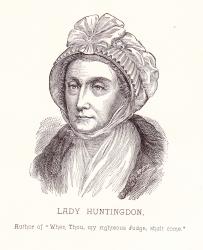
Selina Hastings, Countess of Huntingdon
www.hymntime.com/tch
| Short Name: | Selina Hastings, Countess of Huntingdon |
| Full Name: | Huntingdon, Selina Hastings, Countess of, 1707-1791 |
| Birth Year: | 1707 |
| Death Year: | 1791 |
Born: August 24, 1707, Astwell House, Nottinghamshire, England.
Died: June 17, 1791, London, England.
Buried: St. Helen’s Church, Ashby-de-la-Zouch, Leicester, England.
Selena Huntingdon, née Shirley, Countess of, daughter of Washington, Earl Ferrers, was born Aug. 24, 1707; married to Theophilus Hastings, 9th Earl of Huntindon, June, 1728; and d. in London, June 17, 1701. At an early age she received serious religious impressions, which continued with her, and ruled her conduct through life. She was a member of the first Methodist Society, in Fetter Lane, London, and the first Methodist Conference was held at her house in June, 1744. Her sympathies, however, were with the Calvinism of G. Whitefield, and when the breach took place between Whitefield and Wesley she joined the former. Her money was freely expended in chapel building, in the founding of Trevecca College, South Wales (now Cheshunt), and in the support of her preachers. A short time before her death the Connection which is known by her name was founded; and at her death it numbered more than sixty chapels. For use in these chapels she compiled A Select Collection of Hymns. Her own part in hymn-writing is most uncertain. The hymns, "Come, Thou Fount of every blessing," and "O when my righteous Judge shall come", have been specially claimed for her, but upon insufficient testimony. No mention of these hymns as being by her is made in her Life and Times, 1839. Miller says, "although the Countess was not much known as a hymn-writer, yet it is proved beyond doubt that she was the author of a few hymns of great excellence" (Singers & Songs, 1869, p. 183): but he neither names the hymns, nor submits the evidence. It is most uncertain that she ever wrote a hymn; and it is quite clear that upon reliable evidence not one has yet been ascertained to be of her composing. Her history and that of her Connexion are elaborately set forth in The Life and Times of Selina, Countess of Huntingdon, London, Painter, 1839.
--Dictionary of Hymnology, John Julian, 1907.
Hymnary Pro Subscribers
Access an additional article on the Canterbury Dictionary of Hymnology:
Access an additional article on the Canterbury Dictionary of Hymnology:
Hymnary Pro subscribers have full access to the Canterbury Dictionary of Hymnology.
Get Hymnary Pro
Texts by Selina Hastings, Countess of Huntingdon (7) | As | Authority Languages | Instances |
|---|---|---|---|
| Come, sinner, to the gospel feast, O come without delay | Selina (Author) | English | 18 |
| Come, sinners, to the gospel feast, Let every soul be Jesus' guest | Huntingdon (Author) | English | 4 |
| Come, Thou Fount of every blessing | Huntondon (Author) | English | 3 |
| Fading, still fading, the last beam is shining | Selina Huntington (Author) | English | 10 |
| Jesus, at Thy command | Selina (Author) | English | 2 |
| The world can neither give nor take | Selina, Countess of Huntingdon, 1707-1792 (Author) | English | 6 |
| When Thou my righteous Judge shalt come | Selina, Countess of Huntingdon (Author) | English | 283 |
Data Sources
Suggestions or corrections? Contact us