You help make Hymnary.org possible. More than 10 million people from 200+ countries found hymns, liturgical resources and encouragement on Hymnary.org in 2025, including you. Every visit affirms the global impact of this ministry.

If Hymnary has been meaningful to you this year, would you take a moment today to help sustain it? A gift of any size—paired with a note of encouragement if you wish—directly supports the server costs, research work and curation that keep this resource freely available to the world.

Give securely online today, or mail a check to:
Hymnary.org
Calvin University
3201 Burton Street SE
Grand Rapids, MI 49546

Thank you for your partnership, and may the hope of Advent fill your heart.

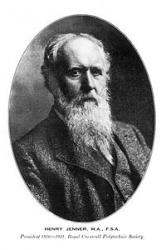
Henry Jenner

Henry Jenner
www.wikipedia.org
Short Name: Henry Jenner
Full Name: Jenner, Henry, 1848-1934
Birth Year: 1848
Death Year: 1934

Jenner, Henry, son of H. L. Jenner, D.D., sometime Bishop of Dunedin, born in 1848, is the author of one hymn only, “Jesus, Thou hast willed it," which was written in 1870 for the anniversary of the Society for Promoting the Unity of Christendom, and was first sung in procession at St. Michael's, Shoreditch, on “the Octave of Our Lady St. Mary," 1870, to a tune by his father. It is in the Scotch Ch. Hymnary, 1898. [Rev. John Brownlie]

--John Julian, Dictionary of Hymnology, New Supplement (1907)

Wikipedia Biography

Henry Jenner FSA (8 August 1848 – 8 May 1934) was a British scholar of the Celtic languages, a Cornish cultural activist, and the chief originator of the Cornish language revival. Jenner was born at St Columb Major on 8 August 1848. He was the son of Henry Lascelles Jenner, who was one of two curates to the Rector of St. Columb Major, and later consecrated though not enthroned as the first Bishop of Dunedin and the grandson of Herbert Jenner-Fust. In 1869 Jenner became a clerk in the Probate Division of the High Court and two years later was nominated by the Primate at Canterbury for a post in the Department of Ancient Manuscripts in the British Museum, his father then being the Rector of Wingham, a small village near Canterbury.

Data Sources

Suggestions or corrections? Contact us

It looks like you are using an ad-blocker. Ad revenue helps keep us running. Please consider white-listing Hymnary.org or getting Hymnary Pro to eliminate ads entirely and help support Hymnary.org.