You help make Hymnary.org possible. More than 10 million people from 200+ countries found hymns, liturgical resources and encouragement on Hymnary.org in 2025, including you. Every visit affirms the global impact of this ministry.

If Hymnary has been meaningful to you this year, would you take a moment today to help sustain it? A gift of any size—paired with a note of encouragement if you wish—directly supports the server costs, research work and curation that keep this resource freely available to the world.

Give securely online today, or mail a check to:
Hymnary.org
Calvin University
3201 Burton Street SE
Grand Rapids, MI 49546

Thank you for your partnership, and may the hope of Advent fill your heart.

Person Results

Text Identifier:"^through_the_day_thy_love_has_spared_us$"
In:people

Planning worship? Check out our sister site, ZeteoSearch.org, for 20+ additional resources related to your search.
Showing 11 - 20 of 27Results Per Page: 102050

James Tilleard

1827 - 1876 Person Name: J. Tilleard Composer of "[Through the day thy love has spared us]" in The Hymnal, Revised and Enlarged, as adopted by the General Convention of the Protestant Episcopal Church in the United States of America in the year of our Lord 1892

Henry Thomas Smart

1813 - 1879 Person Name: Henry Smart Composer of "[Through the day thy love has spared us]" in The Hymnal, Revised and Enlarged, as adopted by the General Convention of the Protestant Episcopal Church in the United States of America in the year of our Lord 1892 Henry Smart (b. Marylebone, London, England, 1813; d. Hampstead, London, 1879), a capable composer of church music who wrote some very fine hymn tunes (REGENT SQUARE, 354, is the best-known). Smart gave up a career in the legal profession for one in music. Although largely self taught, he became proficient in organ playing and composition, and he was a music teacher and critic. Organist in a number of London churches, including St. Luke's, Old Street (1844-1864), and St. Pancras (1864-1869), Smart was famous for his extemporiza­tions and for his accompaniment of congregational singing. He became completely blind at the age of fifty-two, but his remarkable memory enabled him to continue playing the organ. Fascinated by organs as a youth, Smart designed organs for impor­tant places such as St. Andrew Hall in Glasgow and the Town Hall in Leeds. He composed an opera, oratorios, part-songs, some instrumental music, and many hymn tunes, as well as a large number of works for organ and choir. He edited the Choralebook (1858), the English Presbyterian Psalms and Hymns for Divine Worship (1867), and the Scottish Presbyterian Hymnal (1875). Some of his hymn tunes were first published in Hymns Ancient and Modern (1861). Bert Polman

Henry J. E. Holmes

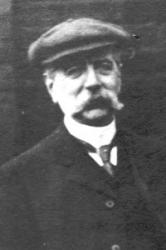
1852 - 1938 Person Name: H. J. E. Holmes Composer of "EVENSONG" in Hymns of Consecration and Faith Born: March 5, 1852, Burnley, Lancashire, England. Died: October 1938, Burnley, Lancashire, England. Buried: Burnley, Lancashire, England. Son of Richard and Jane Holmes, Henry’s father and great grandfather were both solicitors; his father had offices in Colne and Burnley. Henry was educated at Clitheroe Royal Grammar School. In 1875, he became an Attorney for Common Law and was admitted a Solicitor of the High Court of Chancery. He was articled to his father in November 1869, and practiced in Burnley for over 60 years, first in partnership with his brother Richard Marmaduke as Holmes and Holmes. He continued to practice on his own as Holmes and Holmes after his brother’s death in 1894, and later as Messrs. Holmes, Butterfield and Hartley. Holmes had moved from the family home on Westgate some time after the death of his sister Susannah in 1878. By 1881, he was living at 12 Palatine Square. Holmes was intimately associated with church and Sunday school work all his life. At age 17, he became a teacher and later a lay superintendent of Sandygate Sunday school, connected with Holy Trinity Church, a position he held nearly 20 years. From the 1880’s he took a deep interest in "The Home for Little Boys" at Farningham, Kent. His desire to help in this work led to the formation of the Burnley branch of the National Society for the Prevention of Cruelty to Children. Another organization that Holmes took a great interest in was the Burnley Law Society, which he helped found in 1883; he lived to be the last survivor of the eight founders. Holmes is said to have written over 250 hymn tunes in his life. --www.hymntime.com/tch/

C. H. Dretzel

1697 - 1775 Composer of "DRETZEL" in The Book of Common Praise Born: (baptised).September 18, 1697 - Nuremberg, Bavaria, Germany Died: May 7, 1755 - Nuremberg, Bavaria, Germany The German composer, organist and musicographer, Cornelius Heinrich Dretzel, was a grandson of Georg Dretzel (c1610-after 1676; organist of St Michael, Schwäbisch Hall) and nephew of Valentin, the most important member of the family. A possible student of Johann Pachelbel's eldest son, C.H. Dretzel also studied with J.S. Bach in Weimar in 1716-1717. He appears to have spent his whole life in Nuremberg, his hometown, in various organists' posts: Frauenkirche, St Lorenz (from 1743) and St Sebald. Cornelius Heinrich Dretzel's keyboard counterpoints and fugues were his forte having thoroughly emersed himself in the works of J. S. Bach. His reputation as a virtuoso player and contrapuntist is supported by his solo harpsichord concerto, Harmonische Ergötzung, influenced by J.S. Bach's Italian Concerto (BWV 971). Indeed Harmonische Ergötzung was long thought to be composed by J.S. Bach. An early version of the slow movement was entered into Schmeider as BWV 897:1. C.H. Dretzel's own "divertimenti" were thought to be lost until they were found in a collection that had belonged to Haydn. Of hymnological importance is his collection and commentary Des evangelishen Zions musicalische Harmonie (1731), which contains over 900 melodies, suspended over a continuous bass, most appealing in print for the first time in their local versions; the preface discusses the origin and development of the chorale. --www.bach-cantatas.com/L

J. H. Cornell

1828 - 1894 Person Name: John Henry Cornell (1828- ) Composer of "[Thro the day Thy love has spared us]" in The New Alleluia An or­gan­ist for St. Paul’s Cha­pel, Trin­i­ty Church, Cor­nell com­piled the Con­gre­ga­tion­al Tune Book in 1872. --www.hymntime.com/tch/

H. Heathcote Statham

1839 - 1924 Person Name: Henry Heathcote Statham, 1839- Composer of "ST. AGNES (STATHAM)" in The Book of Praise

Caryl Florio

1843 - 1920 Composer of "ANDREAS" in Gloria Deo Real name William James Robjohn. He used Caryl Florio as a pseudonym.

Jeremiah Franklin Ohl

1850 - 1941 Person Name: J. F. Ohl Composer of "LEWARS" in Common Service Book of the Lutheran Church

George B. Nevin

1859 - 1933 Person Name: G. B. Nevin, 1859- Composer of "JOCELYN" in Methodist Hymn and Tune Book Born: March 15, 1859, Shippensburg, Pennsylvania. Died: April 17, 1933, Easton, Pennsylvania. A member of the Nevin musical family, George’s cousins were composers Ethelbert and Arthur Nevin; his son, Gordon Balch Nevin, also became a composer. George spent most of his life in the town of Easton. His output consisted mainly of cantatas, and included such works as The Crown of Life and The Incarnation. He was also known for his setting of Sidney Lanier’s poem A Ballad of Trees and the Master, and wrote a number of hymns as well. For nearly 30 years, he ran a wholesale paper business in addition to composing. Nevin was also a historian and lecturer, and sometimes gave lectures on subjects related to music history to local historical societies. Sources: New York Times, April 18, 1933, p. 16 http://www.hymntime.com/tch/bio/n/e/v/nevin_gb.htm

J. W. Elliott

1833 - 1915 Composer of "[Thro' the day thy love hath spared us]" in The Spirit of Praise J.W. Elliott was a popular composer of the Victorian period, and is best known for his nursery rhyme music and for his work on hymnals in the 1870s. He was born James William Elliott, in Warwick, England, on February 13, 1833. As a child, he sang as a chorister in the Leamington Parish Church. In those days, choristers were given lessons in all facets of church music, including organ lessons, counterpoint studies, and more in exchange for providing an extraordinary level of service to their parish church (services throughout the week, all holidays, extra services, etc.). The result is that most choristers who completed their studies received an excellent music education, and James was no exception. After starting his career as an organist and choirmaster for a countryside church, his talent became obvious. He moved to London, where he assisted Sir Arthur Sullivan (of Gilbert and Sullivan fame) in editing Church Hymns. In addition, James worked for a music publisher. His compositions include two operettas, numerous anthems, service music, works for instruments including the very popular harmonium, and most particularly for Nursery Rhymes and Nursery Songs, his children’s music score that sets many of the Nursery Rhymes to delightful music. Several of his hymn tunes are still in use today in many hymnals, most notably his hymn tune “Day of Rest.” He was heavily involved in the preparation of the musical edition of Church Hymns in 1874, the Choral Service Book of 1892, and transcriptions of hymn tunes using harmonies different than the traditional ones found in hymnals. He died in St. Marylebone, London, on February 5, 1915. --www.nursery-songs.com/

Pages


Export as CSV
It looks like you are using an ad-blocker. Ad revenue helps keep us running. Please consider white-listing Hymnary.org or getting Hymnary Pro to eliminate ads entirely and help support Hymnary.org.