

 My Starred Hymns
 My FlexScores
 My Hymnals
 My Purchased Files
Planning worship?
Check out our sister site, ZeteoSearch.org,
for 20+ additional resources related to your search.
- |
User Links
Person Results
John R. Sweney

1837 - 1899 Topics: Recursos Para el Culto Oraciones de iluminación Composer of "PLENITUD" in Mil Voces para Celebrar John R. Sweney (1837-1899) was born in West Chester, Pennsylvania, and exhibited musical abilities at an early age. At nineteen he was studying with a German music teacher, leading a choir and glee club, and performing at children’s entertainments. By twenty-two he was teaching at a school in Dover, Delaware. Soon thereafter, he was put in charge of the band of the Third Delaware Regiment of the Union Army for the duration of the Civil War. After the war, he became Professor of Music at the Pennsylvania Military Academy, and director of Sweney’s Cornet Band. He eventually earned Bachelor and Doctor of Music degrees at the Academy.
Sweney began composing church music in 1871 and became well-known as a leader of large congregations. His appreciators stated “Sweney knows how to make a congregation sing” and “He had great power in arousing multitudes.” He also became director of music for a large Sunday school at the Bethany Presbyterian Church in Philadelphia of which John Wanamaker was superintendent (Wanamaker was the founder of the first major department store in Philadelphia). In addition to his prolific output of hymn melodies and other compositions, Sweney edited or co-edited about sixty song collections, many in collaboration with William J. Kirkpatrick. Sweney died on April 10, 1899, and his memorial was widely attended and included a eulogy by Wanamaker.
Joe Hickerson from "Joe's Jottings #9" used by permission
John R. Sweney
Daniel C. Roberts
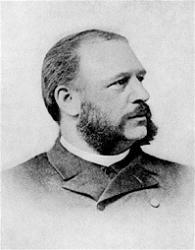
1841 - 1907 Topics: Recursos Para el Culto Procesionales Author of "Señor Jehová, omnipotente Dios" in Mil Voces para Celebrar Daniel C. Roberts (b. Bridgehampton, Long Island, NY, 1841; d. Concord, NH, 1907) Educated at Kenyon College, Gambier, Ohio, served in the union army during the Civil War. He was ordained in the Episcopal Church as a priest in 1866 and ministered to several congregations in Vermont and Massachusetts. In 1878 he began a ministry at St. Paul Church in Concord, New Hampshire, that lasted for twenty-three years. Serving for many years president of the New Hampshire State Historical Society, Roberts once wrote, "I remain a country parson, known only within my small world," but his hymn "God of Our Fathers" brought him widespread recognition.
Bert Polman
=================
Roberts, Daniel C., D.D., of the Prot. Episcopal Church in America, b. at Bridge Hampton, L.I., Nov. 5, 1841, and graduated at Gambler College, 1857. After serving for a time as a private in the Civil War, he was ordained in 1866. He is at present (1905) Rector of Concord, N.H. His hymn, "God of our fathers, Whose almighty hand " (National Hymn), was written in 1876 for the "Centennial" Fourth of July celebration at Brandon, Vermont. In 1892 it was included in the Protestant Episcopal Hymnal, and again in Sursum Corda, 1898. [Rev. L. F. Benson, D.D.]
--John Julian, Dictionary of Hymnology, New Supplement (1907)
Daniel C. Roberts
Cesáreo Gabarain
1936 - 1991 Person Name: Cesáreo Gabaráin Topics: Recursos Para el Culto Oraciones de invitación; Recursos Para el Culto Oraciones de invitación Author of "Tú has venido a la orilla (Pescador de hombres) (Lord, You Have Come to the Lakeshore)" in Mil Voces para Celebrar
Cesáreo Gabarain
Ludwig van Beethoven
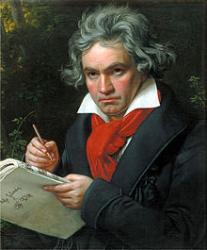
1770 - 1827 Topics: Recursos Para el Culto Procesionales Composer of "HYMN TO JOY" in Mil Voces para Celebrar A giant in the history of music, Ludwig van Beethoven (b. Bonn, Germany, 1770; d. Vienna, Austria, 1827) progressed from early musical promise to worldwide, lasting fame. By the age of fourteen he was an accomplished viola and organ player, but he became famous primarily because of his compositions, including nine symphonies, eleven overtures, thirty piano sonatas, sixteen string quartets, the Mass in C, and the Missa Solemnis. He wrote no music for congregational use, but various arrangers adapted some of his musical themes as hymn tunes; the most famous of these is ODE TO JOY from the Ninth Symphony. Although it would appear that the great calamity of Beethoven's life was his loss of hearing, which turned to total deafness during the last decade of his life, he composed his greatest works during this period.
Bert Polman
Ludwig van Beethoven
M. R. Newbolt
1874 - 1956 Person Name: Michael Robert Newbolt Topics: Recursos Para el Culto Procesionales Author of "Alzad la cruz" in Mil Voces para Celebrar Michael R. Newbolt (b. Dymock, Gloucestershire, England, 1874; d. Bierton, Buckinghamshire, England, 1956) was educated at St. John's College, Oxford, and ordained as priest in the Church of England in 1900. He ministered at several churches during the early part of his career and then became principal of the Missionary College in Dorchester (1910-1916). From 1916 to 1927 he served St. Michael and All Angels Church in Brighton and from 1927 to 1946 was canon of Chester Cathedral. Newbolt wrote several theological works, including a commentary on the Book of Revelation.
Bert Polman
M. R. Newbolt
Michael Card
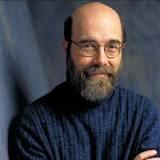
b. 1957 Topics: Recursos Para el Culto Responsos Author of "El Shaddai" in Mil Voces para Celebrar Michael Card (born April 11, 1957) is an American Christian singer-songwriter, musician, author, and radio host from Franklin, Tennessee. He is best known for his contributions in contemporary Christian music, which couple folk-style melodies and instrumentation with lyrics that stem from intensive study of the Bible. Since his debut in 1981, he has sold more than 4 million albums and has written 19 No. 1 singles. He has also authored several books, including Gold Medallion Book Award winner A Sacred Sorrow.
Card was born in Madison, Tennessee as the son of a doctor and grandson of a Baptist minister. He received Bachelor's and Master's degrees in Biblical Studies from Western Kentucky University, and was awarded the university's "Distinguished Alumni Award" in 1997. His studies in physics and astronomy allowed him to support himself while a student by working for six years at a planetarium. As of 2005, he is working on a Doctorate of Philosophy (Ph.D.) in Classical Literature
Card never intended to be a professional musician. He got his start when his professor and mentor, William L. Lane, asked Card to write some music to accompany weekly sermons at their church. His friend, musician Randy Scruggs, then asked him to record a demo tape so Scruggs could get a job as a producer. The record label agreed to hire Scruggs as long as his first project was to produce an album featuring Card. Since then Card has released nineteen original albums and at least six compilation albums. Another album, Starkindler, is composed of Card's interpretations of traditional Celtic hymns. The compilations often include one or two new songs along with previously released material. With the exception of Starkindler, Card writes the vast majority of the music he records (although sometimes with collaborators).
Many of Card's albums are structured around a unifying theme. For example, the songs from The Beginning are all based on the Pentateuch. The individual songs have subjects such as Genesis, Leviticus, Abraham, Isaac and Moses. Card is particularly adept at relating difficult or obscure concepts from the Old Testament to more understandable themes from the New Testament. For example, the song "Jubilee" talks about the period of rest and the release from debts and slavery commanded in the Jubilee year as described in Leviticus 25, but also reveals how the idea culminated in the rest and freedom from condemnation offered through Jesus.
Card's most famous song is "El Shaddai", which was recorded by Amy Grant as well as by Card himself. Grant's recording was named No. 326 on the RIAA's list of 365 Songs of the Century in 2001. Other popular Card songs include "Immanuel", "Joy in the Journey", and "Heal Our Land". "Heal Our Land" was commissioned as the 1993 National Day of Prayer's theme song.
Despite his success in music, Card has always maintained that his music career is secondary to his calling as a Bible teacher. He has at times distanced himself from the CCM industry by criticizing the promotion of personalities over musical contentand the shifting emphasis away from God in order to sell more albums.
One current music project is his writing and mentoring of musicians under the ByFor.org Project.
Michael Card is the author or co-author of nineteen books. He originally started writing as a way to share the knowledge he accumulated while researching his songs. His studies were so in-depth that he couldn't condense everything he had learned into one short song. The books that resulted from album research bear the same titles as the albums. He then branched out to other subjects not specifically based on his music, such as the Gospel of John, homeschooling, and Christian discipleship and mentoring. As of 2005, he has joined with NavPress to pursue his interest in writing Christian fiction.
Radio Host
In addition to touring and writing, Card also hosted a weekly radio program. In the Studio with Michael Card was carried by stations in 48 states, Canada, and the Caribbean. It was also available via internet streaming audio and as a podcast. The show was an amalgam of talk, musical performances and Bible study. The show ceased production in March, 2009.
--en.wikipedia.org/wiki (excerpts)
Michael Card
Lanny Wolfe
b. 1942 Topics: Recursos Para el Culto Llamado a la adoración Author of "Sé que el Espíritu" in Mil Voces para Celebrar
Lanny Wolfe
Daniel Read
1757 - 1836 Topics: Recursos Para el Culto Oraciones de confesi´øn y perdón Composer of "WINDHAM" in Mil Voces para Celebrar Daniel Read; b. 1757, Rehoboth, Mass.; d. 1837, New Haven, Conn.An American composer and a primary figure in early American classical music. He was one of the “Yankee Tunesmiths” (1st New England School of Music) when classical music was popular in Europe. Read was a private in Massachusetts militia and later a comb maker and owner of a general store in New Haven, CN. He was only the 3rd composer in the U. S. to put out a collection of his own music. His work, “The American Singing Book” went through 5 editions, making him the most popular composer in the nation. Others often plagarized his tunes in those days. Tunebook sales supplemented his general store income, including “The Columbian Harmonist” (3 volumnes) with 3 revisions, and “The New Haven Collection of Sacred Music” 1818. Read also published “The American Musical magazine” in 12 annual issues in 1786 and 1787. In later years he came to appreciate European music more and imitated that styling in devotional music. Some of Read's music is still being performed, and selections have been published in “The Sacred Harp”, 1991 Edition, and the “Stoughton Music Society” (Centennial Collection 1980).
John Perry
Daniel Read
Lewis Edson
1748 - 1820 Topics: Recursos Para el Culto Procesionales Composer of "LENOX" in Mil Voces para Celebrar Lewis EdsonBorn in Massachusetts,he began working as a blacksmith and farmer. After marrying, he became a singing teacher, notable in his day. He taught singing in MA NY and CN, moving to NY in 1817. He was also an author. His 35 works consist of tunebooks, anthems, Psalm music, music scores and chants for choir use.
John Perry
Lewis Edson
Speros Demetrios Athans
1883 - 1969 Person Name: S. D. Athans Topics: Recursos Para el Culto Oraciones de iluminación Translator of "Abre mis ojos a la luz" in Mil Voces para Celebrar Speros Demetrios Athans was born 1883 in Turkey. Raised in the Greek Orthodox Church, Athans left home at age 15, after his father’s death. He spent two years on the island of Corfu, Greece, and two more in Egypt, then went to Great Britain, where he worked as a sailor. In 1903 he went to America, and during immigration processing, someone gave him a New Testament in Greek. A year later, he joined a Nazarene church in Chicago, Illinois. He then enrolled in a Bible school and university. While in school in California, he began to study Spanish and to work with the Latino community. In 1910 he decided to work in evangelism. In 1931, he joined the Methodist missionary work in Latin America, retiring in 1949.
© The Cyber Hymnal™ (hymntime.com/tch)
Speros Demetrios Athans
Pages




