You help make Hymnary.org possible. More than 10 million people from 200+ countries found hymns, liturgical resources and encouragement on Hymnary.org in 2025, including you. Every visit affirms the global impact of this ministry.

If Hymnary has been meaningful to you this year, would you take a moment today to help sustain it? A gift of any size—paired with a note of encouragement if you wish—directly supports the server costs, research work and curation that keep this resource freely available to the world.

Give securely online today, or mail a check to:
Hymnary.org
Calvin University
3201 Burton Street SE
Grand Rapids, MI 49546

Thank you for your partnership, and may the hope of Advent fill your heart.

Person Results

Tune Identifier:"^st_andrew_barnby$"
In:people

Planning worship? Check out our sister site, ZeteoSearch.org, for 20+ additional resources related to your search.
Showing 41 - 50 of 53Results Per Page: 102050

John Austin

1613 - 1669 Person Name: J. Austin Author of "Blest be thy love, dear Lord" in The Primitive Methodist Church Hymnal See also Birchley, William, 1613-1699 John Austin, born 1613, Walpole, Norfolk; died 1669, London was a Catholic author who wrote under the pseudonym William Birchley. Evangelical Lutheran Hymnal, 1908 ===================== Austin, John, born at Walpole, Norfolk, and educated at St. John's, Cambridge (cr. 1640). He became a Roman Catholic, entered Lincoln's Inn to study for the Bar: subsequently became a tutor, and finally devoted himself to literature. Died in London, 1669. His works include The Christian Moderator, Reflections upon the Oaths of Supremacy, and:— Devotions in the Antient Way of Offices Containing Exercises for every day in the Week. 1668. This last work, through which Austin is associated with hymnody, attained a 2nd ed. in 1672,3rd ed. 1684, and two 4th eds. 1685. (A second part, consisting of a Harmony of the Gospels, was also published, and is of excessive rarity. A third, according to Anthony a Wood, existed in MS.) It was a Roman Catholic Manual, and contained 43 hymns, 39 of which are in the first edition, and those added in the third edition are perhaps by the editor. A few of these were renderings from the Latin by R. Crashaw, altered and adapted by Austin. In 1686 it was adapted for members of the Church of England by Theophilus Dorrington, and again in 1687 by the Lady Susanna Hopton under the editorship of George Hickes, afterwards a Nonjuring Bishop. Of the 5th ed., 1717, of the last adaptation, a reprint was published by Masters in 1856. [William T. Brooke] --John Julian, Dictionary of Hymnology, p. 97 (1907)

Henry Harbaugh

1817 - 1867 Author of "Jesus, I live to Thee" in The Hymnal Harbaugh, Henry, D.D., born in Franklin Co., Pennsylvania, Oct. 24, 1817, was of Swiss descent. In early life he was a farmer, carpenter, and teacher; but in 1840 he entered Marshall College, Mercersburg. Entering the ministry of the German Reformed body, he became, in 1844, Pastor at Lewisburg, Lancaster and Lebanon, Pennsylvania, and in 1864 Professor in Theology at Mercersburg. He died Dec. 27, 1867. He was Editor of the Guardian and the Mercersburg Review, in which he advocated what was called "Mercersburg Theology." His published works include sundry books about Heaven; Poems, Philadelphia, 1860, and Hymns & Chants for Sunday Schools, Lebanon, 1861. This last includes his hymns. The best known and most widely used of his compositions are:— 1. Jesus, I live to Thee. [Life consecrated to Jesus.] This hymn is dated 1850. It is No. 391 in the Hymns of the Church, N. Y., 1869; No. 255 in Allon's Supplementary Hymns, London, 1868, and is also in other collections. 2. God most mighty, sovereign Lord. [National Hymn.] Appeared in his Poems, 1860, in 8 stanzas of 8 lines, and headed, "A National Litany hymn." In some collections it is abridged, as in Hatfield's Church Hymnbook, N. Y., 1872, No. 1307; and in others part of it is altered to "Christ by heavenly hosts adored," as in the Reformed Dutch Hymns of the Church, 1869, No. 935, and others. 3. Make the cross your meditation. [Passiontide.] This translation of "Recordare sanctae crucis" (q.v.) appeared in the Mercersburg Review, 1858, p. 481, and in his Poems 1860. It is worthy of more attention than it has received. [Rev. F. M. Bird, M.A.] --John Julian, Dictionary of Hymnology (1907) ================== Harbaugh, H., p. 484, ii. From No. 2, “God most mighty, &c," the cento, "Thou, by heavenly hosts adored" in the Songs of Christian Praise, N. Y., 1880, No. 658, is taken. --John Julian, Dictionary of Hymnology, Appendix, Part II (1907)

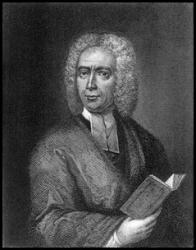
Isaac Watts

1674 - 1748 Author of "To God the only wise" in Common Service Book of the Lutheran Church Isaac Watts was the son of a schoolmaster, and was born in Southampton, July 17, 1674. He is said to have shown remarkable precocity in childhood, beginning the study of Latin, in his fourth year, and writing respectable verses at the age of seven. At the age of sixteen, he went to London to study in the Academy of the Rev. Thomas Rowe, an Independent minister. In 1698, he became assistant minister of the Independent Church, Berry St., London. In 1702, he became pastor. In 1712, he accepted an invitation to visit Sir Thomas Abney, at his residence of Abney Park, and at Sir Thomas' pressing request, made it his home for the remainder of his life. It was a residence most favourable for his health, and for the prosecution of his literary labours. He did not retire from ministerial duties, but preached as often as his delicate health would permit. The number of Watts' publications is very large. His collected works, first published in 1720, embrace sermons, treatises, poems and hymns. His "Horae Lyricae" was published in December, 1705. His "Hymns" appeared in July, 1707. The first hymn he is said to have composed for religious worship, is "Behold the glories of the Lamb," written at the age of twenty. It is as a writer of psalms and hymns that he is everywhere known. Some of his hymns were written to be sung after his sermons, giving expression to the meaning of the text upon which he had preached. Montgomery calls Watts "the greatest name among hymn-writers," and the honour can hardly be disputed. His published hymns number more than eight hundred. Watts died November 25, 1748, and was buried at Bunhill Fields. A monumental statue was erected in Southampton, his native place, and there is also a monument to his memory in the South Choir of Westminster Abbey. "Happy," says the great contemporary champion of Anglican orthodoxy, "will be that reader whose mind is disposed, by his verses or his prose, to imitate him in all but his non-conformity, to copy his benevolence to men, and his reverence to God." ("Memorials of Westminster Abbey," p. 325.) --Annotations of the Hymnal, Charles Hutchins, M.A., 1872. ================================= Watts, Isaac, D.D. The father of Dr. Watts was a respected Nonconformist, and at the birth of the child, and during its infancy, twice suffered imprisonment for his religious convictions. In his later years he kept a flourishing boarding school at Southampton. Isaac, the eldest of his nine children, was born in that town July 17, 1674. His taste for verse showed itself in early childhood. He was taught Greek, Latin, and Hebrew by Mr. Pinhorn, rector of All Saints, and headmaster of the Grammar School, in Southampton. The splendid promise of the boy induced a physician of the town and other friends to offer him an education at one of the Universities for eventual ordination in the Church of England: but this he refused; and entered a Nonconformist Academy at Stoke Newington in 1690, under the care of Mr. Thomas Rowe, the pastor of the Independent congregation at Girdlers' Hall. Of this congregation he became a member in 1693. Leaving the Academy at the age of twenty, he spent two years at home; and it was then that the bulk of the Hymns and Spiritual Songs (published 1707-9) were written, and sung from manuscripts in the Southampton Chapel. The hymn "Behold the glories of the Lamb" is said to have been the first he composed, and written as an attempt to raise the standard of praise. In answer to requests, others succeeded. The hymn "There is a land of pure delight" is said to have been suggested by the view across Southampton Water. The next six years of Watts's life were again spent at Stoke Newington, in the post of tutor to the son of an eminent Puritan, Sir John Hartopp; and to the intense study of these years must be traced the accumulation of the theological and philosophical materials which he published subsequently, and also the life-long enfeeblement of his constitution. Watts preached his first sermon when he was twenty-four years old. In the next three years he preached frequently; and in 1702 was ordained pastor of the eminent Independent congregation in Mark Lane, over which Caryl and Dr. John Owen had presided, and which numbered Mrs. Bendish, Cromwell's granddaughter, Charles Fleetwood, Charles Desborough, Sir John Hartopp, Lady Haversham, and other distinguished Independents among its members. In this year he removed to the house of Mr. Hollis in the Minories. His health began to fail in the following year, and Mr. Samuel Price was appointed as his assistant in the ministry. In 1712 a fever shattered his constitution, and Mr. Price was then appointed co-pastor of the congregation which had in the meantime removed to a new chapel in Bury Street. It was at this period that he became the guest of Sir Thomas Abney, under whose roof, and after his death (1722) that of his widow, he remained for the rest of his suffering life; residing for the longer portion of these thirty-six years principally at the beautiful country seat of Theobalds in Herts, and for the last thirteen years at Stoke Newington. His degree of D.D. was bestowed on him in 1728, unsolicited, by the University of Edinburgh. His infirmities increased on him up to the peaceful close of his sufferings, Nov. 25, 1748. He was buried in the Puritan restingplace at Bunhill Fields, but a monument was erected to him in Westminster Abbey. His learning and piety, gentleness and largeness of heart have earned him the title of the Melanchthon of his day. Among his friends, churchmen like Bishop Gibson are ranked with Nonconformists such as Doddridge. His theological as well as philosophical fame was considerable. His Speculations on the Human Nature of the Logos, as a contribution to the great controversy on the Holy Trinity, brought on him a charge of Arian opinions. His work on The Improvement of the Mind, published in 1741, is eulogised by Johnson. His Logic was still a valued textbook at Oxford within living memory. The World to Come, published in 1745, was once a favourite devotional work, parts of it being translated into several languages. His Catechisms, Scripture History (1732), as well as The Divine and Moral Songs (1715), were the most popular text-books for religious education fifty years ago. The Hymns and Spiritual Songs were published in 1707-9, though written earlier. The Horae Lyricae, which contains hymns interspersed among the poems, appeared in 1706-9. Some hymns were also appended at the close of the several Sermons preached in London, published in 1721-24. The Psalms were published in 1719. The earliest life of Watts is that by his friend Dr. Gibbons. Johnson has included him in his Lives of the Poets; and Southey has echoed Johnson's warm eulogy. The most interesting modern life is Isaac Watts: his Life and Writings, by E. Paxton Hood. [Rev. H. Leigh Bennett, M.A.] A large mass of Dr. Watts's hymns and paraphrases of the Psalms have no personal history beyond the date of their publication. These we have grouped together here and shall preface the list with the books from which they are taken. (l) Horae Lyricae. Poems chiefly of the Lyric kind. In Three Books Sacred: i.To Devotion and Piety; ii. To Virtue, Honour, and Friendship; iii. To the Memory of the Dead. By I. Watts, 1706. Second edition, 1709. (2) Hymns and Spiritual Songs. In Three Books: i. Collected from the Scriptures; ii. Composed on Divine Subjects; iii. Prepared for the Lord's Supper. By I. Watts, 1707. This contained in Bk i. 78 hymns; Bk. ii. 110; Bk. iii. 22, and 12 doxologies. In the 2nd edition published in 1709, Bk. i. was increased to 150; Bk. ii. to 170; Bk. iii. to 25 and 15 doxologies. (3) Divine and Moral Songs for the Use of Children. By I. Watts, London, 1715. (4) The Psalms of David Imitated in the Language of the New Testament, And apply'd to the Christian State and Worship. By I. Watts. London: Printed by J. Clark, at the Bible and Crown in the Poultry, &c, 1719. (5) Sermons with hymns appended thereto, vol. i., 1721; ii., 1723; iii. 1727. In the 5th ed. of the Sermons the three volumes, in duodecimo, were reduced to two, in octavo. (6) Reliquiae Juveniles: Miscellaneous Thoughts in Prose and Verse, on Natural, Moral, and Divine Subjects; Written chiefly in Younger Years. By I. Watts, D.D., London, 1734. (7) Remnants of Time. London, 1736. 454 Hymns and Versions of the Psalms, in addition to the centos are all in common use at the present time. --Excerpts from John Julian, Dictionary of Hymnology (1907) ================================== Watts, I. , p. 1241, ii. Nearly 100 hymns, additional to those already annotated, are given in some minor hymn-books. --John Julian, Dictionary of Hymnology, Appendix, Part II (1907) ================= Watts, I. , p. 1236, i. At the time of the publication of this Dictionary in 1892, every copy of the 1707 edition of Watts's Hymns and Spiritual Songs was supposed to have perished, and all notes thereon were based upon references which were found in magazines and old collections of hymns and versions of the Psalms. Recently three copies have been recovered, and by a careful examination of one of these we have been able to give some of the results in the revision of pp. 1-1597, and the rest we now subjoin. i. Hymns in the 1709 ed. of Hymns and Spiritual Songs which previously appeared in the 1707 edition of the same book, but are not so noted in the 1st ed. of this Dictionary:— On pp. 1237, L-1239, ii., Nos. 18, 33, 42, 43, 47, 48, 60, 56, 58, 59, 63, 75, 82, 83, 84, 85, 93, 96, 99, 102, 104, 105, 113, 115, 116, 123, 124, 134, 137, 139, 146, 147, 148, 149, 162, 166, 174, 180, 181, 182, 188, 190, 192, 193, 194, 195, 197, 200, 202. ii. Versions of the Psalms in his Psalms of David, 1719, which previously appeared in his Hymns and Spiritual Songs, 1707:— On pp. 1239, U.-1241, i., Nos. 241, 288, 304, 313, 314, 317, 410, 441. iii. Additional not noted in the revision:— 1. My soul, how lovely is the place; p. 1240, ii. 332. This version of Ps. lxiv. first appeared in the 1707 edition of Hymns & Spiritual Songs, as "Ye saints, how lovely is the place." 2. Shine, mighty God, on Britain shine; p. 1055, ii. In the 1707 edition of Hymns & Spiritual Songs, Bk. i., No. 35, and again in his Psalms of David, 1719. 3. Sing to the Lord with [cheerful] joyful voice, p. 1059, ii. This version of Ps. c. is No. 43 in the Hymns & Spiritual Songs, 1707, Bk. i., from which it passed into the Ps. of David, 1719. A careful collation of the earliest editions of Watts's Horae Lyricae shows that Nos. 1, 7, 9, 10, 11, 12, 14, 16, p. 1237, i., are in the 1706 ed., and that the rest were added in 1709. Of the remaining hymns, Nos. 91 appeared in his Sermons, vol. ii., 1723, and No. 196 in Sermons, vol. i., 1721. No. 199 was added after Watts's death. It must be noted also that the original title of what is usually known as Divine and Moral Songs was Divine Songs only. --John Julian, Dictionary of Hymnology, New Supplement (1907) =========== See also in: Hymn Writers of the Church

Pantycelyn

Author of "Wel, mi ddarfyddaf mwy" in Cân a Mawl See Williams, William, 1717-1791

Anonymous

Author of "He'll Not Forget His Little Ones" in A First Book in Hymns and Worship In some hymnals, the editors noted that a hymn's author is unknown to them, and so this artificial "person" entry is used to reflect that fact. Obviously, the hymns attributed to "Author Unknown" "Unknown" or "Anonymous" could have been written by many people over a span of many centuries.

Bradford Torrey

1843 - 1912 Author of "One gift, my God, I seek" in Services for Congregational Worship. The New Hymn and Tune Book

George Washington Doane

1799 - 1859 Person Name: George W. Doane Author of "Return, and come to God" in Praise Songs Doane, George Washington, D.D. Bishop Doane was born at Trenton, New Jersey, May 27, 1799, and graduated at Union College, Schenectady, New York. Ordained in 1821, he was Assistant Minister at Trinity Church, New York, till 1824. In 1824 he became a Professor at Trinity College, Hartford, Conn.; in 1828 Rector of Trinity Church, Boston; and, in 1832, Bishop of New Jersey. He founded St. Mary's Hall, Burlington, 1837, and Burlington College, Burlington, 1846. Died April 27, 1859.  Bishop Doane's exceptional talents, learning, and force of character, made him one of the great prelates of his time. His warmth of heart secured devoted friends, who still cherish his memory with revering affection. He passed through many and severe troubles, which left their mark upon his later verse. He was no mean poet, and a few of his lyrics are among our best. His Works, in 4 volumes with Memoir by his son, were published in 1860. He issued in 1824 Songs by the Way, a small volume of great merit and interest. This edition is now rare. A second edition, much enlarged, appeared after his death, in 1859, and a third, in small 4to, in 1875. These include much matter of a private nature, such as he would not himself have given to the world, and by no means equal to his graver and more careful lyrics, on which alone his poetic fame must rest.The edition of 1824 contains several important hymns, some of which have often circulated without his name. Two of these are universally known as his, having been adopted by the American Prayer Book Collection, 1826:-- 1. Softly now the light of day. Evening. This, in addition to its use in American hymnals, is also found in the English Collections, including Snepp's Songs of Grace & Glory.   Written in 1824. 2. Thou art the way, to Thee alone. Christ the Way. This, in the judgment of many, is the first of American hymns, and one of the most admirable and useful in the English language. In the United States its use is most extensive, and since its introduction into the English Collections by Bickersteth in 1833, Hall in his Mitre, in 1836, and others, it has grown in favour until it ranks with the most popular of the great English hymns. Near in merit to the foregoing stands a companion piece in the same work, which deserves to be better known :— 3.  Lord, should we leave Thy hallowed feet. The next three have been overlooked at home, but have obtained considerable circulation in English Collections. 4.  Father of mercies hear,  Thy pardon we implore.    Ash Wednesday or Lent.    A translation of "Audi, benigne Conditor" q.v.), published in his Songs by the Way, 1824, together with several other translations, thus anticipating by twelve years the great English movement in that direction.   Original translation in his Songs by the Way, 1875Miller (S. & S., p. 12) attributes this translation to Dr. Neale in error. 5.  Return and come to God.   Invitation.   In his Songs, &c, 1824.   It is found in  Hall’s Mitre, 1836; the Baptist Hymnal, 1879, and several others. 6.  To thee, 0 Lord, with dawning light.  Morning.    This hymn is attributed to Heber by Miller (S. & S. , p. 381) in error.  It is included in the Society for Promoting Christian Knowledge Hymns, 1852; in Windle and others.    It is from the Songs, &c, 1824. His later hymns, the dates of which are generally preserved in the last edition of his Songs by the Way, include the following, which are more or less in use :— 7.  Beloved, it is well.   All well in Christ.   This is entitled "To my wife"; is dated Mar. 12, 1833, and was written in a copy of Dr. Bedell's "It is well."    It is given in Kennedy, 1863. 8.  Broken-hearted, weep no more.    Assurance of Peace.    The date of this hymn is not preserved. It is found as early as 1829, when it appeared in the 2nd edition of Cleland's (Baptist) Hymns. 9.  Fling out the banner, let it float.    Missions, Home & Foreign.    This hymn, sometimes dated 1824 in error, was written at Riverside, 2nd Sunday in Advent, 1848, and is one of the author's latest effusions.    It is in extensive use both in Great Britain and America. 10.  He came not with His heavenly crown.   The two Advents. In his Songs by the Way, edition 1875, this poem is dated Dec. 1827.    In Dale's English Hymnbook, 1879, it is given with the omission of stanza iii., and in the American Protestant Episcopal  Hymnal,   1871,  it begins  with stanza iv., "Once more, O Lord, Thy sign shall be."    Full text in Lyra Sac. Amer., p. 92. 11.  Lift not thou the wailing voice.   Burial.   A funeral hymn, adopted by the Anglican Hymnbook, but dated 1826 in error, for 1830. 12.  What is that, mother?  The lark, my child. This is not a hymn, but a familiar and long popular song. 13.  "When darkness erst [once] at God's command. Israel in Egypt.    In Kennedy, 1863, No. 722. 14.  Young and happy while thou art.    Youth for Christ.   A favourite piece in many juvenile collections.   It is dated Sept., 1827, and is given in Songs by the Way, 1875. The Lyra Sacra Americana also contains the following:— 15.  Brightness of the Father's glory.    Morning. A tr. of "Consors Paterni luminis " (q.v.).   It is from the Songs, &c, 1824. 16.  Child that kneelest meekly there.     Child at Prayer.    Suggested by a cast from a piece of sculpture by Greenough representing a child at prayer. 17.  Grant me, Lord, Thy graces three.    Faith, Hope, and Charity desired. 18.  Perfect through suffering may it be.     Uses of suffering.    Dated in Songs by the Way, "The Breakers, June 1, 1853." 19.  Yes, it is a faithful saying.   Redemption. In his Songs, &c, 1824.             [Rev. F. M. Bird, M.A.] -- John Julian, Dictionary of Hymnology (1907)

Alan D. Tyree

b. 1929 Person Name: Alan D. Tyree, 1929- Author of "When as a Child We Spoke" in Community of Christ Sings

James Freeman Clarke

1810 - 1888 Person Name: James F. Clarke Author of "To Thee, O God, in Heaven" in The Cyber Hymnal Clarke, James Freeman, D.D., is a grandson of James Freeman (q. v.)> from whom he was named. He was born at Hanover, New Hampshire, April 4, 1810, and graduated at Harvard College, in Arts, in 1829, and in Divinity, 1833. Receiving ordination as a Unitarian Minister, he was Pastor at Louisville, Kentucky, from 1833 to 1840; of the Church of the Disciples, Boston, from 1811 to 1830; and also from 1853. Dr. Clarke for some time edited, whilst at Louisville, The Western Messenger, and is the author of Orthodoxy, its Truths and Errors, 1866; The Christian Doctrine of Forgiveness, 1852; The Christian Doctrine of Prayer, 1854, and other works. In 1844 he published the Hymn Book for the Church of the Disciples. This he enlarged in 1852. To each edition be contributed five hymns. Of these ten hymns five are found in the Lyra Sacra Americana The best known of Dr. Clarke's hymns are:— 1. Father, to us Thy children, humbly kneeling. [thoughts desired.] Dr. Clarke says this was manufactured from:— 2. Infinite Spirit, who art round us ever. [Holy thoughts desired], “which was written in Kentucky about 1833, and printed in the Dial soon after." 3. Brother, hast thou wandered far! [The Prodigal Son.] This appeared in his Disciples' Hymn Book, 1844, and is somewhat extensively used. It appeared in an Brother abbreviated form as, "Hast thou wasted all the powers?" beginning with stanza ii., in Hymns for the Church of Christ, Boston, 1853; Beecher's Plymouth Collection, 1855, and subsequently in others in Great Britain and America. The next three are also in one or two English collections. 4. To Thee, 0 God, in heaven. [Holy Baptism.] 1844. 5. To Him who children blessed. [Holy Baptism.] 1844. 6. Friend, whose presence in the house. [Christ's presence desired.] 1855. The beauty and value of this last hymn have been partly, and deserve to be more fully, recognized. It is found in Lyra Sac. Amer., which also has the following on "The Protestant Reformation":— 7. For all Thy gifts we praise Thee, Lord. This hymn was sung at the collation given by the Unitarians of New York and Brooklyn to the Members of the Convention assembled in the former city, Oct. 22, 1845. As originally written it contained 8 stanzas; the last two are omitted from both Lyra Sac. Americana and Putnam's Singers and Songs of the Liberal Faith. [Rev. F. M. Bird, M.A.] --John Julian, Dictionary of Hymnology (1907)

Edward Denny

1796 - 1889 Author of "Blest Feast of Love Divine" in Church Hymnal, Mennonite Denny, Sir Edward, Bart . Sir Edward Denny, son of Sir E. Denny, 4th baronet, of Tralee Castle, County of Kerry, was born 2 Oct., 1796, and succeeded his father in August, 1831. He is a member of the Plymouth Brethren, and has contributed largely to their hymnody. His first publication, in which many of his hymns appeared, was A Selection of Hymns, Lond. Central Tract Depot, 1839. This was followed by Hymns & Poems , Lond., 1848 (third ed., 1870). He has also published several prose works. Many of his hymns are popular, and are in extensive use as:—" A pilgrim through this lonely world"; "Bride of the Lamb, rejoice, rejoice"; “Bright with all His crowns of glory"; “Light of the lonely pilgrim's heart”; "Sweet feast of love divine," and several others. In addition to these, which are separately annotated, and those which are confined in their use to the congregations of the "Brethren," there are also nearly 20 in limited use in Great Britain and America. Of these the following appeared, first in his Selection of Hymns, 1839; then, in the Appendix to Hymns for the Poor of the Flock, 1841; and then in his Hymns & Poems, 1848-70 :— 1. Break forth, 0 earth, in praises. Praise for Redemption. This is given in several collections in Great Britain and America. 2. Children of God, in all your need. The Great High Priest. In limited use. 3. Children of light, arise and shine. Looking unto Jesus. In numerous hymnals in G. Britain and America. 4. Children of light, awake, awake. Advent . This hymn is an application of the Parable of the Ten Virgins to the Second Coming of Christ. 5. Dear Lord, amid the throng that pressed. The Holy Women at the Cross. The use of this hymn in America is somewhat extensive. 6. Hope of our hearts, 0 Lord, appear. The Second Advent desired. In the Hymns for the Poor of the Flock, 1837; and the author's Hymns & Poems, 1848-60, and various collections in Great Britain and America. 7. Joy to the ransomed earth. Jesus the King. Its use is limited. 8. Lo 'tis the heavenly army. The Second Advent. The original of this hymn is in 4 stanzas of 10 lines and as such it is usually given: but in the Peoples Hymnal, 1867, it is arranged in 4 stanzas of 8 lines, and is also slightly altered. 9. 0 grace divine! the Saviour shed. Good Friday. In limited use. 10. 0 what a bright and blessed world. The New Earth. This hymn is based upon Gen. v. 29, as interpreted from a Millennial point of view. Christ is regarded as the Rest (Noah-Rest) of His people, and the remover of the curse from the earth. 11. Sweet was the hour, 0 Lord, to Thee. Christ at the Well of Sychar. Limited in use. 12. Thou vain deceitful world, farewell. Forsaking the World for Christ. In several collections. 13. Through Israel's land the Lord of all . Mission to the Jews. In addition to its use in its full form, it is also given as: "O Zion, when thy Saviour came," as in Dr. Walker's Psalms & Hymns, 1855-71; Snepp's Songs of Grace & Glory, and others. This opens with stanza ii. 14. 'Tis finish'd all—our souls to win. Jesus the Guide and Friend. In several collections. 15. 'Tis He, the Mighty Saviour comes . Missions . Given in Snepp, and one or two others. 16. 'Tis night, but O the joyful morn. Hope. In a few hymnals; also, beginning with stanzas ii., "Lord of our hearts, beloved of Thee," in Dr. Hatfield's Church Hymn Book, N. Y., 1872. 17. To Calvary, Lord, in Spirit now. Good Friday. This is given in several hymnals, including Spurgeon's Our Own Hymn Book, 1866, &c. The next is in the Selection of 1839, and the Hymns & Poems, 1848-70:— 18. 0 Blessed Lord, Thy feeble Sheep. The Good Shepherd. Its use is limited. The three with which we close are from J. G, Deck's Psalms & Hymns, 1842, Pt. ii., and the Hymns & Poems, 1848-70:— 19. Hark to the trump! behold it breaks . The Resurrection . The design of this hymn is thus described, by the author: "These lines are supposed to be the utterance of the saints at the blessed moment when they are actually ascending to meet the Lord in the air, as described in 1 Cor. xv. 51-57 and 1 Thess. iv. 16-18. It is given in several collections." 20. Isles of the deep, rejoice, rejoice. Missions. 21. Where, in this waste unlovely [and desert] world! Rest for the Weary. Its use is limited. -- John Julian, Dictionary of Hymnology (1907) ===================== Denny, Sir Edward, Bart., p. 287, ii., died in London, June 13, 1889. Additional pieces from his Selection of Hymns, 1839, are in modern collections including:— 1. O wondrous hour! when, Jesus, Thou. Good Friday . 2. 'Tis past, the dark and dreary night. Easter. 3. While in sweet communion feeding. Holy Communion. --John Julian, Dictionary of Hymnology, Appendix, Part II (1907)

Pages


Export as CSV
It looks like you are using an ad-blocker. Ad revenue helps keep us running. Please consider white-listing Hymnary.org or getting Hymnary Pro to eliminate ads entirely and help support Hymnary.org.