You help make Hymnary.org possible. More than 10 million people from 200+ countries found hymns, liturgical resources and encouragement on Hymnary.org in 2025, including you. Every visit affirms the global impact of this ministry.

If Hymnary has been meaningful to you this year, would you take a moment today to help sustain it? A gift of any size—paired with a note of encouragement if you wish—directly supports the server costs, research work and curation that keep this resource freely available to the world.

Give securely online today, or mail a check to:
Hymnary.org
Calvin University
3201 Burton Street SE
Grand Rapids, MI 49546

Thank you for your partnership, and may the hope of Advent fill your heart.

Person Results

Text Identifier:"^join_all_who_love_the_saviors_name$"
In:people

Planning worship? Check out our sister site, ZeteoSearch.org, for 20+ additional resources related to your search.
Showing 1 - 3 of 3Results Per Page: 102050

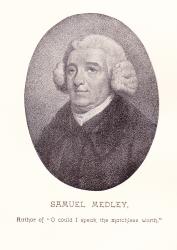
Samuel Medley

1738 - 1799 Author of "Join all who love the Saviour's name" in The Evangelical Hymnal Medley, Samuel, born June 23, 1738, at Cheshunt, Herts, where his father kept a school. He received a good education; but not liking the business to which he was apprenticed, he entered the Royal Navy. Having been severely wounded in a battle with the French fleet off Port Lagos, in 1759, he was obliged to retire from active service. A sermon by Dr. Watts, read to him about this time, led to his conversion. He joined the Baptist Church in Eagle Street, London, then under the care of Dr. Gifford, and shortly afterwards opened a school, which for several years he conducted with great success. Having begun to preach, he received, in 1767, a call to become pastor of the Baptist church at Watford. Thence, in 1772, he removed to Byrom Street, Liverpool, where he gathered a large congregation, and for 27 years was remarkably popular and useful. After a long and painful illness he died July 17, 1799. Most of Medley's hymns were first printed on leaflets or in magazines (the Gospel Magazine being one). They appeared in book form as:— (1) Hymns, &c. Bradford, 1785. This contains 42 hymns. (2) Hymns on Select Portions of Scripture by the Rev. Mr. Medley. 2nd ed. Bristol. W. Pine. 1785. This contains 34 hymns, and differs much from the Bradford edition both in the text and in the order of the hymns. (3) An enlargement of the same in 1787. (4) A small collection of new Hymns, London, 1794. This contains 23 hymns. (5) Hymns. The Public Worship and Private Devotion of True Christians Assisted in some thoughts in Verse; principally drawn from Select Passages of the Word of God. By Samuel Medley. London. Printed for J. Johnson. 1800. A few of his hymns are also found in a Collection for the use of All Denominations, published in London in 1782. Medley's hymns have been very popular in his own denomination, particularly among the more Calvinistic churches. In Denham's Selections there are 48, and in J. Stevens's Selections, 30. Their charm consists less in their poetry than in the warmth and occasional pathos with which they give expression to Christian experience. In most of them also there is a refrain in the last line of each verse which is often effective. Those in common use include:— 1. Come, join ye saints, with heart and voice. (1800). Complete in Christ. 2. Death is no more among our foes. Easter. 3. Eternal Sovereign Lord of all. (1789). Praise for Providential Care. 4. Far, far beyond these lower skies. (1789). Jesus, the Forerunner. 5. Father of mercies, God of love, whose kind, &c. (1789.) New Year. 6. Great God, today Thy grace impart. Sermon. 7. Hear, gracious God! a sinner's cry. (1789). Lent. 8. In heaven the rapturous song began. Christmas. 9. Jesus, engrave it on my heart. (1789). Jesus, Needful to all. 10. Mortals, awake, with angels join. (1782). Christmas. 11. My soul, arise in joyful lays. (1789). Joy in God. 12. Now, in a song of grateful praise. Praise to Jesus. In the Gospel Magazine, June, 1776. 13. O could I speak the matchless worth. (1789.) Praise of Jesus. 14. O for a bright celestial ray. Lent. 15. O God, Thy mercy, vast and free. (1800). Dedication of Self to God. 16. O let us tell the matchless love. Praise to Jesus. 17. O what amazing words of grace. (1789). Foutain of Living Waters. 18. Saints die, and we should gently weep. (1800). Death and Burial. From his "Dearest of Names, Our Lord and King." 19. See a poor sinner, dearest Lord. Lent. 20. Sing the dear Saviour's glorious fame. (1789). Jesus the Breaker of bonds. In 1800 a Memoir of Medley was published by his son, which is regarded by members of the family now living as authoritative. But in 1833 appeared another Memoir by Medley's daughter Sarah, to which are appended 52 hymns for use on Sacramental occasions. These she gives as her father's. But 8 of them are undoubtedly by Thos. Kelly, published by him in 1815, and reprinted in subsequent editions of his Hymns. The remainder are by Medley. Nearly all of these 52 hymns (both Medley's and Kelly's) have been altered in order to adapt them to Sacramental use. In Sarah Medley's volume, Kelly's hymns all follow one another, and three of them are in a metre which Medley apparently never used. What could have been Sarah Medley's motive in all this it is hard to divine. She is said to have been a clever, though unamiable woman, and was herself the author of a small volume of Poems published in 1807. In the Memoir she does not conceal her hatred of her brother. [Rev. W. R. Stevenson, M.A.] -- John Julian, Dictionary of Hymnology (1907)

Samuel Dyer

1785 - 1835 Arranger of "MENDON" in The Evangelical Hymnal Rv Samuel Dyer United Kingdom 1785-1835. Born in White Chapel, Hampshire, the family moved to Wellshire, England, where he was ordained and served as a Baptist minister. In 1806 the family moved to Coventry, and Samuel emigrated to the U.S. in 1811. He married Renee Novak. He taught music and directed choirs in New York City and Philadelphia, PA. He later moved to Baltimore, MD, and wrote, conducted singing schools in the south and east, and conducted the New York Sacred Music Society. He published “New selection of sacred music” (1817), “Anthems” (1822 & 1834), and “The Philadelphia collection of sacred music” (1828). He died in Hoboken, NJ. John Perry

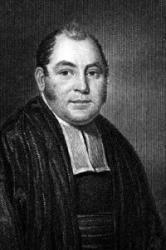
William Bengo Collyer

1782 - 1854 Person Name: Collyer Author of "Join all who love the Saviour's name" in The People's Hymn Book William Bengo Collyer was born at Blackheath Hill, in 1782, and studied at Homerton College. Before completing his twentieth year he became pastor of a Congregational society at Peckham, continuing in that position through his life. He died in 1854. He received the degree of D.D. from the University of Edinburgh in 1808. For many years he was one of the most popular Dissenting ministers in London. He published many hymns and some works on theology. --Annotations of the Hymnal, Charles Hutchins, M.A. 1872. =================== Collyer, William Bengo, D.D., born at Blackheath, April 14, 1782, educated at Homerton College, where, when 16 years old, he was enrolled as a student for the ministry. At 20 he began his ministry at Peckham on Dec. 17, 1801 ordained pastor of a small church consisting of ten communicants. From 1814 to 1826 he was also pastor of a Church meeting in Salters' Hall. On June 17, 1817, a new chapel was opened for him at Peckham. There, from the time of his settlement in 1801, he laboured with great success and honour until Dec. 11, 1853, on which clay he preached for the last time. He died Jan. 8, 1854. Dr. Collyer was eminent in his day as an eloquent Evangelical preacher, when formalism in worship, and Arianism in doctrine, prevailed. He was a man of amiable disposition, polished manners, and Christian courtesy; popular with rich and poor alike. He was the author of a series of lectures on Divine Revelation, in seven volumes: Scripture Facts, Prophecies, Miracles, Parables, Doctrines, Duties, Comparisons. Dr. Collyer compiled a hymn-book with the title, Hymns partly collected and partly original, designed as a supplement to Dr. Watts's Psalms and Hymns, 1812. It was intended at first for the use of his own congregation only, and was to include many hymns composed by himself, to be sung after sermons which he had preached to them, but he was led to alter the plan. It comprises 979 hymns, 6 choruses, and 4 doxologics, arranged in groups according to their authors, and not subjects. Of this number 57 were written by Dr. Collyer, and are for the most part short descriptive or didactic poems, religious or moral essays in verse, and not hymns addressed to the Creator and Redeemer. Some of them are devoid of Christian truth, and are poems of nature or of sentiment. Some of them were written during the hard and sorrowful times of the wars of Bonaparte, and relate to famine and national calamity. Several were prepared for the public meetings of missionary and benevolent societies, which had their origin in his time. He also published Services suited to the Solemnization of Matrimony, Baptism, &c, 1837, which contained 89 of his hymns, &c.; Hymns for Israel, a Tribute of Love for God's Ancient People, 1848 (41 hymns). In Dr. Leifchild's Original Hymns, 1843, there are also 39 of his compositions. Many of his pieces appeared in the Evangelical Magazine, and were also appended to his numerous published Sermons. A few of his hymns are still in common use, including. "Another fleeting day is gone"; "Assembled at Thy great command"; "O Jesu, in this solemn hour"; "O Thou, the helpless orphan's hope"; "Return, O wanderer, return," and the fine cento, "Great God, what do I see and hear." [Rev. F. J. Faulding, D.D.] --John Julian, Dictionary of Hymnology (1907) ====================== Collyer, William Bengo, p. 243, ii. The following hymns by Dr. Collyer are also in common use:— 1. Another fleeting day is gone. Evening. (1812.) 2. 0 Jesus, in this solemn hour. Reception of Church Officers. (1842.) 3. O Thou, the helpless orphan's hope. On Behalf of Orphans. In the Evangelical Magazine, 1808, p. 48. 4. See the clouds upon the mountain. Sunday Morning. (1842.) 5. Soft be the gently breathing notes. Praise to the Redeemer. (1812.) 6. Softly the shade of evening falls. Evening. (1812.) From this, “Soon shall a darker night descend" is taken. 7. Thou Prince of glory slain for me. Good Friday. (1812.) The date 1812 is that of his Collection, and 1842 of Leifchild's Original Hymns. --John Julian, Dictionary of Hymnology, Appendix, Part II (1907)

Export as CSV
It looks like you are using an ad-blocker. Ad revenue helps keep us running. Please consider white-listing Hymnary.org or getting Hymnary Pro to eliminate ads entirely and help support Hymnary.org.