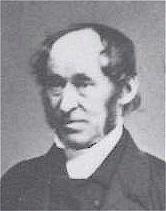
1798 - 1863 Author of "O Saviour, who didst come" in The New Laudes Domini Osler, Edward, was born at Falmouth in January, 1798, and was educated for the medical profession, first by Dr. Carvosso, at Falmouth, and then at Guy's Hospital, London. From 1819 to 1836 he was house surgeon at the Swansea Infirmary. He then removed to London, and devoted himself to literary pursuits. For some time he was associated with the Society for Promoting Christian Knowledge, both in London and at Bath. In 1841 he became the Editor of the Royal Cornwall Gazette, and took up his residence at Truro. He retained that appointment till his death, at Truro, March 7, 1863. For the Linnaean Society he wrote Burrowing and Boring Marine Animals. He also published Church and Bible; The Voyage: a Poem written at Sea, and in the West Indies, and Illustrated by papers on Natural History, 1830; The Life of Lord Exmouth, 1837, &c. His hymnological work is mainly connected with the Mitre Hymn Book. During 1835-36 he was associated with Prebendary W. J. Hall, the editor, in producing that collection, which was published in 1836 as Psalms and Hymns adapted to The Services of the Church of England. He resided in Mr. Hall's house during the time. From the "hall manuscript" we gather that he contributed 15 versions of the Psalms (5 being rewritten from others), and 50 hymns (a few rewritten). Most of these hymns and Psalm versions, together with others not in the Mitre Hymn Book, were afterwards given in the monthly numbers of his Church and King, from Nov. 1836 to Aug. 1837. The best known of these hymns are, “O God, unseen, yet ever near," and “Worship, honour, glory, blessing." Several of his hymns in common use are:—
1. Father, Whose love and truth fulfil. Holy Baptism.
2. Glory to God! with joyful adoration. Praise to the Father.
3. Great God, o'er earth and heaven supreme. Men the Stewards of God's Bounties.
4. Great God of hosts, our ears have heard. Ps. xliv. Based on the N. Version.
5. Great God, Whose awful mystery. Holy Trinity.
6. I hold the sacred book of God. Martyrs.
7. Jehovah hath spoken, the nations shall hear. Second Advent.
8. Lord, may the inward grace abound. Holy Baptism.
9. May we Thy precepts, Lord, fulfil. Love.
10. Mighty Saviour, gracious King. Advent.
11. 0 God, the help of all Thy Saints. Ps. x.
12. O Thou, the Lord and Life of those. Christ the Life of Men.
13. O Saviour, Who didst come. Easter.
14. Saviour, Whose love could stoop to death. Easter.
15. See, Lord, before Thy mercy seat. For Schools.
16. Set in a high and favoured place. Advent.
17. Wake frem the dead, new life begin. Lent.
18. With trembling awe we come. Lent.
Several of these hymns are not in Osier's Church and King. We have ascribed them and others to him on the authority of the "hall MSS." It must be noted also that the text in the Church and King often differs from that in the Mitre.
--John Julian, Dictionary of Hymnology (1907)
Though not mentioned by Julian, perhaps his most enduring contribution to hymnody is the third stanza of "Praise the Lord! Ye Heavens, Adore Him", whose first two stanzas are of anonymous authorship.
--Leland Bryant Ross (2019)
Edward Osler


 My Starred Hymns
 My FlexScores
 My Hymnals
 My Purchased Files