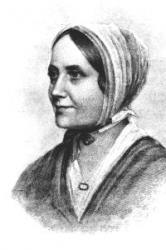
1787 - 1860 Person Name: Eliza L. Follen Author of "Praise To God, Oh Let Us Raise" in The Cyber Hymnal Follen, Eliza Lee, née Cabot, a well-known Unitarian writer, daughter of Samuel Cabot, born at Boston, August 15, 1787, and married, in 1828, to Professor Charles Follen, who perished on board the "Lexington," which was burnt on Long Island Sound, Jan. 13,1840. Mrs. Follen died at Brookline, Mass., 1860. She was a voluminous writer. Her Poems were first published at Boston (Crosby & Co.), 1839, and whilst she was in England she issued another volume for children's use, entitled The Lark and the Linnet, in 1854. Both volumes also contain some translations from the German, and versions of a few Psalms.
Her best known hymns are:—
1. How sweet to be allowed to pray. Resignation. Appeared in the Christian Disciple, Sept., 1818, and in her Poems, 1839, p. 116, in 4 stanzas of 4 lines, and entitled, "Thy will be done."
2. How sweet upon this sacred day. Sunday. In her Poems, 1839, pp. 113-114, in 6 stanzas of 4 lines, and entitled “ Sabbath Day.” It previously appeared in Sabbath Recreations, 1829.
3. Lord, deliver, Thou canst save. Prayer for the Slave. Found in Songs of the Free, 1836; but is not given in her Poems, 1839. In Adams and Chapin's Hymns for Christian Devotion, Boston, U.S., 1846, it is No. 802, in 5 stanzas of 4 lines. In common with No. 2 it has found acceptance out¬side Unitarian Collections.
4. God, Thou art good, each perfumed flower. This is the original of J. H. Gurney's hymn," Yes, God is good," &c. (q.v.) There is some obscurity about the text. It is found in her Hymns for Children, Boston, 1825, beginning, "God is good," each perfumed flower," and this obvious misprint (which destroys the metre) was usually copied in later books. It is also given with the same first line as an original piece, never before published, and signed "E. L. C." (initials of Mrs. Follen's maiden name), in Emily Taylor's Sabbath Recreations, Wellington, Salop, 1826, p. 203. This suggests that it was printed in the American book after the US. was posted to England. Mrs. Follen may have written at first “Yes, God is good," but this cannot now be determined. It begins, “God, Thou art good," &c, in her Poems, 1839, p. 119, and in her verses, The Lark and the Linnet, &c, 1854, and in each case is in 6 stanzas of 4 lines, with the title, "God is Good."
5. Will God, Who made the earth and sea. A Child's Prayer. Given in her Poems, 1839, p. 164, in 7 stanzas of 4 lines. In Dr. Allon's Children's Worship, 1878, No. 212, it is abbreviated to 4 stanzas (i.-iv.), and attributed to H. Bateman in error. [Rev. F. M. Bird, M.A.]
--John Julian, Dictionary of Hymnology (1907)
Eliza Lee Cabot Follen


 My Starred Hymns
 My FlexScores
 My Hymnals
 My Purchased Files



