You help make Hymnary.org possible. More than 10 million people from 200+ countries found hymns, liturgical resources and encouragement on Hymnary.org in 2025, including you. Every visit affirms the global impact of this ministry.

If Hymnary has been meaningful to you this year, would you take a moment today to help sustain it? A gift of any size—paired with a note of encouragement if you wish—directly supports the server costs, research work and curation that keep this resource freely available to the world.

Give securely online today, or mail a check to:
Hymnary.org
Calvin University
3201 Burton Street SE
Grand Rapids, MI 49546

Thank you for your partnership, and may the hope of Advent fill your heart.

Person Results

Text Identifier:"^christ_is_my_prophet_priest_and_king$"
In:people

Planning worship? Check out our sister site, ZeteoSearch.org, for 20+ additional resources related to your search.
Showing 1 - 3 of 3Results Per Page: 102050

John Mason

1645 - 1694 Person Name: J. Mason Author of "Christ is my Prophet, Priest and King" in The Standard Hymnal Mason, John. The known facts of his life are scanty. He was the son of a Dissenting Minister, and the grandfather of John Mason, the author of A Treatise on Self-Knowledge. He was educated at Strixton School, Northants, and Clare Hall, Cambridge. After taking his M.A., he became Curate of Isham; and in 1668, Vicar of Stantonbury, Bucks. A little more than five years afterwards he was appointed Rector of Water-Stratford. Here he composed the volume containing The Songs of Praise, his paraphrase of The Song of Solomon, and the Poem on Dives and Lazarus, with which Shepherd's Penitential Cries was afterwards bound up. This volume passed through twenty editions. Besides the Songs of Praise, it contains six Penitential Cries by Mason, and it is this portion of his work which harmonizes with the compositions of Shepherd. Probably his hymns were used in public worship, and if so, they are among the earliest hymns so used in the Church of England. Some of his hymns are often found in the early Hymn Collections of the 18th century. The most notable work besides this volume is Select Remains of the Rev, John Mason, a collection of sententious and practical sayings and Christian letters, published by his grandson, and much eulogized by Dr. Watts. His friend, Shepherd, who was at Water-Stratford at the remarkable period to which reference is made below, published two of Mason's Sermons, with a preface of his own. Mason was a man of true piety and humility; known for eminent prayerfulness; faithful, experimental, effectual preaching; "a light in the pulpit, and a pattern out of it." His friendship with Baxter, and Shepherd, the Nonconformist Minister of Braintree, probably indicates his sympathies and theological position. Baxter calls him "the glory of the Church of England," and says :— "The frame of his spirit was so heavenly, his deportment so humble and obliging, his discourse of spiritual things so weighty, with such apt words and delightful air, that it charmed all that had any spiritual relish.” The close of his life was sensational enough. One night, about a month before his death, he had a vision of the Lord Jesus, wearing on His head a glorious crown, and with a look of unutterable majesty in His face. Of this vision he spoke; and preached a Sermon called The Midnight Cry, in which he proclaimed the near approach of Christ's Second Advent. A report spread that this Advent would take place at Water-Stratford itself, and crowds gathered there from the surrounding villages. Furniture and provisions were brought in, and every corner of the house and village occupied. Most extraordinary scenes occurred, singing and leaping and dancing. The excitement had scarcely died out when the old man passed away (1694), still testifying that he had seen the Lord, and that it was time for the nation to tremble, and for Christians to trim their lamps. His last words were, “I am full of the loving kindness of the Lord." [Rev. H. Leigh Bennett, M.A.] The full titles of his Songs of Praise, and the additions thereto, are:— (1) Spiritual Songs; or, Songs of Praise to Almighty God upon several occasions, 1683. (2) The Song of Songs which is Solomon's first Turned, then Paraphrased in English Verse. Published with the former. (3) Dives and Lazarus, incorporated with the former 1685. (4) Penitential Cries, Begun by the Author of the Songs of Praise, And carried on by another Hand. Licensed and Entered, Sept. 13, 1693. This forms the concluding part of all editions of the Songs of Praise after 1693. The complete work was reprinted by D. Sedgwick in 1859. This reprint was accompanied by a short Memoir. In this reprint Mason's Penitential Cries and Ps. 86 are given under Songs of Praise, pp. 49-61, those under Penitential Cries being all by Shepherd (q.v.). Mason's Life, by John Dunton, was published in 1694, and included some miscellaneous poems; and another, by Henry Maurice, in 1695, in which are two hymns not found elsewhere. We may add that Mason published a Catechism, with some Verses for Children. Of this, however, no copy is known to exist. Mason's Songs are commonly presented in modern hymnbooks in the form of centos, which are sometimes compiled from a single Song, and in other instances from several Songs. Many of these are annotated under their respective first lines. The rest include:— 1. Blest be my God that I was born. Praise for the Gospel. 2. Lord, for the mercies of the night. Morning. 3. Lord of my life, Length of my days. Praise for Deliverance from Immediate danger of Death. 4. My God, a God of pardon is. Praise for Pardon of Sin. 5. My God, my only Help and Hope. Praise for Providence. 6. My God, my reconciled God. Praise for Peace of Conscience. 7. My God was with me all this night. Morning. 8. Thou wast, 0 God; and Thou wast blest. Praise for Creation. 9. Thousands of thousands stand around. Praise. A cento from Songs i. and ii. In Griffith, Farran & Co.'s Ancient and Modern Library, No. 12, Giles Fletcher's Christ's Victory and Triumph, &c, 1888, p. 208 (edited by W. T. Brooke), a short hymn by Mason is given from Multum in Parvo: or the Jubilee of Jubilees, 1732, beginning "High praises meet and dwell within." It is an indifferent example of Mason's powers as a writer of sacred verse. -- John Julian, Dictionary of Hymnology (1907) ==================== Mason, J., p. 716, ii. Mason's Midnight Cry, stated on p. 717, i. as having been preached in 1694, was delivered in 1691. The 1st ed. of this sermon is:— “The Midnight Cry. A Sermon Preached On the Parable of the Ten Virgins . . . . By J. M., M.A., Rector of W. in the County of B., London: Nathanael Ranew . . 1691. This edition has no hymns. To the 4th ed. in 1692, published by the same Nathanael Ranew, there was added:— The Fourth Edition, with the Addition of two Hymns for the Coming of Christ. By the same Author. The first of these hymns begins:— "The evening of the Day Portends a dismal night," and is in 12 stanzas of 8 lines. The second hymn is:— "Come, come, my dearest, dearest Lord, Make haste and come away." This is in 14 stanzas of 4 lines. Of the first and fifth eds. there are copies in the Brit. Museum, and of the first in the Julian Collection of the Church House, London. --John Julian, Dictionary of Hymnology, New Supplement (1907)

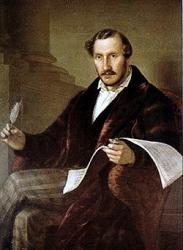
Gaetano Donizetti

1797 - 1848 Person Name: Donizetti Composer of "[Christ is my Prophet, Priest and King]" in The Standard Hymnal Domenico Gaetano Maria Donizetti (born 29 November 1797 – died 8 April 1848) was an Italian composer from Bergamo, Lombardy. Donizetti came from a non-musical background but, at an early age, he was taken under the wing of composer Simon Mayr who had set up the Lezioni Caritatevoli and had enrolled him by means of a full scholarship. There he received detailed training in the arts of fugue and counterpoint, and it was from there that Mayr was instrumental in obtaining a place for the young man at the Bologna Academy. In Bologna, at the age of 19, he wrote his first one-act opera, the comedy Il Pigmalione, although it does not appear to have been performed during his lifetime. Through his life, Donizetti wrote about 70 operas, but an offer in 1822 from Domenico Barbaja, the impresario of the Teatro San Carlo in Naples, which followed the composer's ninth opera, led to his move to that city and the composition of 28 operas which were given their premieres at that house or in one of the city's smaller houses including the Teatro Nuovo or the Teatro del Fondo. This continued until the production of Caterina Cornaro in January 1844. In all, Naples presented 51 of Donizetti's operas. During this period, success came primarily with the comic operas, the serious ones failing to attract significant audiences. However, the situation changed with the appearance in 1830 of the serious opera, Anna Bolena which was the first to make a major impact on the Italian and international opera scene and, at the same time, to shift the balance for the composer away from success with only comedic operas. However, even after 1830, his best-known works did also include comedies such as L'elisir d'amore (1832) and Don Pasquale (1843). But significant historical dramas did appear and became successful, sometimes outside Naples before reaching that city. Most significantly, they included Lucia di Lammermoor (the first to be written by librettist Salvadore Cammarano) in 1835, as well as "one of [his] most successful Neapolitan operas", Roberto Devereux in Up to that point, all of his operas had been written to Italian librettos. However, moving to Paris in 1838, Donizetti set his operas to French texts; these include La favorite and La fille du régiment and were first performed in that city from 1840 onward. It appears that much of the attraction of moving to Paris was not just for larger fees and prestige, but his chafing against the censorial limitations which existed in Italy, thus giving him a much greater freedom to choose subject matter. By 1845 severe illness caused him to be moved back to Bergamo to die in 1848. Along with Gioachino Rossini and Vincenzo Bellini, he was a leading composer of bel canto opera during the first fifty years of the Nineteenth Century. The youngest of three sons, Donizetti was born in 1797 in Bergamo's Borgo Canale quarter located just outside the city walls. His family was very poor and had no tradition of music, his father Andrea, being the caretaker of the town pawnshop. Simone Mayr, a German composer of internationally successful operas had become maestro di cappella at Bergamo's principal church in 1802 and he then founded the Lezioni Caritatevoli school in Bergamo in 1805 for the purpose of providing musical training, including classes in literature, beyond that which choirboys ordinarily received up until the time that their voices broke. In 1807, Andrea Donizetti attempted to enroll both his sons, but the elder, Giuseppe (then 18), was considered too old. Gaetano (then 9) was accepted. While not especially successful as a choirboy during the first three trial months of 1807, there being some concern about a diffetto di gola (throat defect), in every other regard Mayr was reporting that Gaetano "surpasses all the others in musical progress". Mayr was able to persuade the authorities that the young boy's talents were worthy of keeping him in the school, and he remained there for nine years until 1815. However, as William Ashbrook notes, in 1809 he was threatened with having to leave because his voice was changing. In 1810 he applied for and was accepted by the local art school, the Academia Carrara, but it is unknown whether he attended classes. Then, in 1811, Mayr once again intervened. Having written both libretto and music for a "pasticcio-farsa", Il piccolo compositore di musica, as the final concert of the academic year, he cast five your students amongst them Donizetti, his young pupil, as "the little composer". As Ashbrook notes this "was nothing less than Mayr's argument that Donizetti be allowed to continue his musical studies". In Bologna, he justified the faith which Mayr had placed in him and in 1816 he wrote what Allitt describes as "his initial exercises in operatic style", the opera Il pigmalione, as well as composing portions of Olympiade and L'ira d'Achille in 1817, these two being no more than "suggest[ing] the work of a student". Encouraged by Mayr to return to Bergamo in 1817, he began his "quartet years" as well as composing piano pieces and most likely being part of quartets where he would have played and heard music of other composers. In addition, he began seeking employment. After some minor compositions under the commission of Paolo Zancla, Donizetti wrote his ninth opera, Zoraida di Granata. This work impressed Domenico Barbaia, a prominent theatre manager, and Donizetti was offered a contract to compose in Naples. Writing in Rome and Milan in addition to Naples, Donizetti achieved some popular success in the 1820s (although critics were often unimpressed). It was not until 1830 that he became well known internationally, when his Anna Bolena was premiered in Milan, and this brought him instant fame throughout Europe. L'elisir d'amore, a comedy produced in 1832, came soon after, and is deemed to be one of the masterpieces of 19th-century opera buffa (as is his Don Pasquale, written for Paris in 1843). Shortly after L'elisir d'amore, Donizetti composed Lucia di Lammermoor, based on The Bride of Lammermoor, the novel by Sir Walter Scott. This became his most famous opera, and one of the high points of the bel canto tradition, reaching a stature similar to that of Bellini's Norma. Donizetti's wife, Virginia Vasselli, gave birth to three children, none of whom survived. Within a year of his parents' deaths, on 30 July 1837 his wife died from cholera. By 1843, Donizetti was exhibiting symptoms of syphilis and probable bipolar disorder. After being institutionalized in 1845, he was sent to Paris, where he could be cared for. After visits from friends, including Giuseppe Verdi, Donizetti was taken back to Bergamo, his hometown. After several years in the grip of insanity, he died in 1848 in the house of a noble family, the Scotti. Donizetti was buried in the cemetery of Valtesse but in the late 19th century his body was transferred to Bergamo's Basilica of Santa Maria Maggiore near the grave of his teacher Simon Mayr. Donizetti, a prolific composer, is best known for his operatic works, but he also wrote music in a number of other forms, including some church music, a number of string quartets, and some orchestral pieces. Altogether, he composed about 75 operas, 16 symphonies, 19 string quartets, 193 songs, 45 duets, 3 oratorios, 28 cantatas, instrumental concertos, sonatas, and other chamber pieces. --en.wikipedia.org/wiki/ (excerpts)

J. Mason

Author of "Christ is my Prophet, Priest and King"

Export as CSV
It looks like you are using an ad-blocker. Ad revenue helps keep us running. Please consider white-listing Hymnary.org or getting Hymnary Pro to eliminate ads entirely and help support Hymnary.org.