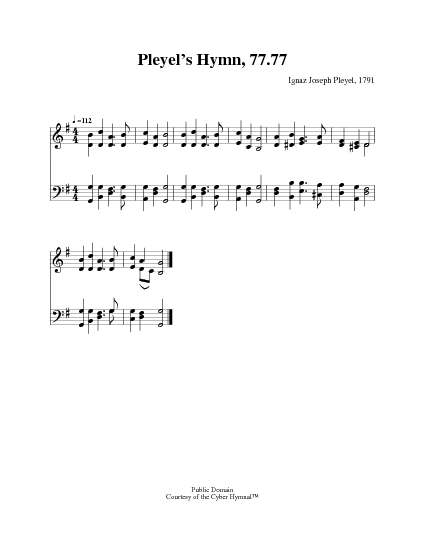
1 Children of the heavenly King,
As we journey let us sing;
Sing our Savior’s worthy praise,
Glorious in His works and ways,
Glorious in His works and ways.
2 We are traveling home to God,
In the way our fathers trod;
They are happy now, and we
Soon their happiness shall see,
Soon their happiness shall see.
3 Fear not, brethren; joyful stand
On the borders of our land;
Jesus Christ, our Father’s Son,
Bids us undismayed go on,
Bids us undismayed go on.
4 Lord, obediently we'll go,
Gladly leaving all below;
Only Thou our leader be,
And we still will follow Thee,
And we still will follow Thee.
Amen.
Source: African Methodist Episcopal Church Hymnal #526
John Cennick was born at Reading, Berkshire, in the year 1717. He became acquainted with Wesley and Whitefield, and preached in the Methodist connection. On the separation of Wesley and Whitefield he joined the latter. In 1745, he attached himself to the Moravians, and made a tour in Germany to fully acquaint himself with the Moravian doctrines. He afterwards ministered in Dublin, and in the north of Ireland. He died in London, in 1755, and was buried in the Moravian Cemetery, Chelsea. He was the author of many hymns, some of which are to be found in every collection.
--Annotations of the Hymnal, Charles Hutchins, M.A. 1872.… Go to person page >| First Line: | Children of the heavenly King, As we journey, sweetly sing |
| Title: | The Pilgrim's Song |
| Author: | John Cennick (1743) |
| Meter: | 7.7.7.7 |
| Language: | English |
| Refrain First Line: | Praise the Lord, as you sing |
| Notes: | Spanish translation: See "Hijos del celeste Rey" by Juan Bautista Cabrera Ivars; Swahili translation: See "Watoto wake Mungu" |
| Copyright: | Public Domain |
Children of the heavenly King. J. Cennick. [Encouragement to Praise.] This is the most popular of this author's hymns, and, in an abbreviated form, it is found in a large proportion of the hymnals published in the English language for more than 100 years. It appeared in his Sacred Hymns for the Children of God, &c, 1742, Pt. iii., in 12 stanzas of 4 lines. In 1753, G. Whitefield gave 6 stanzas in his Collection as No. 38 of Pt. ii. M. Madan repeated this in 1760, and thus the abbreviated form came into use. Departures from Whitefield's arrangement are found in several instances, but as the full text has been included by Dr. Rogers in Lyra Britannica, 1867, p. 666, and can be easily consulted, they are not tabulated. Whitefield's text consisted of stanzas i., ii., iv., v., vii. and viii. In Bingham's Hymnologia Christiana Latina, 1871, p. 123, there is a Latin rendering of the text as given in Bickersteth's Christian Psalmody, 1833, "Filii Regis superni, cantatis."
--John Julian, Dictionary of Hymnology (1907)
My Starred Hymns