1 A Friend there is, your voices join,
Ye saints, to praise his name,
Whose truth and kindness are divine,
Whose love’s a constant flame.
2 When most we need his helping hand,
This Friend is always near;
With heaven and earth at his command,
He waits to answer prayer.
3 His love no end or measure knows;
No change can turn its course;
Immutably the same, it flows
From one eternal source!
4 When frowns appear to veil his face,
And clouds surround his throne,
He hides the purpose of his grace,
To make it better known.
5 And if our dearest comforts fall
Before his sovereign will,
He never takes away our all –
Himself he gives us still.
6 [Our sorrows in the scale he weighs,
And measures out our pains;
The wildest storm his word obeys;
His word its rage restrains.]
Source: A Selection of Hymns for Public Worship. In four parts (10th ed.) (Gadsby's Hymns) #132
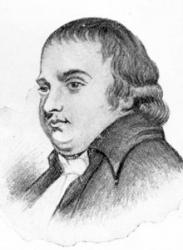
Swain, Joseph, was born at Birmingham in 1761, and after being apprenticed to an engraver, removed to London. After a time he became a decided Christian, and being of an emotional poetic temperament, began to give expression to his new thoughts and feelings in hymns. In 1783 he was baptized by the Rev. Dr. Rippon, and in 1791 became minister of a Baptist congregation in East Street, Walworth. After a short but popular and very useful ministry, he died April 16, 1796 Swain published the following:—
(1) A Collection of Poems on Several Occasions, London, 1781; (2) Redemption, a Poem in five Books, London, 1789; (3) Experimental Essays on Divine Subjects, London, 1791; (4) Walworth Hymns, by J. Swain, Pastor of the Baptist Church Meeting… Go to person page >| First Line: | A friend there is, your voices join |
| Author: | Joseph Swain |
| Language: | English |
| Copyright: | Public Domain |
A Friend there is; your voices join. J. Swain. [Jesus the Friend.] Appeared as one of two hymns in his Experimental Essays on Divine Subjects, London, 1791, pp. 85-87, with the note "The two following pieces were occasioned by the death of an only son.” The second piece is:—"When Jesus, both of God and Man." In 1792 he included the former in his Walworth Hymns, in 10 stanzas of 4 lines, and from thence it has passed iuto several collections, mainly those of the Baptists, but including also other Non-conforming bodies and a limited number in the Church of England. In America it is almost unknown. Original text, Lyra Britannica 1867, pp. 37—8.
--John Julian, Dictionary of Hymnology (1907)

My Starred Hymns