1 Awake, my soul! lift up thine eyes;
See where thy foes against thee rise,
In long array, a numerous host;
Awake, my soul! or thou art lost.
2 See where rebellious passions rage,
And fierce desires and lusts engage;
The meanest foe of all the train
Has thousands and ten thousands slain.
3 Thou treadest on enchanted ground;
Perils and snares beset thee round;
Beware of all, guard every part
But most the traitor in thy heart.
4 The terror and the charm repel,
The powers of earth, and powers of hell;
The Man of Calvary triumphed here;
Why should his faithful followers fear?
5 Come then, my soul! now learn to wield
The weight of thine immortal shield;
Put on the armor, from above,
Of heavenly truth and heavenly love.
Source: The Seventh-Day Adventist Hymn and Tune Book: for use in divine worship #594
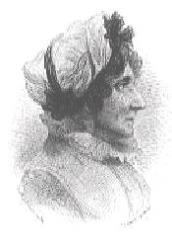
Barbauld, Anna Laetitia, née Aikin, daughter of the Rev. John Ailrin, D.D., a dissenting minister, was b. at Kibworth-Harcourt, Leicestershire, June 20, 1743. In 1753 Dr. Aikin became classical tutor at a dissenting academy at Warrington. During her residence there she contributed five hymns to Dr. W. Enfield's Hymns for Public Worship, &c, Warrington, 1772. In the following year these were included in her Poems, Lond., J. Johnson, 1773. In May, 1774, Miss Aikin was married to the Rev. Rochemont Barbauld, a descendant of a French Protestant family, and a dissenting minister. For some years Mr. Barbauld conducted, in addition to his pastoral work, a boarding school at Palgrave, Suffolk. From this he retired in 1785. In 1786 he undertook t… Go to person page >| First Line: | Awake, my soul, lift up thine eyes |
| Author: | Anna L. Barbauld |
| Meter: | 8.8.8.8 |
| Language: | English |
| Copyright: | Public Domain |
Awake, my soul, lift up thine eyes. Anna L. Barbauld. [Watchfulness.] Contributed to Dr. Enfield's Hymns, &c, Warrington, 1772, No. 126, in 6 stanzas of 4 lines, and headed "The Conflict." In the following year it was repeated in her Poems, London, 1773, and again in her Works, &c, 1825, vol. i. p. 330. Its use has been and still is fairly extensive both in Great Britain, and America. Original text in Lyra Britannica, 1867, p. 34, and Lord Seiborne's Book of Praise, 1862, p. 485. In the latter the date, 1773, is given in error.
-- John Julian, Dictionary of Hymnology (1907)

My Starred Hymns