Go Ad-Free
If you regularly use Hymnary.org, enhance your experience with Hymnary Pro—ad-free browsing plus powerful tools for planning, discovery and customization.
God in his temple let us meet:
Low on our knees before Him bend,
Here hath He fix'd his Mercy-seat,
Here on his worship we attend.
Arise into thy resting-place,
Thou, and thine ark of strength, O Lord!
Shine through the veil, we seek Thy face;
Speak, for we hearken to Thy word.
With righteousness Thy priests array;
Joyful Thy chosen people be;
Let those who teach, and hear, and pray,
Let all be Holiness to Thee!
Sacred Poems and Hymns
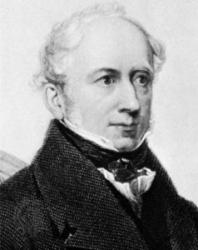
James Montgomery (b. Irvine, Ayrshire, Scotland, 1771; d. Sheffield, Yorkshire, England, 1854), the son of Moravian parents who died on a West Indies mission field while he was in boarding school, Montgomery inherited a strong religious bent, a passion for missions, and an independent mind. He was editor of the Sheffield Iris (1796-1827), a newspaper that sometimes espoused radical causes. Montgomery was imprisoned briefly when he printed a song that celebrated the fall of the Bastille and again when he described a riot in Sheffield that reflected unfavorably on a military commander. He also protested against slavery, the lot of boy chimney sweeps, and lotteries. Associated with Christians of various persuasions, Montgomery supported missio… Go to person page >| First Line: | God in his temple let us meet |
| Author: | James Montgomery |
| Meter: | 8.8.8.8 |
| Language: | English |
| Copyright: | Public Domain |
God in His temple let us meet. J. Montgomery. [Ps. cxxxii.] Appeared in Cotterill's Selection, 1819, p. 74, in 4 stanzas of 8 lines. In the revised edition of 1820, lines 1-12 were given instead of the full text of the previous edition, thus making a hymn in 3 stanzas of 4 lines. This was repeated in Montgomery's Songs of Zion, 1822, as No. 1 of Ps. 132, and the rest of the Cotterill text of 1819 as No. 2, beginning, "Lord, for Thy servant David's sake." Pt. i. was also included in his Original Hymns, 1853, No. 101. Both parts are in common use as separate hymns, but the first is found in the greater number of hymn books.
--John Julian, Dictionary of Hymnology (1907)

My Starred Hymns