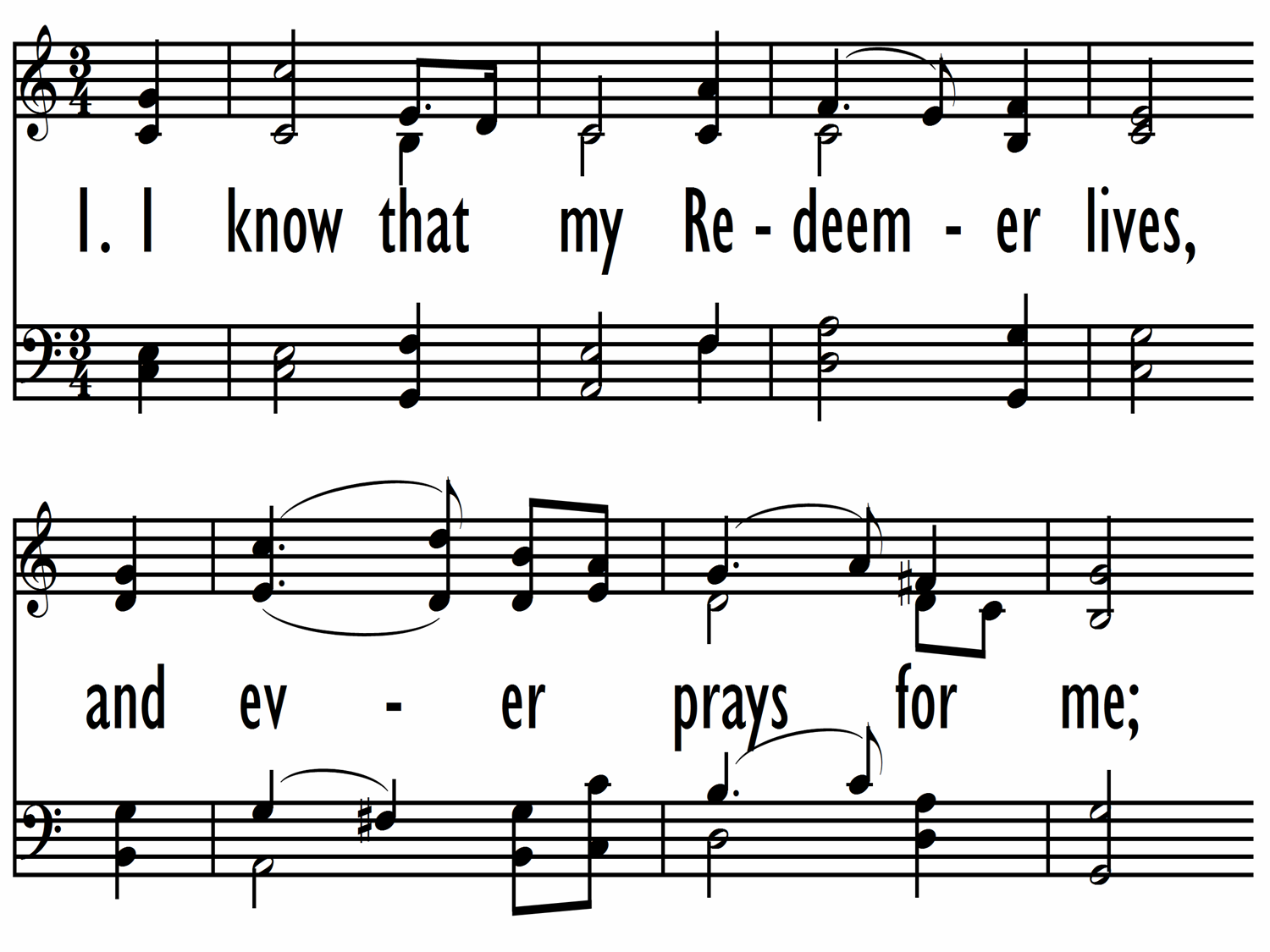
1 I know that my Redeemer lives,
And ever prays for me;
A token of His love He gives,
A pledge of liberty.
2 I find Him lifting up my head;
He brings salvation near;
His presence makes me free indeed,
And He will soon appear.
3 He wills that I should holy be,
What can withstand His will?
The counsel of His grace in me
He surely shall fulfill.
4 Jesus, I hang upon Thy word;
I steadfastly believe
Thou wilt return and claim me, Lord,
And to Thyself receive.
5 When God is mine and I am His,
Of paradise possessed,
I taste unutterable bliss
And everlasting rest.
Source: African Methodist Episcopal Church Hymnal #166
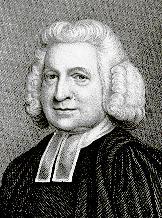
Charles Wesley, M.A. was the great hymn-writer of the Wesley family, perhaps, taking quantity and quality into consideration, the great hymn-writer of all ages. Charles Wesley was the youngest son and 18th child of Samuel and Susanna Wesley, and was born at Epworth Rectory, Dec. 18, 1707. In 1716 he went to Westminster School, being provided with a home and board by his elder brother Samuel, then usher at the school, until 1721, when he was elected King's Scholar, and as such received his board and education free. In 1726 Charles Wesley was elected to a Westminster studentship at Christ Church, Oxford, where he took his degree in 1729, and became a college tutor. In the early part of the same year his religious impressions were much deepene… Go to person page >| First Line: | I know that my Redeemer lives, And ever prays for me (Wesley) |
| Title: | I Know That My Redeemer Lives |
| Author: | Charles Wesley (1742) |
| Meter: | 8.6.8.6 |
| Language: | English |
| Refrain First Line: | The cleansing stream, I see, I see |
| Copyright: | Public Domain |
I know that my Redeemer lives, And ever prays for me. C. Wesley. [Rejoicing in hope.] Published in Hymns & Sacred Poems, 1742, p. 180, in 23 stanzas of 4 lines, and entitled, “Rejoicing in Hope." (Poetical Works, 1868-72, vol. ii. p. 242.) Two centos from this hymn, both beginning with stanza i., are in common use:—
1. In Toplady's Psalms & Hymns, Itt6, No. 290, in 8 stanzas. This is in use in the Church of England.
2. In the Wesleyan Hymn Book, 1780, in 9 stanzas, No. 373 (ed. 1875, No. 384). This is the arrangement commonly found in the Methodist hymn-books (but sometimes abbreviated) in Great Britain and America. Stevenson has an interesting note on this cento in his Methodist Hymn Book Notes, 1883, p. 265.
--John Julian, Dictionary of Hymnology (1907)

My Starred Hymns