
Raise thee, my soul, fly up, and run
Through every heav'nly street,
And say, there's naught below the sun
That's worthy of thy feet.
[Thus will we mount on sacred wings,
And tread the courts above;
Nor earth, nor all her mightiest things,
Shall tempt our meanest love.]
There on a high majestic throne
Th' Almighty Father reigns,
And sheds his glorious goodness down
On all the blissful plains.
Bright like a sun the Savior sits,
And spreads eternal noon;
No evenings there, nor gloomy nights,
To want the feeble moon.
Amidst those ever-shining skies,
Behold the sacred Dove!
While banished sin and sorrow flies
From all the realms of love.
The glorious tenants of the place
Stand bending round the throne;
And saints and seraphs sing and praise
The infinite Three One.
[But O! what beams of heav'nly grace
Transport them all the while
Ten thousand smiles from Jesus' face,
And love in every smile!]
Jesus! and when shall that dear day,
That joyful hour, appear,
When I shall leave this house of clay,
To dwell amongst them there?
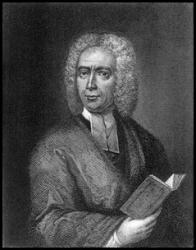
Isaac Watts was the son of a schoolmaster, and was born in Southampton, July 17, 1674. He is said to have shown remarkable precocity in childhood, beginning the study of Latin, in his fourth year, and writing respectable verses at the age of seven. At the age of sixteen, he went to London to study in the Academy of the Rev. Thomas Rowe, an Independent minister. In 1698, he became assistant minister of the Independent Church, Berry St., London. In 1702, he became pastor. In 1712, he accepted an invitation to visit Sir Thomas Abney, at his residence of Abney Park, and at Sir Thomas' pressing request, made it his home for the remainder of his life. It was a residence most favourable for his health, and for the prosecution of his literary… Go to person page >| First Line: | Raise thee, my soul, fly up, and run |
| Title: | The Blessed Society in Heaven |
| Author: | Isaac Watts |
| Meter: | 8.6.8.6 |
| Language: | English |
| Copyright: | Public Domain |
Raise thee, my soul, fly up and run. I. Watts. [Heavenly Joys.] Appeared in his Hymns and Sacred Songs, 1707 (ed. 1709, Bk. ii., No. 33), in 8 stanzas of 4 lines, and headed ”The blessed Society in Heaven." It is in common use in its full, and also in an abridged form. In some American collections, including The Baptist Praise Book, N. Y., 1871, it begins "Arise, my soul, fly up and run," and st. ii. and vi. are also omitted.
--John Julian, Dictionary of Hymnology (1907)
My Starred Hymns