Go Ad-Free
If you regularly use Hymnary.org, enhance your experience with Hymnary Pro—ad-free browsing plus powerful tools for planning, discovery and customization.
1 This life's a dream, an empty show;
But the bright world to which I go
Hath joys substantial and sincere;
When shall I wake and find me there?
2 O glorious hour! O blest abode!
I shall be near and like my God,
And flesh and sense no more control
The sacred pleasures of the soul.
3 My flesh shall slumber in the ground
Till the last trumpet's joyful sound;
Then burst the chains with sweet surprise,
And in my Saviour's image rise.
Hymnal: according to the use of the Protestant Episcopal Church in the United States of America, 1871
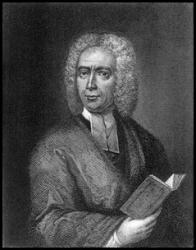
Isaac Watts was the son of a schoolmaster, and was born in Southampton, July 17, 1674. He is said to have shown remarkable precocity in childhood, beginning the study of Latin, in his fourth year, and writing respectable verses at the age of seven. At the age of sixteen, he went to London to study in the Academy of the Rev. Thomas Rowe, an Independent minister. In 1698, he became assistant minister of the Independent Church, Berry St., London. In 1702, he became pastor. In 1712, he accepted an invitation to visit Sir Thomas Abney, at his residence of Abney Park, and at Sir Thomas' pressing request, made it his home for the remainder of his life. It was a residence most favourable for his health, and for the prosecution of his literary… Go to person page >| First Line: | This life's a dream, an empty show |
| Title: | This Life's a dream, an empty show |
| Author: | Isaac Watts |
| Meter: | 8.8.8.8 |
| Language: | English |
| Copyright: | Public Domain |
This life's a dream, an empty show. Part of “Lord, I am Thine, but Thou wilt prove," p. 689, i.
--John Julian, Dictionary of Hymnology, Appendix, Part II (1907)
My Starred Hymns