Composer: Ludwig van Beethoven
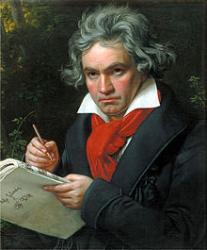
A giant in the history of music, Ludwig van Beethoven (b. Bonn, Germany, 1770; d. Vienna, Austria, 1827) progressed from early musical promise to worldwide, lasting fame. By the age of fourteen he was an accomplished viola and organ player, but he became famous primarily because of his compositions, including nine symphonies, eleven overtures, thirty piano sonatas, sixteen string quartets, the Mass in C, and the Missa Solemnis. He wrote no music for congregational use, but various arrangers adapted some of his musical themes as hymn tunes; the most famous of these is ODE TO JOY from the Ninth Symphony. Although it would appear that the great calamity of Beethoven's life was his loss of hearing, which turned to total deafness during the last…
Go to person page >Arranger: E. T. Hildebrand
Born: January 18, 1866, Rockingham County, Virginia.
Died: March 23, 1931.
Buried: Weaver Mennonite Church Cemetery, Dayton, Virginia.
Hildebrand attended the public schools and Shenandoah Seminary. His mother taught him to sing as soon as he could talk, but his first regular teacher was D. M. Click. He later studied with James Ruebush, Benjamin Unseld, P. J. Merges, George and Frederick Root, C. B. Shaw, F. H. Tubbs and others. He began teaching singing schools during the summer months while pursuing his college course. He was elected principal of the Dayton Music School in 1894, resigning in 1899 to become Director of Music at Bridgewater College, Virginia. He owned the Hildebrand-Burnette music publishing company in Waynesboro, Virg…
Go to person page >Texts
Come, Thou Fount of Every BlessingCome, thou Fount of every blessing;
tune my heart to sing thy grace;
streams of mercy, never ceasing,
call for songs of loudest praise.
Teach me some melodious sonnet,
sung by flaming tongues above;
praise the mount! I’m fixed upon it,
mount of God’s unchanging love!
Go to text page...








 My Starred Hymns
 My FlexScores
 My Hymnals
 My Purchased Files