

 My Starred Hymns
 My FlexScores
 My Hymnals
 My Purchased Files
Planning worship?
Check out our sister site, ZeteoSearch.org,
for 20+ additional resources related to your search.
- |
User Links
Person Results
Arthur Sullivan
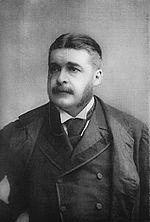
1842 - 1900 Person Name: A. S. Sullivan Composer of "EMMELAR" in In Excelsis for School and Chapel Arthur Seymour Sullivan (b Lambeth, London. England. 1842; d. Westminster, London, 1900) was born of an Italian mother and an Irish father who was an army bandmaster and a professor of music. Sullivan entered the Chapel Royal as a chorister in 1854. He was elected as the first Mendelssohn scholar in 1856, when he began his studies at the Royal Academy of Music in London. He also studied at the Leipzig Conservatory (1858-1861) and in 1866 was appointed professor of composition at the Royal Academy of Music. Early in his career Sullivan composed oratorios and music for some Shakespeare plays. However, he is best known for writing the music for lyrics by William S. Gilbert, which produced popular operettas such as H.M.S. Pinafore (1878), The Pirates of Penzance (1879), The Mikado (1884), and Yeomen of the Guard (1888). These operettas satirized the court and everyday life in Victorian times. Although he composed some anthems, in the area of church music Sullivan is best remembered for his hymn tunes, written between 1867 and 1874 and published in The Hymnary (1872) and Church Hymns (1874), both of which he edited. He contributed hymns to A Hymnal Chiefly from The Book of Praise (1867) and to the Presbyterian collection Psalms and Hymns for Divine Worship (1867). A complete collection of his hymns and arrangements was published posthumously as Hymn Tunes by Arthur Sullivan (1902). Sullivan steadfastly refused to grant permission to those who wished to make hymn tunes from the popular melodies in his operettas.
Bert Polman
Arthur Sullivan
Ludwig van Beethoven
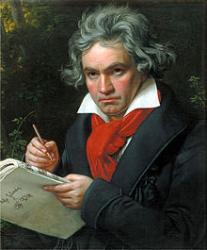
1770 - 1827 Person Name: Beethoven (1770-1827) Composer of "BUTLER" in Worship and Song. (Rev. ed.) A giant in the history of music, Ludwig van Beethoven (b. Bonn, Germany, 1770; d. Vienna, Austria, 1827) progressed from early musical promise to worldwide, lasting fame. By the age of fourteen he was an accomplished viola and organ player, but he became famous primarily because of his compositions, including nine symphonies, eleven overtures, thirty piano sonatas, sixteen string quartets, the Mass in C, and the Missa Solemnis. He wrote no music for congregational use, but various arrangers adapted some of his musical themes as hymn tunes; the most famous of these is ODE TO JOY from the Ninth Symphony. Although it would appear that the great calamity of Beethoven's life was his loss of hearing, which turned to total deafness during the last decade of his life, he composed his greatest works during this period.
Bert Polman
Ludwig van Beethoven
César Malan
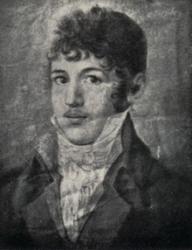
1787 - 1864 Person Name: Abraham H. C. Malan Composer of "HENDON" in Hymns, Psalms and Gospel Songs Rv Henri Abraham Cesar Malan, 1787-1864. Born in Geneva, Switzerland, into a bourgeois family that moved to Switzerland to escape religious persecution during the French Revolution, he attended the university in Marseilles, France, intending to become a businessman. Although having some grounding in religious faith by his mother, he decided to attend the Academy at Geneva (founded by Calvin) in preparation for ministry. He was ordained in 1810, after being appointed a college master (teaching Latin) in 1809. Malan was in accord with the National Church of Geneva as a Unitarian, but the Reveil Movement caused him to become a dissident (evangelical) instead of a proponent of the Reformed Church (believing works, not faith, was what mattered). In 1811 he married (wife’s name not found). They had at least two children (one son was Solomon, referenced below). From 1813 on Malan slowly became an evangelical, after being given an understanding of true salvation through grace (not works) in 1816 by two German Lutherans from Geneva. He became saved upon this realization and was so changed that he burned his prized collection of classical authors and manuscripts. In 1817 he preached around Geneva, and one sermon in particular, “Man only justified by faith alone” created a firestorm and brought him into conflict with religious authorities of the region. From then on he wished to help reform the national church from within, but the forces of the Venerable Company were too strong for him and excluded him from the pulpits and caused his dismissal from his regentsship at the college in 1818. Others in agreement with Malan were Charles Spurgeon, Robert Wilcox, Robert Haldane, and Henry Drummond. In 1820 he built a chapel in his garden and obtained the license of the State for it as a separatist place of worship. He preached in that chapel 43 years. In 1823 he was formally deprived of his status as a minister of the national Church. Various events caused his congregation to diminish over the next few years, and he began long tours of evangelization subsidized by religious friends in his land, Belgium, France, England and Scotland. He often preached to large congregations. Malan also authorized a hymn book, “Chants de Sion” (1841). A strong Calvinist, Malan lost no opportunity to evangelize. On one occasion an old man he visited pulled Malan’s hymnal out and told him he had prayed to see the author of it before he died. On a visit to England Malan also inspired author, Charlotte Elliott, to write the hymn lyrics for “Just as I am”, when seeking an answer to her conversion she asked and he advised her to come to Christ ‘just as she was’. Malan published a score of books and also produced many religious tracts and pamphlets largely on questions in dispute between the National and evangelical churches of Rome. He also wrote articles in the “Record” and in American reviews. His hymns were set to his own melodies. He was an artist, a mechanic, a carpenter, a metal forger, and a printer. He had his own workshop, forge and printing press. One of his greatest joys was the meeting of the evangelical alliance at Geneva in 1861 which helped change church views. He retired to his home, Vandoeuvres, in the countryside near Geneva in 1857, dying there seven years later.. He was honored by a visit from the Queen of Holland two years before his death. He is mainly remembered as a hymn writer, having written 1000+ hymn lyrics and tunes. One son, Solomon, a gifted linguist and theologian, became Vicar of Broadwindsor. About a dozen of his hymns appeared translated in the publication “Friendly visitor” (1826). He was an author, creator, composer, editor, correspondent, contributor, translator, owner, and performer.
John Perry
=================
Malan, Henri Abraham César. The family of Malan traces its origin to the valleys of Piedmont. A branch of it settled at Mérindol, in Dauphiné, but was driven from France by the persecutions that followed the Revocation of the Edict of Nantes. Pierre Malan [Cesar's father], after seeing his sister fall a victim to persecution, left Mérindol (1714), and arrived at Geneva (1722). Henri Abraham César Malan was born at Geneva in 1787. After an education at the College, he went to Marseilles, with the intention of learning business: but, soon after, entered the Academy at Geneva, as a preparation for the ministry, to which he was ordained in 1810. He had been appointed one of the masters at the College in the previous year. The National Church of Geneva was at that time almost Unitarian, and Malan's convictions were in accord with it. But the great movement known as the Réveil, of which the first products were the dissident church of Bourg de Four and at a later date that founded by Malan himself, and which finally imbued the whole Swiss Church with its spirit, was silently preparing itself. The germ of the movement may be traced in the Société des Amis (1810), of which Empeytaz and A. Bost were leaders; and in Malan's independent attainment to the doctrines of the Divinity of the Saviour and the free gifts of salvation through Him (1816). But the human agency, which gave it force, and determined its Calvinistic direction, was the visit of Robert Haldane (in the autumn of 1816), to whom not only these pioneers of the movement, but F. Monod, E. Rieu, Guers, Gonthier, Merle d'Aubigné, and others, always pointed as their spiritual father. Empeytaz and others sought to attain enfranchisement by the establishment of the "petite Eglise of Bourg de Four." Malan wished to reform the national Church from within: and a sermon at Geneva, which brought on him the obloquy of the professors and theologians that composed his audience, and which Haldane characterized as a republication of the Gospel, was his first overt act (Jan. 19, 1817). But the opposing forces were far too strong for him. The Venerable Company excluded him from the pulpits, and achieved his dismissal from his regentship at the College (1818). In 1820 he built a chapel (Chapelle du Temoignage) in his garden, and obtained the licence of the State for it, as a separatist place of worship. In 1823 he was formally deprived of his status as a minister of the national Church. The seven years that succeeded were the palmy days of the little chapel. Strangers, especially from England, mingled with the overflowing Swiss congregation. But (in 1830) a secession to Bourg de Four, and then the foundation of the Oratoire and the Société Evangelique, which in 1849 absorbed the congregation of Bourg de Four under the title of the Église Evangélique, thinned more and more the number of his adherents. His burning zeal for the conversion of souls found a larger outlet in long tours of evangelization, subsidized by religious friends, in his own land and Belgium and France, and also in Scotland and England, where he had friends among many religious bodies, and where he preached to large congregations. The distinguishing characteristic of these tours was his dealing with individuals. On the steamboat or the diligence, in the mountain walk, at the hotel, no opportunity was lost. On one occasion an old,man whom he visited drew from under his pillow a copy of his great hymnbook, Chants de Sion, 1841, and told him how he had prayed to see the author of it before he died.
It is as the originator of the modern hymn movement in the French Reformed Church that Malan's fame cannot perish. The spirit of his hymns is perpetuated in the analysis of Christian experience, the never-wearied delineation of the hopes and fears, the joys and sorrows of the believer's soul, which are still the staple of French Protestant hymns. To this was added, in Malan himself, a marked didactic tone, necessitated by the great struggle of the Réveil for Evangelical doctrine; and an emphatic Calvinism, expressing itself with all the despondency of Newton and Cowper, but, in contrast with them, in bright assurance, peace and gladness. French criticism has pronounced his hymns unequal, and full of literary defects; but their unaffected freshness and fervent sincerity are universally allowed. In the Chants de Sion, hymns 20, ”Hosanna! Béni soit"; 165, “Mon coeur joyeux, plein d'espérance"; 199, "Du Rocher de Jacob"; 200, "Agneau de Dieu"; 239, "Trois fois Jehovah," are in every Protestant French hymnbook; and several others are very widely used.
Besides his hymns Malan produced numberless tracts and pamphlets on the questions in dispute between the National and Evangelical Churches and the Church of Rome, as well as articles in the Record and in American reviews. He was a man of varied acquirements. His hymns were set to his own melodies. He was an artist, a mechanic: his little workshop had its forge, its carpenter's bench, its printing press. To the end of his life his strong Calvinism, and his dread of mere external union in church government, kept him distinct from all movements of church comprehension, though freely joining in communion with all the sections of Evangelical thought in Geneva and Scotland. At one time there seemed a prospect of his even rejoining the national Church, which had driven him from her. One of his greatest joys was the meeting of the Evangelical Alliance at Geneva (1861). He left no sect; one of his latest orders was the demolition of his decayed chapel, in which he had preached for 43 years. He died at Vandoeuvres, near Geneva, in 1864, leaving a numerous family, one of whom, the Rev. S. C. Malan, D.D., sometime Vicar of Broadwindsor, is well known as a linguist and a theologian of the English Church. To English readers Malan is chiefly known as a hymn-writer through translations of his "Non, ce n'est pas mourir" (q.v.): "It is not death to die", &c. About a dozen of his hymns appear in a translated form in the Friendly Visitor for 1826. [Rev. H. Leigh Bennett, M.A.]
-- John Julian, Dictionary of Hymnology (1907)
=================
http://en.wikipedia.org/wiki/César_Malan
César Malan
Charles Edward Pollock
1853 - 1928 Person Name: Chas. Edw. Pollock Composer of "CRISMAN" in The Songs of Zion Charles Edward Pollock USA 1853-1928. Born at Newcastle, PA, he moved to Jefferson City, MO, when age 17. He was a cane maker for C W Allen. He also worked 20 years for the MO Pacific Railroad, as a depot clerk and later as Assistant Roadmaster. He was a musician and prolific songwriter, composing 5000+ songs, mostly used in Sunday school settings and church settings. He took little remuneration for his compositions, preferring they be freely used. He produced three songbooks: “Praises”, “Beauty of praise”, and “Waves of melody”. In 1886 he married Martha (Mattie) Jane Harris, and they had three children: Robert, Edward, and a daughter. He died in Merriam, KS.
John Perry
=================
Pollock, Charles Edward. (Jefferson City, Missouri, 1853-1924). Records of Jefferson City indicate the following:
1897 clerk at depot; residence at 106 Broadway (with Mildred Pollock)
1904-1905 cane maker for C. W. Allen
1908-1909 musician; residence at 106 Broadway (with wife Matty)
1912-1913 residence at St. Louis Road, east city limits
--Wilmer Swope, DNAH Archives
Note: not to be confused with Charles Edward Pollock (c.1871-1924).
Charles Edward Pollock
Howard A. Crosbie
b. 1844 Person Name: H. A. Crosbie Composer of "ALLERTON" in The Sunday School Hymnary As of 1879, Crosbie was Vicar of Milnrow, Lancashire, England.
--www.hymntime.com/tch/
Howard A. Crosbie
H. W. Greatorex
1813 - 1858 Person Name: Henry W. Greatorex Arranger of "SEYMOUR" in Praise for the Lord (Expanded Edition) Henry Wellington Greatorex United Kingdom 1813-1858. Born at Burton upon Trent, England, he received a thorough musical education from his father, Thomas Greatorex, who was for many years organist of Westminster Abbey, and conductor of the London concerts of ancient music. Henry became a composer, author, compiler, editor, and arranger of music. He emigrated to the U.S. In 1839. In 1849 he married artist Eliza Pratt, and they had four children: Elizabeth, Kathleen, Thomas, and Francis Henry. Prior to settling in New York City as a music teacher and organist at Calvary Church, he played at churches in Hartford, CT, including Center Church and St Johns Episcopal Church in West Hartford, CT. He frequently sang in oratorios and concerts. For some years he was also organist and conductor of the choir at St. Paul's Chapel. In 1853 he was an organist at St. Philip's Episcopal Church in Charleston, SC. He did much to advance the standard of sacred music in the U.S. In days when country singing school teachers imposed more rudimentary melodies on hymn books. He published a collection of “Psalm & hymn tunes, chants, anthems & sentences” (Boston 1851). He died of yellow fever in Charleston, SC.
John Perry
H. W. Greatorex
Jane Eliza Leeson
1807 - 1882 Person Name: Jane Elizabeth Leeson Author of "Savior, Teach Me, Day by Day" in Trinity Hymnal (Rev. ed.) Leeson, Jane E.. The earliest work by Miss Leeson with which we are acquainted is her Infant Hymnings. Then followed Hymns and Scenes of Childhood, or A Sponsor's Gift (London, James Burns; Nottingham, Dearden), 1842, in which the Infant Hymnings were incorporated. Concerning Pt. ii. of the Hymns and Scenes, &c, Miss Leeson says, "For the best of the Poems in the second part, the Writer is indebted to a friend." In the Rev. Henry Formby's Catholic Hymns arranged in order for the principal Festivals, Feasts of Saints, and other occasions of Devotion throughout the Year, London, Burns and Lambert, N.D. [1851], "Imprimatur, N. Cardinalis Wiseman, May 3rd, 1853," her translation of Victimae Paschali (“Christ the Lord is risen to-day"), and her "Loving Shepherd of Thy Sheep" (also in Hymns & Scenes, 1842), were given under the signature "M. L." Her Paraphrases and Hymns for Congregational Singing (most of " which were re-written from the Scottish Translations and Paraphrases (q.v.), 1781) were published by Wertheimer & Co., London, in 1853. In the Irvingite Hymns for the Use of the Churches, 1864, there are five of her original hymns and four of her translations from the Latin under the signature of "J. E. L.; "and most of these were repeated in the 2nd edition, 1871. In addition Miss Leeson is the author of several other works, including The Christian Child's Book, 1848, The Child's Book of Ballads, 1849, Songs of Christian Chivalry, 1848, Margaret, a Poem, 1850, The Seven Spiritual Works of Mercy, and others. Her hymns in common use include:—
1. A little child may know. God's love of little Children. In Hymns & Scenes of Childhood, 1842, No. 20, in 5 stanzas of 4 lines.
2. Dear Saviour, to Thy little lambs. For Purity. In Hymns & Scenes of Childhood, 1842, No. 19, in 4 stanzas of 8 lines.
3. Father, I [we] love Thy house of prayer. Public Worship. In Hymns & Scenes of Childhood, 1842, No. 76, in 3 stanzas of 12 lines. It is usually abbreviated.
4. Have ye counted the cost? Soldiers of the Cross . In Songs of Christian Chivalry, 1848, p. 8, in 10 stanzas of 9 lines. Usually abbreviated as in the Enlarged London Hymn Book, 1873.
5. In the dark and silent night. Confidence. In The Christian Child's Book, 1848, in 3 stanzas of 3 lines, with the refrain, "Hallelujah." It is in the Irish Church Hymnal , 1873, and other collections.
6. Jesus Christ, my Lord and King. Child's Praise of Christ. In Hymns & Scenes of Childhood, 1842, No. 18, in 6 stanzas of 4 lines.
7. King of Saints and King of glory. All Saints . In her Paraphrases & Hymns, 1853, p. 84, in 2 stanzas of 8 lines.
8. Saviour, teach me day by day. Obedience. In Hymns & Scenes of Childhood, 1842, No. 49, in 4 stanzas of 8 lines. In several hymn-books in Great Britain and America.
9. Songs of glory fill the sky. Christmas. In the Irvingite Hymns for the Use of the Churches, 1864, No. 21, in 3 stanzas of 8 lines, with the refrain "Hail! Lord Jesu."
10. Stand we prepared to see and hear. Advent. In the Irvingite Hymns for the Use of the Churches, 1864, No. 173, in 4 stanzas of 8 lines. Written in 1800.
11. Sweet the lesson Jesus taught. Christ blessing little Children. In Hymns & Scenes of Childhood, 1842, No. 1, in 5 stanzas of 4 lines.
12. Wake the song, 0 Zion's daughter. A cento of much excellence, which see.
13. Wake, ye saints, the song of triumph. Ascension . Written in 1861, and published in the Irvingite Hymns for the Use of the Churches, 1864, No. 60, in 4 stanzas of 6 lines, with the refrain "Hallelujah." In stanza ii., lines 3, 4, and 6 are from C. Wesley's "Hail the day that sees Him rise."
Miss Leeson's most popular hymn, “Loving Shepherd of Thy Sheep," and her translations from the Latin are noted elsewhere in this work. Of Miss Leeson's personal history we can gather nothing. Born 1807; died 1882.
--John Julian, Dictionary of Hymnology (1907)
Jane Eliza Leeson
Herbert B. Turner
1852 - 1927 Person Name: Rev. Herbert B. Turner (1852- ) Composer of "GIBSON" in Carmina for the Sunday School and Social Worship Turner, Herbert Barclay; b. 1852, Brooklyn, New York, d. 1927, Washington, Connecticut; composer
Herbert B. Turner
George Hews
1806 - 1873 Person Name: Geo. Hews Composer of "HOLLEY" in The Primitive Methodist Church Hymnal Born: January 6, 1806, Weston, Massachusetts.
Died: July 6, 1873, Boston, Massachusetts.
George Hews
S. M. Bixby
1833 - 1912 Composer of "[Saviour, teach me, day by day]" in The Church and Home Hymnal Samuel M. Bixby was born on May 27, 1833 in Haverhill, New Hampshire. His company, S. M. Bixby & Company, manufactured shoe blackings and shoe dressings, but music was his passion. He was also a Sunday school superintendent and choir leader. He died on March 11, 1912 in Fordham, New York. His works include:
Church and Home Hymnal, circa 1893
Evangel Songs, circa 1894
Gloria Deo: A Collection of Hymns and Tunes for Public Worship in All Departments of the Church (New York: Funk & Wagnalls Company, 1901)
NN, Hymnary. Source: http://www.hymntime.com/tch/bio/b/i/x/bixby_sm.htm
S. M. Bixby
Pages