You help make Hymnary.org possible. More than 10 million people from 200+ countries found hymns, liturgical resources and encouragement on Hymnary.org in 2025, including you. Every visit affirms the global impact of this ministry.

If Hymnary has been meaningful to you this year, would you take a moment today to help sustain it? A gift of any size—paired with a note of encouragement if you wish—directly supports the server costs, research work and curation that keep this resource freely available to the world.

Give securely online today, or mail a check to:
Hymnary.org
Calvin University
3201 Burton Street SE
Grand Rapids, MI 49546

Thank you for your partnership, and may the hope of Advent fill your heart.

Person Results

Text Identifier:"^o_god_of_love_o_king_of_peace$"
In:people

Planning worship? Check out our sister site, ZeteoSearch.org, for 20+ additional resources related to your search.
Showing 11 - 20 of 34Results Per Page: 102050

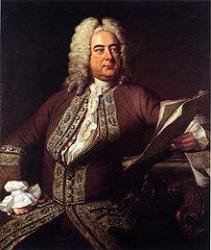
George Frideric Handel

1685 - 1759 Person Name: George Frederick Handel (1685-1759) Composer of "CANNONS" in The Hymnal George Frideric Handel (b. Halle, Germany, 1685; d. London, England, 1759) became a musician and composer despite objections from his father, who wanted him to become a lawyer. Handel studied music with Zachau, organist at the Halle Cathedral, and became an accomplished violinist and keyboard performer. He traveled and studied in Italy for some time and then settled permanently in England in 1713. Although he wrote a large number of instrumental works, he is known mainly for his Italian operas, oratorios (including Messiah, 1741), various anthems for church and royal festivities, and organ concertos, which he interpolated into his oratorio performances. He composed only three hymn tunes, one of which (GOPSAL) still appears in some modern hymnals. A number of hymnal editors, including Lowell Mason, took themes from some of Handel's oratorios and turned them into hymn tunes; ANTIOCH is one example, long associated with “Joy to the World.” Bert Polman

Henry Percy Smith

1825 - 1898 Person Name: H. Percy Smith, 1825-1898 Composer of "MARYTON" in Discipleship Ministries Collection Henry Percy Smith (b. Malta, 1825; d. Bournemouth, Hampshire, England, 1898) was educated at Balliol College, Oxford, England, and ordained a priest in the Church of England in 1850. He served five churches, including St. Michael's York Town in Farnborough (1851-1868), Great Barton in Suffolk (1868-1882), Christ Church in Cannes, France (1882-1892), and the Cathedral in Gibraltar (1892-1898). MARYTON is his only tune found in contemporary hymnals and is thought to be the only tune he published. Bert Polman

Samuel Sebastian Wesley

1810 - 1876 Person Name: Samuel Sebastian Wesley, 1810-1876 Harmonizer of "ELTHAM" in The Hymnal 1982 Samuel Sebastian Wesley (b. London, England, 1810; d. Gloucester, England, 1876) was an English organist and composer. The grandson of Charles Wesley, he was born in London, and sang in the choir of the Chapel Royal as a boy. He learned composition and organ from his father, Samuel, completed a doctorate in music at Oxford, and composed for piano, organ, and choir. He was organist at Hereford Cathedral (1832-1835), Exeter Cathedral (1835-1842), Leeds Parish Church (1842­-1849), Winchester Cathedral (1849-1865), and Gloucester Cathedral (1865-1876). Wesley strove to improve the standards of church music and the status of church musicians; his observations and plans for reform were published as A Few Words on Cathedral Music and the Music System of the Church (1849). He was the musical editor of Charles Kemble's A Selection of Psalms and Hymns (1864) and of the Wellburn Appendix of Original Hymns and Tunes (1875) but is best known as the compiler of The European Psalmist (1872), in which some 130 of the 733 hymn tunes were written by him. Bert Polman

Henry Baker

1835 - 1910 Composer of "QUEBEC" in Trinity Hymnal (Rev. ed.) Henry Baker, Mus. Bac., son of the Rev. James Baker, Chancellor of the diocese of Durham; born at Nuneham, Oxfordshire; educated at Winchester School; graduated Bachelor in Music at the University of Oxford in 1867. He also worked as a civil engineer. Scottish Church Music, its composers and sources by James Love; William Blackwwod and Sons, Edinburgh and London, 1891

Sydney H. Nicholson

1875 - 1947 Person Name: Sydney Nicholson, 1875 - 1947 Composer of "BOW BRICKHILL" in The Book of Praise Sydney H. Nicholson, (b. St. Marylebone, London, England, 1875; d. Ashford, Kent, England, 1947) was an organist and church music educator who greatly influenced English hymnody. Educated at Oxford's New College, the Royal College of Music in London, and in Frankfurt, Germany, he became organist at several famous cathedrals, including Westminster Abbey (1919-1928). Nicholson founded and administered the School of English Church Music at Chislehurst in 1927; this important institution, with branches throughout the English-speaking world, was renamed the Royal School of Church Music in 1945. Located in Canterbury after World War II, its headquarters were moved to Addington Palace, Croydon, in 1954. Nicholson was music adviser for the 1916 Supplement of Hymns Ancient and Modern and prepared the way for its 1950 edition. He wrote Church Music: a Practical Handbook (1920) and Quires and Places Where They Sing (1932) and composed operettas, anthems, and hymn tunes. In 1938 he was knighted for his contributions to church music. Bert Polman

Samuel W. Beazley

1873 - 1944 Person Name: Samuel W. Beazley, 1873- Composer of "FOSTER" in The Baptist Standard Hymnal Samuel W. Beazley was born in Sparta, Virginia in 1873. He was a music scholar and taught music at Shenandoah College for five years. He composed over 4,000 gospel songs during his lifetime. Samuel W. Beazley maintained a successful publishing business in Chicago, Illinois. He died in Chicago on September 16, 1944. He was inducted into the Gospel Music Hall of Fame in 1992. NN, Hymnary editor. Source: Gospel Music Hall of Fame

Henry K. Oliver

1800 - 1885 Person Name: Henry K. Oliver, 1800-1885 Composer of "FEDERAL STREET" in Christian Worship Henry Kemble Oliver (b. Beverly, MA, 1800; d. Salem, MA, 1885) was educated at Harvard and Dartmouth. He taught in the public schools of Salem (1818-1842) and was superintendent of the Atlantic Cotton Mills in Lawrence, Massachusetts (1848-1858). His civic service included being mayor of Lawrence (1859­1861) and Salem (1877-1880), state treasurer (1861-1865), and organizer of the Massachusetts Bureau of Statistics and Labor (1867-1873). Oliver was organist at several churches, including Park Street Congregational Church in Boston, North Church in Salem, and the Unitarian Church in Lawrence. A founder of the Mozart Association and several choral societies in Salem, he published his hymn tunes in Hymn and Psalm Tunes (1860) and Original Hymn Tunes (1875). Bert Polman

Anonymous

Person Name: Anon. Author of "O God of love, O King of peace" in The Spirit of Praise In some hymnals, the editors noted that a hymn's author is unknown to them, and so this artificial "person" entry is used to reflect that fact. Obviously, the hymns attributed to "Author Unknown" "Unknown" or "Anonymous" could have been written by many people over a span of many centuries.

George Kingsley

1811 - 1884 Composer of "WARE" in Evangelical Hymnal Born: July 7, 1811, Northampton, Massachusetts. Died: March 14, 1884, Northampton, Massachusetts. Kingsley played the organ at the Old South Church and Hollis Street Church in Boston, Massachusetts. He also taught music at Girard College in Philadelphia, Pennsylvania, served as music supervisor for public schools in Philadelphia, and compiled a number of music books, including: Sunday School Singing Book, 1832 The Harmonist, 1833 The Social Choir, 1836 The Sacred Choir, 1838 The Harp of David, 1844 The Young Ladies’ Harp, 1847 Templi Carmina (Northampton, Massachusetts: 1853) The Juvenile Choir, 1865 --www.hymntime.com/tch

William Knapp

1698 - 1768 Person Name: W. Knapp Composer of "WAREHAM" in The Book of Praise for Sunday Schools Born: 1698, Ware­ham, Dor­set­shire, Eng­land. Died: Sep­tem­ber 26, 1768, Poole, Dor­set­shire, Eng­land. Buried: Poole, Dor­set­shire, Eng­land.

Pages


Export as CSV
It looks like you are using an ad-blocker. Ad revenue helps keep us running. Please consider white-listing Hymnary.org or getting Hymnary Pro to eliminate ads entirely and help support Hymnary.org.