

 My Starred Hymns
 My FlexScores
 My Hymnals
 My Purchased Files
Planning worship?
Check out our sister site, ZeteoSearch.org,
for 20+ additional resources related to your search.
- |
User Links
Person Results
Nāşīf Yāzijī
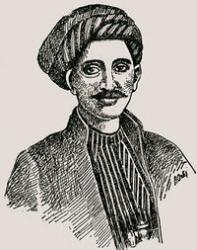
1800 - 1871 Person Name: ناصيف اليازجي Author of "مثل عظيم رحمتك" in كتاب الترانيم الروحية للكنائس الإنجيلية Nasif al-Yaziji (March 25, 1800 – February 8, 1871) was a Lebanese author at the times of the Ottoman Empire and father of Ibrahim al-Yaziji. He was one of the leading figures in the Nahda movement. We was a poet, wrote and translated many hymns, and helped in translating the complete Bible into Arabic.
ناصيف بن عبد الله بن جنبلاط بن سعد اليازجي (25 مارس 1800 - 8 فبراير 1871)، أديب وشاعر لبناني ولد في قرية كفر شيما، من قرى الساحل اللبناني في 25 آذار سنة 1800 م في أسرة اليازجي التي نبغ كثير من أفرادها في الفكر والأدب، وأصله من حمص.
لعب دورا كبيرا في إعادة استخدام اللغة الفصحى بين العرب في القرن التاسع عشر، عمل لدى الأسرة الشهابية كاتبا وشارك في أول ترجمة الإنجيل والعهد القديم إلى العربية في العصر الحديث.
Nāşīf Yāzijī
Lucy Larcom
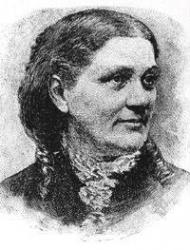
1824 - 1893 Author of "A Thanksgiving" in The Cyber Hymnal Larcom, Lucy, was born at Beverley Farm, Massachusetts, in 1826. Her Poems were published in 1864. Her hymn, "When for me the silent oar" [Death Anticipated), was published in 1868. She died in 1893.
--John Julian, Dictionary of Hymnology, Appendix, Part II (1907)
===============
Larcom, Lucy, p. 1576, ii. The extended use of this writer's hymns justifies a more detailed account of her life and work than is given on p. 1576. She was born in 1824, and worked from 1837-45 in the mills of Lawrence, Mass., then engaged in elementary teaching 1846-49, became a student at Monticello Female Seminary, Alton, Ill., 1849-52, and then entered upon advanced teaching in higher-class schools, and literary work. She edited with J. G. Whittier, Child Life in Poetry, 1871; Child Life in Prose, 1873; Songs of Three Centuries, 1875, &c. Her own works are Poems, 1869; Childhood Songs, 1875; Wild Roses of Cape Ann, 1881; Poetical Works, 1885; At the Beautiful Gate; And Other Songs of Faith, 1892. Her autobiography was published as A New England Girlhood. She died in 1893. In addition to "When for me the silent oar," of her hymns the following are in common use:—
i. From her Poems, 1869.
1. Hand in hand with angels. Angelic companion¬ship.
2. If the world seems cold to you.
3. When for me the silent oar. Death
ii. From her Wild Roses of Cape Ann, 1881.
4. In Christ I feel the heart of God.
5. O Spirit, "Whose name is the Saviour.”
in. From her Poetical Works, 1885.
6. Breaks the joyful Easter dawn, master.
7. Heavenly Helper, Friend Divine. Christ the Friend.
iv. From her At the Beautiful Gate, &c, 1892.
8. Draw Thou, my soul, O Christ. Looking to Jesus.
9. O God, Thy world is sweet with prayer. Prayer.
10. Open your hearts as a flower to the light.
11. King, happy bells of Easter time. Easter.
The above notes are from the British Museum copies of Miss Larcom's works.
--John Julian, Dictionary of Hymnology, New Supplement (1907)
Lucy Larcom
Charles Edward Pollock
1853 - 1928 Person Name: Chas. Edw. Pollock Author (chorus) of "Wonderful Fountain" in Crowning Praises Charles Edward Pollock USA 1853-1928. Born at Newcastle, PA, he moved to Jefferson City, MO, when age 17. He was a cane maker for C W Allen. He also worked 20 years for the MO Pacific Railroad, as a depot clerk and later as Assistant Roadmaster. He was a musician and prolific songwriter, composing 5000+ songs, mostly used in Sunday school settings and church settings. He took little remuneration for his compositions, preferring they be freely used. He produced three songbooks: “Praises”, “Beauty of praise”, and “Waves of melody”. In 1886 he married Martha (Mattie) Jane Harris, and they had three children: Robert, Edward, and a daughter. He died in Merriam, KS.
John Perry
=================
Pollock, Charles Edward. (Jefferson City, Missouri, 1853-1924). Records of Jefferson City indicate the following:
1897 clerk at depot; residence at 106 Broadway (with Mildred Pollock)
1904-1905 cane maker for C. W. Allen
1908-1909 musician; residence at 106 Broadway (with wife Matty)
1912-1913 residence at St. Louis Road, east city limits
--Wilmer Swope, DNAH Archives
Note: not to be confused with Charles Edward Pollock (c.1871-1924).
Charles Edward Pollock
August Johann Berens
1843 - 1908 Person Name: A. Berens Author of "O Gotteslamm, dein teures Blut" in Liederkranz für Sonntags-Schulen und Jugend-Vereine Berens, August. (Hamburg, Germany, October 30, 1843--January 12, 1908, Niles Center, Illinois). He attended the Missionhaus at Barmen, Germany, ca. 1859-1862, and then did post-graduate study at Tübingen, ca. 1862-1863. Coming to the United States, he was a missionary pastor for the Evangelical Synod of North America on the western frontier, especially in Wisconsin and Minnesota. He was pastor in Washington, Missouri, 1878-1887, and of St. Peter's Church, Elmhurst, Illinois, 1887-1906. He was the author of Frülingsboten: Gedichte (St. Charles, Illinois, 1889) and Frisch und fromm: Ein Kinderbüchlein mit Gedichten, Liedern, und Sprüchen (St. Louis, n.d.). He became a U.S. citizen in June, 1892.
Berens married a school teacher, Clara Rieger, in 1878, and had three children. She was the author of Frau Nicholas Magd: eine Erzählung (St. Louis, 1894), and Aus vergangen Tagen (St. Louis, 1906).
--Paul Westermeyer, DNAH Archives
August Johann Berens
George Cutting
Person Name: Geo. Cutting Author of "O Gracious Savior" in Choice Hymns of the Faith
George Cutting
Gustav Friedrich Ludwig Knak
1806 - 1878 Person Name: Gustav Knack Author of "O, daß mein Herz ein Altar wär'" in Die Glaubensharfe (With Melodies) Knak, Gustav Friedrich Ludwig, son of Christian F. L. Knak, Justiz Commissarius at Berlin, was born at Berlin, July 12, 1806. He matriculated as a student of theology at the University of Berlin, Easter, 1826. In the autumn of 1829 he became tutor in a private school at Königs-Wusterhausen, near Berlin, where he worked manfully for the sick and dying during the cholera year 1831. He returned to Berlin in August, 1832, and acted as one of the editors of the well-known Geistlicher Lieder Schatz (referred to in this Dictionary as the Berlin Geistlicher Lieder Schatz), to which he contributed a number of hymns, and for which he wrote the preface dated Dec. 11, 1832. In the autumn of 1834 he was ordained pastor of Wusterwitz, near Dramburg, in Pomerania; and in the end of 1849 was appointed Gossner's successor as Pastor of the Lutheran-Bohemian congregation (Bethlehemskirche) in Berlin. During a holiday visit to a married daughter at Dünnow, near Stolpemünde, he was taken suddenly ill, and died there July 27, 1878; his body being removed to Berlin and laid to rest in the graveyard belonging to his church (O. Kraus, 1879, p. 266; Allgemeine Deutsche Biographie, xvi. 261, &c).
Knak was a man of prayer, a faithful and successful preacher and pastor, and greatly interested in Missions at home and abroad, especially in the Lutheran missions to China and the Chinese Orphanage at Hong Kong. As a hymn-writer he is distinguished by elegance of style, harmony of rhythm, and deep love to the personal Christ. His hymns appeared in his Simon Johanna, hast du mich lieb? Berlin, 1829 (enlarged editions pub. at Berlin 1840, and again in 1843 as his Zionsharfe); in the Berlin Geistlicher Lieder Schatz, ed. 1832; and in his Liebe urn, Liebe . . . Nachtrag zu dessen Zionsharfe. Werder, 2nd ed. 1849 (3rd ed. Berlin, 1850).
Those of Knak's hymns which have passed into English are:—
i. Lasst mich geh'n, lasst mich geh'n. Longing for Heaven. Of the origin of this favourite hymn, 0. Kraus, 1879, p. 269, gives the following account:—
"Knak's earnest zeal in the cause of missions to the heathen had the natural result, that for many years he was summoned as festival preacher to the most distant Mission services. On the way to fulfil these engage¬ments many of Knak's hymns had their origin. About 1845, one day the pastor of Wusterwitz [his cure] came to pastor Sondermann at Coprieben, and asked him to play the well-known popular melody 'Morgenroth, orgenroth,' as he had just composed a hymn to that tune. As the desired melody rang out, the poet struck up for the first time that hymn since sung by hundreds of thousands, *Lasst mich geh'n! Lasst mich geh'n.” Later, Knak's blind organist, Voigtlander, in Berlin, composed the pleasing melody, to which at the present time the hymn is generally sung."
This hymn appears to have been written on July 23, 1846, and is included in his Liebe um Liebe, 1849 (3rd ed., 1850, No. 48), in 5 stanzas of 5 lines, entitled "Longing after Jerusalem." It soon attained wide popularity, and is given as No. 1597 in the Berlin Geistlicher Lieder Schatz, ed. 1863. Translated as:—
1. To the sky, to the sky. A good and full translation by J. M. Sloan, contributed to J. H. Wilson's Service of Praise, 1865, No. 165, and Songs of Zion, 1878, No. 94; in both cases set to Voigtländer's melody.
2. Let me go, let me go, Jesus, face to face, to know. In full, by Mrs. Edmund Ashley, in the British Herald, Sept., 1867, p. 139; repeated in Reid's Praise Book, 1872. In the Christian Hymns, Adelaide, 1872, No. 347 begins with st. ii. "Glorious light, glorious light."
Other translations are, (1) "Let me close, let me close," as No. 12 in Heart Melodies , Lond., Morgan, N.D., signed “A. P. E. J." (2) "Let me flee, let me flee," by E. Massie, 1866. (3) "Let me go, let me go, Lord to me," by Mrs. H. R. Spaeth, in the Southern Lutheran Service & Hymns for Sunday Schools , Philadelphia, 1883. (4) "Let me go! ah, let me go," by J. Kelly, 1885.
Other hymns by Knak which have been translated into English are:—
ii. Herr, du hast uns reich gesegnet. Close of Divine Service. Zionsharfe, 1843, No. 92, in 2 st. Tr. as "Lord, we've tasted Thy rich blessing," in L. Rehfuess's Church at Sea, 1868.
iii. Ich bin ein Pilger Gottes hier auf Erden. Pilgrimage of Life. Liebe um Liebe, 3rd ed. 1850, No. 45, in 4 stanzas. Translated as "God's pilgrim am I here, on earth below," by J. Kelly, 1885.
iv. Jesus sei mit dir auf alien Wegen. Birthday wish. Liebe um Liebe, 3rd ed. 1850, No. 36, in 22 lines. Tr. as (1) "Jesus be with thee in thy ways, Jesus favour," in L. Rehfuess's Church at Sea, 1868. (2) “Jesu be with thee in all thy ways, Jesu crown," by J. Kelly, 1885.
v. Mit der Sehnsucht heissen Blicken. Love to Christ. Zionsharfe, 1840, p. 4, in 6 stanzas. Translated as "With the glow of ardent longing," by Miss Burlingham, in the British Herald, Sept. 1865, p. 141.
vi. Sei getrost, o Seele. Cross and Consolation. Zionsharfe, 1840, p. 2, in 3 stanzas. Translated as "O my soul, be comforted, Give not," by J. Kelly, 1885.
vii. Wenn Seelen sich zusammenflnden. Communion of Saints. Berlin Geistlicher Lieder Schatz, ed. 1832, No. 1857, in 5 stanzas. Tr. as "When they may chance to meet together," by Dr. H. Mills, 1845 (1856, p. 186).
viii. Zieht im Frieden eure Pfade. Farewell. Zionsharfe, 1843, No. 86, in 11 lines. Tr. as "Now in peace go on your ways," in L. Rehfuess's Church at Sea, 1868. [Rev. James Mearns, M.A.]
--John Julian, Dictionary of Hymnology (1907)
Gustav Friedrich Ludwig Knak
Philipp Bickel
1829 - 1914 Person Name: P. W. Bickel Translator of "Der Born des Heils" in Evangeliums-Lieder 1 und 2 (Gospel Hymns)
Philipp Bickel
Anonymous
Person Name: Unknown Composer of "CLEANSING FOUNTAIN" in Hymns of the Christian Life In some hymnals, the editors noted that a hymn's author is unknown to them, and so this artificial "person" entry is used to reflect that fact. Obviously, the hymns attributed to "Author Unknown" "Unknown" or "Anonymous" could have been written by many people over a span of many centuries.
Anonymous
Ivan S. Prokhanov
Person Name: Ivan Stepanovich Prokhanov, 1869-1924 Author of "Спасенье вечное Христос" in The Cyber Hymnal
Ivan S. Prokhanov
Roswell F. Cottrell
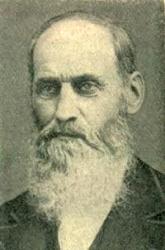
1814 - 1892 Person Name: R. F. Cottrell Author of "Behold God's own exalted Son" in The Seventh-Day Adventist Hymn and Tune Book Born: January 17, 1814, Brookfield, New York.
Died: March 22, 1892, Mill Grove, New York.
Buried: West Ridgeway Cemetery, Medina, New York.
Cottrell was known as a writer, poet and minister. A member of the Seventh-day Adventists, he served for a time on the editorial committee of The Review and Herald in Battle Creek, Michigan. As of 1857, he was living in Mill Grove, New York.
--www.hymntime.com/tch
Roswell F. Cottrell
Pages