You help make Hymnary.org possible. More than 10 million people from 200+ countries found hymns, liturgical resources and encouragement on Hymnary.org in 2025, including you. Every visit affirms the global impact of this ministry.

If Hymnary has been meaningful to you this year, would you take a moment today to help sustain it? A gift of any size—paired with a note of encouragement if you wish—directly supports the server costs, research work and curation that keep this resource freely available to the world.

Give securely online today, or mail a check to:
Hymnary.org
Calvin University
3201 Burton Street SE
Grand Rapids, MI 49546

Thank you for your partnership, and may the hope of Advent fill your heart.

Person Results

Topics:accepted time
In:person

Planning worship? Check out our sister site, ZeteoSearch.org, for 20+ additional resources related to your search.
Showing 21 - 30 of 47Results Per Page: 102050

John Zundel

1815 - 1882 Topics: Salvation Accepted Time of Composer of "LOVE DIVINE" in The Psalter John Zundel; b. 1815, near Stuttgart, Germany; organist in Brooklyn, N. Y., from 1847 to 1878; d. Cannstadt, Germany, 1882 Evangelical Lutheran Hymnal, 1908

Samuel Francis Smith

1808 - 1895 Person Name: Samuel F. Smith Topics: Accepted Time Author of "To-day the Saviour calls: Ye wand'rers, come" in The Hymnal Smith, Samuel Francis, D.D., was born in Boston, U.S.A., Oct. 21, 1808, and graduated in arts at Harvard, and in theology at Andover. He entered the Baptist ministry in 1832, and became the same year editor of the Baptist Missionary Magazine. He also contributed to the Encyclopaedia Americana. From 1834 to 1842 he was pastor at Waterville, Maine, and Professor of Modern Languages in Waterville College. In 1842 he removed to Newton, Massachusetts, where he remained until 1854, when he became the editor of the publications of the Baptist Missionary Union. With Baron Stow he prepared the Baptist collection known as The Psalmist, published in 1843, to which he contributed several hymns. The Psalmist is the most creditable and influential of the American Baptist collections to the present day. Dr. Smith also published Lyric Gems, 1854, Rock of Ages, 1870, &c. A large number of his hymns are in use in America, and several have passed into some of the English collections. Taking his hymns in common use in alphabetical order, we have the following:— 1. And now the solemn deed is done. Ordination. Given in The Psalmist, 1843, No. 954. In Dr. Hatfield's Church Hymn Book, N. Y., 1872, it is altered to "The solemn service now is done." 2. As flows the rapid river. Life Passing Away. In Christian Psalmody, 1833, No. 33; the Hymns for the Vestry and Fireside, Boston, 1841; and The Psalmist, 1843, No. 1059. Found in a few English hymn-books, and in Lyra Sacra Americana, 1868. 3. Auspicious morning, hail. American National Anniversary. Written for July 4th, 1841, and published in The Psalmist, 1843, No. 1007. 4. Beyond where Cedron's waters flow. Gethsemane. In L. Bacon's Appendix, 1833; the Psalmist, 1843, No. 220, and later collections. 5. Blest is the hour when cares depart. Divine Worship. In The Psalmist, 1843, No. 947, and others. 6. Constrained by love we follow where. Holy Baptism. Appeared in the Baptist edition of the Plymouth Hymn Book, 1857. 7. Down to the sacred wave. Holy Baptism. Contributed to Winchell's Additional Hymns added to his Collection of 1817, in 1832, No. 510; repeated in The Psalmist, 1843, No. 818, and in several collections. Also in Lyra Sacra Americana, 1868. 8. Hail! ye days of solemn meeting. Public Worship. An altered form of No. 26 below, in Spurgeon's Our Own Hymn Book, 1866, as an "American Hymn, 1840." 9. How blest the hour when first we gave. Holy Baptism. Appeared in the Baptist edition of thePlymouth Hymn Book, 1857, No. 1468. 10. How calmly wakes the hallowed morn. Holy Baptism. Given in The Psalmist, 1843, No. 810, in later collections, and in Lyra Sacra Americana, 1868. 11. Jesus, Thou hast freely saved us. Salvation. In Winchell's Additional Hymns, 1832, No. 503, and others. 12. Meekly in Jordan's Holy Stream. Holy Baptism. Contributed to The Psalmist, 1843, No. 808. 13. My country, 'tis of thee. National Hymn. "Written in 1832, and first sung at a children's Fourth of July celebration in Park Street church, Boston." Included in The Psalmist, 1843, No. 1000, and found in a large number of American hymn-books, but not in use in Great Britain. It is one of the most popular of Dr. Smith's compositions. Text, with note in Lyra Sacra Americana, 1868. 14. 0 not my own these verdant hills. Bought with a Price. Appeared in Nason's Congregational Hymn Book, 1857, and given inLaudes Domini, 1884. 15. Onward speed thy conquering flight. Missions. Appeared in The Psalmist, 1843, No. 892, and is found in several modern collections in Great Britain and America. Also in Lyra Sac. Americana, 1868. 16. Planted in Christ, the living Vine. Christian Fellowship; or, For Unity. Given in The Psalmist, 1843, No. 929, inLyra Sacra Americana, 1868, and several hymn-books. Of the hymns contributed by Dr. Smith to The Psalmist this is the best, and one of the most popular. 17. Remember thy Creator. Youthful Piety Enforced. In Christian Psalmody, 1832, No. 32; the Hymns for the Vestry and Fireside, 1841; The Psalmist, 1843, No. 778; Lyra Sac. Americana, 1868, and other collections. 18. Sister, thou wast mild and lovely. Death and Burial. Written on the death of Miss J. M. C. of Mount Vernon School, Boston, July 13,1833, and published in The Psalmist, 1843, No. 1096. 19. Softly fades the twilight ray. Sunday Evening. Written in 1832, and included in The Psalmist, 1843, No. 56. Also in Lyra Sacra Americana, and several hymn-books. 20. Spirit of holiness, descend. Whitsuntide. Appeared in the Hymns for the Vestry and Fireside, 1841, No. 295, and again in The Psalmist, 1843, No. 384. In the Unitarian Hymns for the Church of Christ, Boston, 1853. St. ii., iii., iv. were given as "Spirit of God, Thy churches wait." This form of the text and the original are both in modern hymn-books. 21. Spirit of peace and holiness. Institution of a Minister. Appeared in The Psalmist, 1843, No. 953, and Hatfield's Church Hymn Book, 1872. 22. The morning light is breaking. Missions. Written in 1832, and included in Hastings's Spiritual Songs, 1832-33, No. 253; and The Psalmist, 1843, No. 912. This hymn is very popular and has been translated into several languages. Dr. Smith says of it that “it has been a great favourite at missionary gatherings, and I have myself heard it sung in five or six different languages in Europe and Asia. It is a favourite with the Burmans, Karens, and Telegus in Asia, from whose lips I have heard it repeatedly.” 23. The Prince of Salvation in triumph is riding. Missions. Given in Hastings and Mason's Spiritual Songs, 1832-33, No. 274; The Psalmist, 1843, and later collections. 24. Tis done, the [important] solemn act is done. Ordination. Appeared in The Psalmist 1843, No. 951, and later hymn-books. 25. Today the Saviour calls. Invitation. First sketch by Dr. Smith, the revised text, as in Hastings and Mason's Spiritual Songs, No. 176, and The Psalmist, No. 453, by Dr. T. Hastings (p. 495, i. 19). 26. Welcome, days of solemn meeting. Special Devotional Services. Written in 1834, and given in Dr. Hatfield's Church Hymn Book, 1872. See No. 8. 27. When shall we meet again ? Parting. This is a cento. The first stanza is from Alaric A. Watts's Poetical Sketches, &c, 1822, p. 158 ; and st. ii.-iv. are by Dr. Smith. In this form it was published in L. Bacon's Supplement to Dwight, 1833, No. 489. It is in several American hymn-books; and also the English Baptist Psalms & Hymns, 1858, &c. 28. When the harvest is past and the summer is gone. Close of Worship. Contributed to Hastings and Mason's Spiritual Songs, 1831, No. 244; and repeated in the Fuller and Jeter Supplement to The Psalmist, 1847, No. 22, and later collections. 29. When thy mortal life is fled. The Judgment. Contributed to Winchell's Additional Hymns, 1832, No. 379, and repeated in The Psalmist, 1843, No. 455, and later hymn-books. Also in Lyra Sacra Americana, 1868. 30. While in this sacred rite of Thine. Holy Baptism. Appeared in The Psalmist, 1843, No. 803: Lyra Sacra Americana, 1868, &c. 31. With willing hearts we tread. Holy Baptism. In The Psalmist, 1843, No. 798; and again in the Baptist Praise Book, 1871. 32. Yes, my native land, I love thee. A Missionary's Farewell. Contributed to Winchell's Additional Hymns, 1832, No. 445, and found in later collections. Also in Lyra Sacra Americana, 1868. [Rev. F. M. Bird, M.A.] --John Julian, Dictionary of Hymnology (1907)

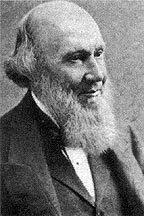
E. J. Hopkins

1818 - 1901 Person Name: Edward J. Hopkins Topics: Accepted Time Composer of "VAUGHAN" in Book of Worship with Hymns and Tunes Dr Edward John Hopkins MusDoc United Kingdom 1818-1901. Born at Westminster, England, the son of a clarinetist with the Royal Opera House orchestra, he became an organist (as did two of his brothers) and a composer. In 1826 he became a chorister of the Chapel Royal and sang at the coronation of King William IV in Westminster Abbey. He also sang in the choir of St. Paul’s Cathedral, a double schedule requiring skill and dexterity. On Sunday evenings he would play the outgoing voluntary at St. Martin’s in-the-field. He left Chapel Royal in 1834 and started studying organ construction at two organ factories. He took an appointment at Mitcham Church as organist at age 16, winning an audition against other organists. Four years later he became organist at the Church of St. Peter, Islington. In 1841 he became organist at St. Luke’s, Berwick St., Soho. Two Years later he was organist at Temple Church, which had a historic organ (built in 1683). He held this position for 55 years. In 1845 he married Sarah Lovett, and they had four sons and five daughters. He was closely associated with the Bach Society and was organist for the first English performances of Bach’s St. Matthew Passion. In 1855 he collaborated with Edward Rimbault publishing “The organ, its history and construction” (3 editions 1855-70-77). In 1864 he was one of the founders of the “College of organists”. In 1882 he received an honorary Doctorate of Music from the Archbishop of Canterbury. He composed 30+ hymn tunes and some psalm chants, used by the Church of England. He died in London, England. John Perry

Frederick C. Maker

1844 - 1927 Person Name: Frederick Charles Maker (1844-1927) Topics: Warning Message The Accepted Time Composer of "INVITATION (MAKER)" in The Christian Hymnary Frederick C. Maker (b. Bristol, England, August 6, 1844; d. January 1, 1927) received his early musical training as a chorister at Bristol Cathedral, England. He pursued a career as organist and choirmaster—most of it spent in Methodist and Congregational churches in Bristol. His longest tenure was at Redland Park Congregational Church, where he was organist from 1882-1910. Maker also conducted the Bristol Free Church Choir Association and was a long-time visiting professor of music at Clifton College. He wrote hymn tunes, anthems, and a cantata, Moses in the Bulrushes. Bert Polman

Jeremiah Ingalls

1764 - 1838 Person Name: Jeremiah Ingals (1764-1828) Topics: Warning Message The Accepted Time Composer of "PARTING HAND" in The Christian Hymnary Jeremiah Ingalls USA 1764-1838. Born at Andover, MA, his father died of hardships from the American Revolutionary War when he was thirteen. In VT, he worked as a farmer, Cooper, Taverner, and choirmaster. He mastered the bass viol (similar to a cello) and became a composer. He moved to Newbury, VT, in 1787, and in 1791 he married Mary (Polly) Bigelow of Westminster, MA, and they had eleven children (nine living to adulthood): Smith, Jeremiah, Joshua, Jeremiah, Mary, Moses, Elizabeth, John, Almyra, Isaac, and Hannah. He taught singing and began leading the singing at the First Congregational Church there. The choir became well-known, and people came from miles around to hear them sing. In 1800 he built and operated a tavern. He also worked as a cooper. In 1803 he became a deacon, and in 1805 he published a song book, “Christian Harmony”, that contained folk and popular songs with tunes used in spiritual songs sung in early religious revivals and campmeetings, some becoming hymns in later song books. It was said that at times he would be so immersed in his music that his livelihood suffered as a result. He was removed and excommunicated from his church in 1810, having a falling out with the church due to marriage infidelity that he refused to repent of. He ran his tavern for a number of years, but finally sold it and moved to Rochester, VT, in 1819, where he became the first choirmaster of the Church of Christ. His tenure there was successful, and he was a signer of the document establishing construction of the first church building in Rochester (1812). Later, his son, John, succeeded him as choirmaster there. the family’s last move was to a farm near Hancock, VT. He was described as short, portly, good-humored, and absentminded, and having a high voice, but singing bass well. His family was musical, some noted for their musical abilities. A singing society in VT was named for him and promoted singing events. Some of his music became well-known around the world. He died at Hancock, VT. Note: It is said that he wrote a letter to the First Congregational Church in Westminster 18 years after departing repenting of his infidelity (allegedly after his illegitimate son, Thomas, was of age, but the letter was lost in church records, although the church said they had received it. John Perry

John Dobell

1757 - 1840 Person Name: John Dobell (1757-1840) Topics: Accepted Time Author of "Now is the accepted Time" in Songs of Praise with Tunes Dobell, John, b. 1757, d. May, 1840, was a port-gauger under the Board of Excise, at Poole, Dorset, and a person of some local note. In 1806 he published:— A New Selection of Seven Hundred Evangelical Hymns for Private, Family, and Public Worship (Many Original) from more than two hundred of the best Authors in England, Scotland, Ireland, and America, Arranged in alphabetical order; Intended as a Supplement to Dr. Watts's Psalms and Hymns. By John Dobell. Lond., Williams and Smith, 1806. Subsequently this Selection was increased to "More than Eight Hundred" hymns, and the wording of the title-page was changed in several instances. Dobell's account of this work is:— "The hymns here presented to the public I have collected from more than two hundred authors; many of them are taken from Manuscripts which I deemed too valuable to be suffered to remain in obscurity, and some have been supplied by friends. As this work has been the labour of years, and the choice of many thousand hymns, it will, I trust, give satisfaction to the Church of God." Preface, p. iii. In addition to a work on Baptisms,1807, and another on Humanity, 1812, Dobell also published:— The Christian's Golden Treasure; or, Gospel Comfort for Doubting Minds, 1823. This work was in two vols., the first of which contained 124 hymns, several of which were by Dobell. Of this writer's hymns very few are found in modern hymn-books. We have from the 1806 book:—(1) "Come, dearest Lord, and bless this day" (Sunday Morning); (2) "Great Ruler of the earth and skies” (In time of War); (3) "Now is the accepted time," (Invitation) — in common use in Great Britain and America, out of twenty or more. It is not as a hymn-writer, but as a diligent and successful hymnologist, that J. Dobell is best known. -- John Julian, Dictionary of Hymnology (1907)

Richard Burdsall

1735 - 1824 Topics: Accepted Time Author of "The voice of free grace cries, "Escape to the mountain!"" in Book of Worship with Hymns and Tunes Burdsall, Richard, for many years a Wesleyan minister, was born in 1735, and died in 1824. To his Memoirs, published at York, n.d., is appended a hymn beginning, "Now Christ He is risen, the Serpent's head is bruised." The hymn “The voice of free grace cries—'Escape to the mountain,'" begins with stanza ii. of this hymn, but with alterations. In some American hymnals, including Hatfield's Church Hymn Book, 1872, Burdsall's two stanzas are expanded into five, but by whom we cannot say. --John Julian, Dictionary of Hymnology, Appendix, Part II (1907)

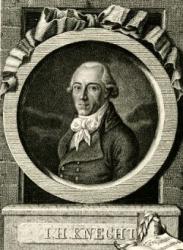
Justin Heinrich Knecht

1752 - 1817 Person Name: Justin Heinrich Knecht (1752-1817) Topics: Warning Message The Accepted Time Composer of "ST HILDA" in The Christian Hymnary Justin Heinrich Knecht Germany 1752-1817. Born at Biberach Baden-Wurttemberg, Germany, he attended a Lutheran college in Esslingen am Neckar from 1768-1771. Having learned the organ, keyboard, violin and oratory, he became a Lutheran preceptor (professor of literature) and music director in Biberach. It was a free imperial city until 1803 and had a rich cultural life. He became organist of St. Martin’s Church in 1792, used by both Lutherans and Catholics, and was there for many years. He led an energetic, busy musical life, composing for both the theatre and church, organizing subscription concerts, teaching music theory, acoustics, aesthetics, composition, and instruments at the Gymnasium, affiliated to the Musikschule in 1806. He went to Stuttgart in 1806 in hopes of a post there as Kapellmeister, serving two years as Konzertmeister, but he was appointed Direktor Beim Orchester by the King of Wurttemberg in 1807. However, he returned to his former life in 1808 and remained there the rest of his life. He died at Biberach. He wrote 10 vocals, 11 opera and stage works, one symphony, 3 chamber music instrumentals, 7 organ works, 4 piano works, and 6 music theories. He was an author composer, editor, contributor, musician, compiler, and lyricist. John Perry

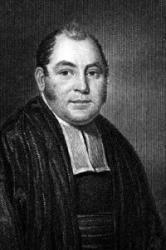
William Bengo Collyer

1782 - 1854 Person Name: William B. Collyer Topics: Accepted Time Author of "Return, O wanderer, return" in Book of Worship with Hymns and Tunes William Bengo Collyer was born at Blackheath Hill, in 1782, and studied at Homerton College. Before completing his twentieth year he became pastor of a Congregational society at Peckham, continuing in that position through his life. He died in 1854. He received the degree of D.D. from the University of Edinburgh in 1808. For many years he was one of the most popular Dissenting ministers in London. He published many hymns and some works on theology. --Annotations of the Hymnal, Charles Hutchins, M.A. 1872. =================== Collyer, William Bengo, D.D., born at Blackheath, April 14, 1782, educated at Homerton College, where, when 16 years old, he was enrolled as a student for the ministry. At 20 he began his ministry at Peckham on Dec. 17, 1801 ordained pastor of a small church consisting of ten communicants. From 1814 to 1826 he was also pastor of a Church meeting in Salters' Hall. On June 17, 1817, a new chapel was opened for him at Peckham. There, from the time of his settlement in 1801, he laboured with great success and honour until Dec. 11, 1853, on which clay he preached for the last time. He died Jan. 8, 1854. Dr. Collyer was eminent in his day as an eloquent Evangelical preacher, when formalism in worship, and Arianism in doctrine, prevailed. He was a man of amiable disposition, polished manners, and Christian courtesy; popular with rich and poor alike. He was the author of a series of lectures on Divine Revelation, in seven volumes: Scripture Facts, Prophecies, Miracles, Parables, Doctrines, Duties, Comparisons. Dr. Collyer compiled a hymn-book with the title, Hymns partly collected and partly original, designed as a supplement to Dr. Watts's Psalms and Hymns, 1812. It was intended at first for the use of his own congregation only, and was to include many hymns composed by himself, to be sung after sermons which he had preached to them, but he was led to alter the plan. It comprises 979 hymns, 6 choruses, and 4 doxologics, arranged in groups according to their authors, and not subjects. Of this number 57 were written by Dr. Collyer, and are for the most part short descriptive or didactic poems, religious or moral essays in verse, and not hymns addressed to the Creator and Redeemer. Some of them are devoid of Christian truth, and are poems of nature or of sentiment. Some of them were written during the hard and sorrowful times of the wars of Bonaparte, and relate to famine and national calamity. Several were prepared for the public meetings of missionary and benevolent societies, which had their origin in his time. He also published Services suited to the Solemnization of Matrimony, Baptism, &c, 1837, which contained 89 of his hymns, &c.; Hymns for Israel, a Tribute of Love for God's Ancient People, 1848 (41 hymns). In Dr. Leifchild's Original Hymns, 1843, there are also 39 of his compositions. Many of his pieces appeared in the Evangelical Magazine, and were also appended to his numerous published Sermons. A few of his hymns are still in common use, including. "Another fleeting day is gone"; "Assembled at Thy great command"; "O Jesu, in this solemn hour"; "O Thou, the helpless orphan's hope"; "Return, O wanderer, return," and the fine cento, "Great God, what do I see and hear." [Rev. F. J. Faulding, D.D.] --John Julian, Dictionary of Hymnology (1907) ====================== Collyer, William Bengo, p. 243, ii. The following hymns by Dr. Collyer are also in common use:— 1. Another fleeting day is gone. Evening. (1812.) 2. 0 Jesus, in this solemn hour. Reception of Church Officers. (1842.) 3. O Thou, the helpless orphan's hope. On Behalf of Orphans. In the Evangelical Magazine, 1808, p. 48. 4. See the clouds upon the mountain. Sunday Morning. (1842.) 5. Soft be the gently breathing notes. Praise to the Redeemer. (1812.) 6. Softly the shade of evening falls. Evening. (1812.) From this, “Soon shall a darker night descend" is taken. 7. Thou Prince of glory slain for me. Good Friday. (1812.) The date 1812 is that of his Collection, and 1842 of Leifchild's Original Hymns. --John Julian, Dictionary of Hymnology, Appendix, Part II (1907)

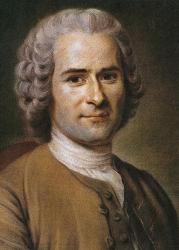
Jean-Jacques Rousseau

1712 - 1778 Person Name: Jean Jacques Rousseau, 1712-1778 Topics: Warning Message The Accepted Time Composer of "GREENVILLE NEW" in The Christian Hymnary Jean Jacques Rousseau; b. 1712, Geneva; d. 1778, Paris. Born in the city-state of Geneva in the Swiss Confederacy, his mother died whenhe was 9 days old. Rousseau's father was a watchmaker, but got into trouble with local officials and left the town, leaving his son with an uncle who had Rousseau and his own son board with a Calvinist minister for 2 years. He was later apprenticed to a notary and then to an engraver, who beat him. He ran away from Geneva at 16. In nearby Savoy, he sheltered with a Roman Catholic priest. He was sent to Italy to convert to Catholicism. He supported himself as a servant, secretary, and tutor. His life was filled with personal and political upheaval, and his writings infuriated many, to the point he had to leave several habitations. He had many friends and enemies due to his philosophies on life, religion, and God. He was concerned with decay of society (having experienced the French Revolution) and became a philosopher, writer, botanist, and composer, he influenced the Enlightenment period through his political philosophy, both in France and across Europe, including aspects of the French Revolution and overall development of modern political and educational thought. A member of the Jacobin Club, he was the most popular of philosophers. He believed that self-preservation was the highest virtue and that we should study to understand how society operates and where pitfalls lie. His personal family life was very chaotic as a result of his outspoken opinions and writings. He returned to his Calvinistic beliefs in later life, but digressed from them on several issues important to that church. John Perry

Pages


Export as CSV
It looks like you are using an ad-blocker. Ad revenue helps keep us running. Please consider white-listing Hymnary.org or getting Hymnary Pro to eliminate ads entirely and help support Hymnary.org.