

 My Starred Hymns
 My FlexScores
 My Hymnals
 My Purchased Files
Planning worship?
Check out our sister site, ZeteoSearch.org,
for 20+ additional resources related to your search.
- |
User Links
Person Results
John White Chadwick
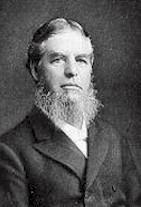
1840 - 1904 Person Name: John White Chadwick, 1840-1904 Meter: 8.7.8.7 with refrain Translator of "Angels We Have Heard on High" in Catholic Book of Worship III Chadwick, John White, was born at Marblehead, Mass., U.S., Oct. 19, 1840; graduated at the Cambridge Divinity School, July 19, 1864, and ordained minister of the Second Unitarian Church, Brooklyn, N.Y., Dec. 21, 1864. A frequent contributor to the Christian Examiner; The Radical; Old and New; Harper's Magazine; and has published many poems in American periodicals. His hymn on Unity, "Eternal Ruler of the ceaseless round," was written for the graduating class of the Divinity School, Cambridge, June 19, 1864. It is in Horder's Congregational Hymns, 1884. It is a hymn of superior merit. [Rev. W. Garrett Horder]
--John Julian, Dictionary of Hymnology (1907)
========================
Chadwick, J. W, p. 216, i. Mr. Chadwick's important prose works were the Life of Theodore Parker, 1890, and that of William Ellery Channing, 1903; and his poetical productions A Book of Poems, 1876, and In Nazareth Town and other Poems, 1883. He received his M.A. from Harvard in 1888; and d. Dec. 11, 1901. In addition to "Eternal Ruler of the ceaseless round," already noted on p. 216, ii., Mr. Chadwick's widow has supplied us with the following data concerning his hymns:—
1. A gentle tumult in the earth. [Easter.] Dated 1876.
2. Another year of setting suns. [New Year.] Written as a New Year's Hymn for 1873, and originally began "That this shall be a better year." In The Pilgrim Hymnal, Boston, 1904.
3. Come, let us sing a tender song, [Communion of Saints.] Dated 1901, and included in The Pilgrim Hymnal, 1904.
4. Everlasting Holy One. [Invocation.] 1875.
5. It singeth low in every heart. [In Memoriam.] Written in 1876, for the 25th Anniversary of the Dedication of his Church at Brooklyn. It has passed into a great many collections in America, and a few in Great Britain, including Horder's Worship Song, 1905.
6. Now sing we a song for the harvest. [Harvest.]
Written for a Harvest Thanksgiving Service in 1871. Given in The Pilgrim Hymnal, 1904, and others.
7. 0 God, we come not as of old. [Perfect Law of Liberty.] Written in 1874, and entitled "The Perfect Law."
8. 0 Love Divine of all that is. [Trust.] Written in 1865, and included in his Book of Poems, 1876, as "A Song of Trust." In several American collections.
9. 0 Thou, Whose perfect goodness crowns. [For an Anniversary.] "Written for the 23th Anniversary of his Installation, Dec. 21, 1889." In The Pilgrim Hymnal, and other collections.
10. Thou Whose Spirit dwells in all. [Easter.] Written in 1890.
11. What has drawn us thus apart? [For Unity.] Undated, in the Boston Unitarian Hymns for Church and Home, 1895.
During the past ten years Mr. Chadwick's hymns have become very popular in America, and especially with the compilers of Congrega¬tional and Unitarian collections.
--John Julian, Dictionary of Hymnology, New Supplement (1907)
John White Chadwick
Joseph Barnby
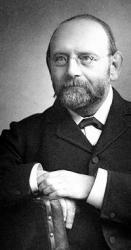
1838 - 1896 Person Name: Joseph Barnby, 1838-1896 Meter: 8.7.8.7 with refrain Composer of "THE BLESSED NAME" in The Book of Praise Joseph Barnby (b. York, England, 1838; d. London, England, 1896) An accomplished and popular choral director in England, Barnby showed his musical genius early: he was an organist and choirmaster at the age of twelve. He became organist at St. Andrews, Wells Street, London, where he developed an outstanding choral program (at times nicknamed "the Sunday Opera"). Barnby introduced annual performances of J. S. Bach's St. John Passion in St. Anne's, Soho, and directed the first performance in an English church of the St. Matthew Passion. He was also active in regional music festivals, conducted the Royal Choral Society, and composed and edited music (mainly for Novello and Company). In 1892 he was knighted by Queen Victoria. His compositions include many anthems and service music for the Anglican liturgy, as well as 246 hymn tunes (published posthumously in 1897). He edited four hymnals, including The Hymnary (1872) and The Congregational Sunday School Hymnal (1891), and coedited The Cathedral Psalter (1873).
Bert Polman
Joseph Barnby
D. S. Warner
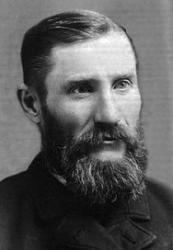
1842 - 1895 Person Name: Daniel S. Warner Meter: 8.7.8.7 with refrain Author of "The Bond of Perfectness" in Our Great Redeemer's Praise Warner, Daniel Sidney. (near Marshallville, Wayne County, Ohio, 1842--1895). Church of God. Reared on an Ohio farm. During the Civil War, he substituted for a brother. Later he taught school. He attended Oberlin College briefly in 1865. By 1867 he was licensed to preach by the Western Ohio Eldership of the Church of God (Winebrennerian). His experience in preaching was gained on circuits in Nebraska and Ohio. In 1874 he was in trouble with the Eldership for preaching entire sanctification. Soon he joined the Indiana Eldership. In 1881 he was in trouble with this Eldership over sectism.
Warner was an associate editor of the Herals of Gospel Freedom in 1878. this paper was merged with the Pilgrim about 1881, and the new paper was called the Gospel Trumpet, with Warner as its editor. Warner was forced to move the paper about, seeing for firm financial foundations. The publishing work was at last established in Grand Junction, Michigan, enabling Warner to travel more extensively with a group of evangelists. Warner's time was spent in editing the Trumpet, writing books, tracts, and songs, and making evangelistic tours of the United States.
--John W.V. Smith, DNAH Archives
===================================
Daniel Sidney Warner, 1842-1895
Born: June 25, 1842, Bristol (now Marshallville), Ohio.
Died: December 12, 1895, Grand Junction, Michigan, of pneumonia.
Buried: Near Grand Junction, Michigan, at the edge of the Church of God campground that was once there.
As of 1880, Warner was living in Rome City, Indiana. His works include:
Echoes From Glory, with Barney Warren (Grand Junction, Michigan: The Gospel Trumpet Publishing Company, 1893)
Lyrics--
Ah Poor Alien Far from the Fold of Love
Ah Poor Sinner, Think of Calvary
All This World, Its Wealth and Honor
All Ye People, Come Down to the Judgment Begun
Along a Dark and Gloomy Path
Are You of the Holy Remnant
Are You Ready, Waiting for the Lord?
Are You Sowing Seeds of Kindness?
Asleep in Jesus, Oh, How Sweet
A Gentle Hand Unseen by Us
A Long Time I Wandered Away
Beautiful, Peaceful Zion
Behold a Form upon the Lonely Mount
Behold, What Love, What Boundless Love
Bond of Perfectness, The
Borne Away in Mind and Spirit
Brighter Days Are Sweetly Dawning
By Thy Blessed Word Obeying
Can the Spirit of a Mortal
Church of God, Thou Spotless Virgin
Church of the Living God
Come, Behold the Love of Jesus
Come unto Me, All Ye That Labor
Come, Within That Upper Chamber
Dear Friends, We Have Precious Tidings of Old
Don’t Resist the Holy Spirit
Down into the Flowing River
Do You Triumph, O My Brother?
Ere Christ Will Reign Within Thy Heart
Fair City of the Gospel Day
Far Down o’er the Ages a Promise Divine
Fill Me with Thy Spirit
From My Soul and All Within
From the Mount of Heavenly Vision
God Is Sitting in the Awful Valley
God Is Sweeping through the Nations
God of Mercy, God of Love
Great Peace Have They That Love Thy Law
Hallelujah to Jesus!
Hark, in the Bible a Warning
Hear the Tidings of a Kingdom
Hear the Voice of Our Commander
Hear Ye the Moan of a Soul That Is Lost
Here We Meet and Part in Jesus
His Yoke Is Easy
How Often I’ve Pondered My Struggles Within
How Sweet Is My Walk with Jesus!
How Sweet This Bond of Perfectness
I Am Resting in Jesus, Hallelujah!
I Know My Name Is There
I Heard the Dear Redeemer Say
I Lost My Life for Jesus on the Cross
I Ought to Love My Savior
I Seem to Hear an Angel Choir
I Will Be with Thee, O, Child of Love
I Will Part with Thee, Old Master
I Will Trust Thee, O My Father
If Thou Wilt Know the Fountain Deep
I’ll Sing of a River Divine
In the Chambers of Thy Bosom
In the Light of God
In the Morning of the Lord
Is the Spirit Glowing in Thy Heart?
It Is Written in the Bible
I’ve Found a Friend in Jesus
I’ve Found My Lord and He Is Mine
I’ve Reached the Land of Pure Delight
Jesus Drank the Cup of Sorrow
Jesus Has Taken My Load of Sin
Jesus, Thou a Fountain Art
Last Great Day, The
Let Us Sing an Invitation
Let Us Sing a Sweet Song of the Home of the Soul
Let Us Sing the Name of Jesus
Life Is Not a Mystic Dream
Light in Our Darkness, Brother
Lord Our Shepherd, The
Listen, Sinner, to the Voice
Lord, the Shades of Night
Lo, Heaven Now Opens to Rapturous View
Lo the Kingdom of Heaven We See
Lo, wisdom Crieth in the Streets
Mansion Is Waiting in Glory, A
Men Speak of a Church Triumphant
Mighty Messengers Are Running
My Jesus Died for Me upon the Cross
My Name Is in the Book of Life
My Soul in Trouble Roamed
My Soul Is Satisfied
My Soul Is Saved from Sin
Not in the Temples Made with Hands
Now My Pilgrim toils Are Over
Now the Great King of Babel
O Blessed Jesus, for Thee W Are Waiting
O Blessed Jesus, Thy Love Is Supreme
O Careless Sinner, Wake to Mercy’s Call
O God, Inspire Our Morning Hymn
O How Can Anyone Refuse
O How Sublime Is the Life of the Christian
O Let Us Sing the Mighty Love
O Love Divine, Unfathomed!
O Praise the Lord, My Soul Is Saved
O Precious Bible! Burning Words from Heaven
O Sinner, Come Home to the Savior
O W Love the Children’s Meeting
O What Deep and Pure Compassion
O Worship God, the Father
O Ye Pilgrims, Sing an Exhortation
O’er the Door of Heaven’s Kingdom
Oft My Heart Has Bled with Sorrow
Oh, Worship God the Father, Just and True
Oh, Come and Praise the Lord Today
Oh, When We Remember the Goodness
O Who Can Stand the Judgment Day
Oh, Why Should I Be Lost
Onward Moves the Great Eternal
Our God Is Love, the Angels Know
Perishing Souls at Stake Today!
Pilgrim of Jesus, o’er Life’s Troubled Sea
Praise the Lord with Songs of Glory
Rejoice, Little Ones, in the Promise Divine
River of Peace
Salvation Is the Sweetest Thing
See the Great King of Babel
Shall I Tell You Why I Ceased from Folly?
Shall My Soul Ascend with Rapture
Shield of Faith, The
Since I Have Found My Savior
Sing of Salvation, O, it Was Love
Sinner, will You Lose Your Soul
Sunbeams Sparkling and Glancing
Sweet Fellowship, Thy Crystal Tide
Sweetly Whispered the Lord in My Mind
Take the Shield of Faith, My Brother
Tell Me, Pilgrim, Traveling Homeward
Tell Me, Watchman, Oh, What of the Morning
There Are Some Rays of Hope Divine
There Are Tidings of a Land Far Away
There Is a Blest Pavilion
There Is a Grace Few Mortals Find
There Is a Story I Often Must Ponder
There Is Joy in the Service of the Master
There Was a Bright and Lovely Boy
There’s an Angel of Mercy from Heaven
There’s a Fact No Mortal Ever Can Deny
There’s a Fountain of Blood That Atones for the Soul
There’s a Land of Everlasting Song
There’s a Peaceful Valley of Decision Found
There’s a Song We Love to Sing
There’s an Awful Day That’s Coming
There’s Mercy, Poor Sinner, for Thee
There’s Music in My Soul
This Is Why I Love My Savior
Tho’ All Along My Happy Pilgrim Race
Time Enough, the Sluggard Cries
Time Onward Flows Like a River Vast
Trusting in Jesus, My Savior and Friend
’Twas Sung by the Poets
Two Little Hands Are Sweetly Folded
Unheeding Winter’s Cruel Blast
Universe Is God’s Domain, The
We Are Coming, Hallelujah!
We Are Going Home to Heaven’s Golden City
We Are the Happy Children
We Have Met Today on the Old Campground
We Have Reached an Awful Era
We Have Read in Sacred Story
We Stand upon the Sea of Glass
We Tread upon the Awful Verge
We Will Work for Jesus
We’ll Follow the Lord All the Way
We’re a Happy Christian Band
What Awful Darkness Shrouds All the Earth!
When Lost in the Darkness of Guilt and Despair
When We Pass the Golden Summer
Where Art Thou, Wand’ring Sinner?
Where Shall We Look for Help in Affliction?
While Sleeping Careless on the Brink
Whiter Than Snow
Who but the Christian Is Happy and Free?
Who Can Sing the Wondrous Love of the Son Divine??
Who Is My Life but Christ Alone?
Who Will Suffer with the Savior?
Why Should a Doubt or Fear Arise?
Why Should a Mortal Man Complain?
Wonderful Fountain of Glory
--hymntime.com/tch
D. S. Warner
Wendell P. Loveless
1892 - 1987 Meter: 8.7.8.7 with refrain Composer of "LOVELESS" in Hymns for the Living Church Rv Wendell Phillips Loveless USA 1892-1987, Born in Wheaton, IL, he first engaged in business in Chicago. In 1914 he became a member of an entertainment group that toured the U.S. on the Chatauqua circuit. Spending six years with the group he learned voice, piano, dramatics, and MC duties, later managing the group. He later used these talents in Christian ministry. In 1917 he married Velma Stone, and they had three children: Robert, David, and Wendell Jr. He was a Lieutenant in the Marine Corps during WWI. He was converted through reading the Bible at home. He joined the Moody Bible Institute (MBI) in 1926, first as business manager of the extension department. He later became director of the Moody Bible Institute radio station WMBI in Chicago from 1926-1947. He then became an itinerant Bible teacher. He later pastored the Wheaton Evangelical Free Church, Community Church in Boca Raton, FL, and First Chinese Church of Christ in Honolulu, HI, continuing his radio ministry in the last two locations (also managing station KAIM Honolulu). In 1960 he assigned all his copyrights to Hope Publishing Company. He wrote popular songs and choruses, many found in hymnals published by Hope, and some translated into other languages. He authored several books: “Glimpses of Christ n Psalm IX” (1937); “Sunrise meditations” (1940); “New radio songs & choruses of the gospel #3” (1940); New radio songs & choruses of the gospel #4” (1942); “Little talks on great words” (1942?); “Christ and the believer in the Song of Songs” (1945); “Plain talks on practical truths” (1945); “New sunrise meditations” (1945); “Manual of gospel broadcasting” (1946); “Plain talks on Romans” (1946); “New radio songs & choruses of the gospel #5” (1946). He died in Honolulu, HI. He was an author, compiler, performer, editor, narrator, composer, actor, and writer.
John Perry
Wendell P. Loveless
Lowell Mason
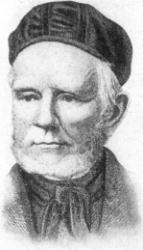
1792 - 1872 Meter: 8.7.8.7 with refrain Composer of "PEREZ" in Songs of Faith and Praise Dr. Lowell Mason (the degree was conferred by the University of New York) is justly called the father of American church music; and by his labors were founded the germinating principles of national musical intelligence and knowledge, which afforded a soil upon which all higher musical culture has been founded. To him we owe some of our best ideas in religious church music, elementary musical education, music in the schools, the popularization of classical chorus singing, and the art of teaching music upon the Inductive or Pestalozzian plan. More than that, we owe him no small share of the respect which the profession of music enjoys at the present time as contrasted with the contempt in which it was held a century or more ago. In fact, the entire art of music, as now understood and practiced in America, has derived advantage from the work of this great man.
Lowell Mason was born in Medfield, Mass., January 8, 1792. From childhood he had manifested an intense love for music, and had devoted all his spare time and effort to improving himself according to such opportunities as were available to him. At the age of twenty he found himself filling a clerkship in a banking house in Savannah, Ga. Here he lost no opportunity of gratifying his passion for musical advancement, and was fortunate to meet for the first time a thoroughly qualified instructor, in the person of F. L. Abel. Applying his spare hours assiduously to the cultivation of the pursuit to which his passion inclined him, he soon acquired a proficiency that enabled him to enter the field of original composition, and his first work of this kind was embodied in the compilation of a collection of church music, which contained many of his own compositions. The manuscript was offered unavailingly to publishers in Philadelphia and in Boston. Fortunately for our musical advancement it finally secured the attention of the Boston Handel and Haydn Society, and by its committee was submitted to Dr. G. K. Jackson, the severest critic in Boston. Dr. Jackson approved most heartily of the work, and added a few of his own compositions to it. Thus enlarged, it was finally published in 1822 as The Handel and Haydn Society Collection of Church Music. Mason's name was omitted from the publication at his own request, which he thus explains, "I was then a bank officer in Savannah, and did not wish to be known as a musical man, as I had not the least thought of ever making music a profession." President Winchester, of the Handel and Haydn Society, sold the copyright for the young man. Mr. Mason went back to Savannah with probably $500 in his pocket as the preliminary result of his Boston visit.
The book soon sprang into universal popularity, being at once adopted by the singing schools of New England, and through this means entering into the church choirs, to whom it opened up a higher field of harmonic beauty. Its career of success ran through some seventeen editions. On realizing this success, Mason determined to accept an invitation to come to Boston and enter upon a musical career. This was in 1826. He was made an honorary member of the Handel and Haydn Society, but declined to accept this, and entered the ranks as an active member. He had been invited to come to Boston by President Winchester and other musical friends and was guaranteed an income of $2,000 a year. He was also appointed, by the influence of these friends, director of music at the Hanover, Green, and Park Street churches, to alternate six months with each congregation. Finally he made a permanent arrangement with the Bowdoin Street Church, and gave up the guarantee, but again friendly influence stepped in and procured for him the position of teller at the American Bank.
In 1827 Lowell Mason became president and conductor of the Handel and Haydn Society. It was the beginning of a career that was to win for him as has been already stated the title of "The Father of American Church Music." Although this may seem rather a bold claim it is not too much under the circumstances. Mr. Mason might have been in the average ranks of musicianship had he lived in Europe; in America he was well in advance of his surroundings. It was not too high praise (in spite of Mason's very simple style) when Dr. Jackson wrote of his song collection: "It is much the best book I have seen published in this country, and I do not hesitate to give it my most decided approbation," or that the great contrapuntist, Hauptmann, should say the harmonies of the tunes were dignified and churchlike and that the counterpoint was good, plain, singable and melodious.
Charles C. Perkins gives a few of the reasons why Lowell Mason was the very man to lead American music as it then existed. He says, "First and foremost, he was not so very much superior to the members as to be unreasonably impatient at their shortcomings. Second, he was a born teacher, who, by hard work, had fitted himself to give instruction in singing. Third, he was one of themselves, a plain, self-made man, who could understand them and be understood of them."
The personality of Dr. Mason was of great use to the art and appreciation of music in this country. He was of strong mind, dignified manners, sensitive, yet sweet and engaging.
Prof. Horace Mann, one of the great educators of that day, said he would walk fifty miles to see and hear Mr. Mason teach if he could not otherwise have that advantage.
Dr. Mason visited a number of the music schools in Europe, studied their methods, and incorporated the best things in his own work. He founded the Boston Academy of Music. The aim of this institution was to reach the masses and introduce music into the public schools. Dr. Mason resided in Boston from 1826 to 1851, when he removed to New York. Not only Boston benefited directly by this enthusiastic teacher's instruction, but he was constantly traveling to other societies in distant cities and helping their work. He had a notable class at North Reading, Mass., and he went in his later years as far as Rochester, where he trained a chorus of five hundred voices, many of them teachers, and some of them coming long distances to study under him. Before 1810 he had developed his idea of "Teachers' Conventions," and, as in these he had representatives from different states, he made musical missionaries for almost the entire country. He left behind him no less than fifty volumes of musical collections, instruction books, and manuals.
As a composer of solid, enduring church music. Dr. Mason was one of the most successful this country has introduced. He was a deeply pious man, and was a communicant of the Presbyterian Church. Dr. Mason in 1817 married Miss Abigail Gregory, of Leesborough, Mass. The family consisted of four sons, Daniel Gregory, Lowell, William and Henry. The two former founded the publishing house of Mason Bros., dissolved by the death of the former in 1869. Lowell and Henry were the founders of the great organ manufacturer of Mason & Hamlin. Dr. William Mason was one of the most eminent musicians that America has yet produced.
Dr. Lowell Mason died at "Silverspring," a beautiful residence on the side of Orange Mountain, New Jersey, August 11, 1872, bequeathing his great musical library, much of which had been collected abroad, to Yale College.
--Hall, J. H. (c1914). Biography of Gospel Song and Hymn Writers. New York: Fleming H. Revell Company.
Lowell Mason
Robert Harkness
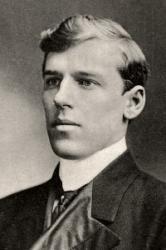
1880 - 1961 Meter: 8.7.8.7 with refrain Arranger of "HYFRYDOL" in Songs of Faith and Praise After attending a revival meeting by Reuben Torrey and Charles M. Alexander, Harkness became Alexander’s pianist. He came to Christ shortly thereafter (on a bicycle, he said), and made several round the world tours with Torrey and Alexander.
Harkness was especially well known for his program The Music of the Cross, and as the author of correspondence courses in hymn playing. He wrote over 2,000 hymns and Gospel songs in his lifetime.
(hymntime.com/tch)
Robert Harkness
Joël Blomqvist
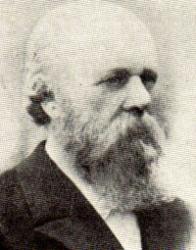
1840 - 1930 Person Name: Joel Blomqvist, 1840-1930 Meter: 8.7.8.7 with refrain Author of "O How Blest to Be a Pilgrim" in The Covenant Hymnal Blomqvist, Joël. (Stockholm, Sweden, November 15, 1840--October 30, 1930, Kullarstad, Sweden). Swedish Free Church Movement. Upholsterer by trade, lay preacher and singer. Colporteur for Uppsala City Mission, 1874-1878. Wrote about 400 hymn texts in the pietistic tradition and almost as many tunes. Published several hymn collections including Sabbatsklockan, 1877-1878, and Fridstoner, 1879-1882. Edited musical periodical, Fridsrösten, 1884-1886. His works are representative of the Rosenian revival period. Author of "Heavenly Father, Hear My Supplication," (Helige Fader, böj ditt öra neder), "Heavenly Spirit, Gentle Spirit" (Himladuva, Ande ljuva), "Praise the Lord, All Praise and Blessing" (Loven Herren, ty att lova), and "Sabbath Day of Rest and Cheer" (Sabbatsdag, hur skön du är).
J. I. Erickson, DNAH Archives
Joël Blomqvist
Anonymous
Meter: 8.7.8.7 with refrain Author of "Humble Praises, Holy Jesus" in Psalter Hymnal (Gray) In some hymnals, the editors noted that a hymn's author is unknown to them, and so this artificial "person" entry is used to reflect that fact. Obviously, the hymns attributed to "Author Unknown" "Unknown" or "Anonymous" could have been written by many people over a span of many centuries.
Anonymous
Betty Bender
Meter: 8.7.8.7 with refrain Author (stanza 3) of "Love One Another" in Songs of Faith and Praise
Betty Bender
Martin Luther
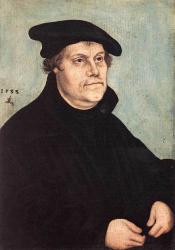
1483 - 1546 Person Name: Martin Luther, 1483-1546 Meter: 8.7.8.7 with refrain Author (attributed to) of "God's Word Shall Stand Forever" in Rejoice Hymns Luther, Martin, born at Eisleben, Nov. 10, 1483; entered the University of Erfurt, 1501 (B.A. 1502, M.A.. 1503); became an Augustinian monk, 1505; ordained priest, 1507; appointed Professor at the University of Wittenberg, 1508, and in 1512 D.D.; published his 95 Theses, 1517; and burnt the Papal Bull which had condemned them, 1520; attended the Diet of Worms, 1521; translated the Bible into German, 1521-34; and died at Eisleben, Feb. 18, 1546. The details of his life and of his work as a reformer are accessible to English readers in a great variety of forms. Luther had a huge influence on German hymnody.
i. Hymn Books.
1. Ellich cristlich lider Lobgesang un Psalm. Wittenberg, 1524. [Hamburg Library.] This contains 8 German hymns, of which 4 are by Luther.
2. Eyn Enchiridion oder Handbuchlein. Erfurt, 1524 [Goslar Library], with 25 German hymns, of which 18 are by Luther.
3. Geystliche Gesangk Buchleyn. Wittenberg, 1524 [Munich Library], with 32 German hymns, of which 24 are by Luther.
4. Geistliche Lieder auffs new gebessert. Wittenberg. J. Klug, 1529. No copy of this book is now known, but there was one in 1788 in the possession of G. E. Waldau, pastor at Nürnberg, and from his description it is evident that the first part of the Rostock Gesang-Buch, 1531, is a reprint of it. The Rostock Gesang-Buch, 1531, was reprinted by C. M. Wiechmann-Kadow at Schwerin in 1858. The 1529 evidently contained 50 German hymns, of which 29 (including the Litany) were by Luther.
5. Geistliche Lieder auffs new gebessert. Erfurt. A. Rauscher, 1531 [Helmstädt, now Wolfenbüttel Library], a reprint of No. 4.
6. Geistliche Lieder. Wittenberg. J. Klug, 1535 [Munich Library. Titlepage lost], with 52 German hymns, of which 29 are by Luther.
7. Geistliche Lieder auffs new gebessert. Leipzig. V. Schumann, 1539 [Wernigerode Library], with 68 German hymns, of which 29 are by Luther.
8. Geistliche Lieder. Wittenberg. J. Klug, 1543 [Hamburg Library], with 61 German hymns, of which 35 are by Luther.
9. Geystliche Lieder. Leipzig. V. Babst, 1545 [Gottingen Library]. This contains Luther's finally revised text, but adds no new hymns by himself. In pt. i. are 61 German hymns, in pt. ii. 40, of which 35 in all are by Luther.
For these books Luther wrote three prefaces, first published respectively in Nos. 3, 4, 9. A fourth is found in his Christliche Geseng, Lateinisch und Deudsch, zum Begrebnis, Wittenberg, J. Klug, 1542. These four prefaces are reprinted in Wackernagel’s Bibliographie, 1855, pp. 543-583, and in the various editions of Luther's Hymns. Among modern editions of Luther's Geistliche Lieder may be mentioned the following:—
Carl von Winterfeld, 1840; Dr. C. E. P. Wackernagel, 1848; Q. C. H. Stip, 1854; Wilhelm Schircks, 1854; Dr. Danneil, 1883; Dr. Karl Gerok, 1883; Dr. A. F. W. Fischer, 1883; A. Frommel, 1883; Karl Goedeke, 1883, &c. In The Hymns of Martin Luther. Set to their original melodies. With an English version. New York, 1883, ed. by Dr. Leonard Woolsey Bacon and Nathan H. Allen, there are the four prefaces, and English versions of all Luther's hymns, principally taken more or less altered, from the versions by A. T. Russell, R. Massie and Miss Winkworth [repub. in London, 1884]. Complete translations of Luther's hymns have been published by Dr. John Anderson, 1846 (2nd ed. 1847), Dr. John Hunt, 1853, Richard Massie, 1854, and Dr. G. Macdonald in the Sunday Magazine, 1867, and his Exotics, 1876. The other versions are given in detail in the notes on the individual hymns.
ii. Classified List of Luther's Hymns. Of Luther's hymns no classification can be quite perfect, e.g. No. 3 (see below) takes hardly anything from the Latin, and No. 18 hardly anything from the Psalm. No. 29 is partly based on earlier hymns (see p. 225, i.). No. 30 is partly based on St. Mark i. 9-11, and xvi., 15, 16 (see p. 226, ii.). No. 35 is partly based on St. Luke ii. 10-16. The following arrangement, however, will answer all practical purposes.
A. Translations from the Latin.
i. From Latin Hymns:
1. Christum wir sollen loben schon. A solis ortus cardine
2. Der du bist drei in Einigkeit. O Lux beata Trinitas.
3. Jesus Christus unser Heiland, Der von. Jesus Christus nostra salus
4. Komm Gott Schopfer, heiliger Geist. Veni Creator Spiritus, Mentes.
5. Nun komm der Beidenheiland. Veni Redemptor gentium
6. Was flirchst du Feind Herodes sehr. A solis ortus cardine
ii. From Latin Antiphons, &c.:
7. Herr Gott dich loben wir. Te Deum laudamus.
8. Verleih uns Frieden gnädiglich. Dapacem, Domine
9. Wir glauben all an einen Gott.
iii. Partly from the Latin, the translated stanzas being adopted from Pre-Reformation Versions:
10. Komm, heiliger Geist, Herre Gott.
11. Mitten wir im Leben sind. Media vita in morte sumus.
B. Hymns revised and enlarged from Pre-Reformation popular hymns.
12. Gelobet seist du Jesus Christ.
13. Gott der Vater wohn uns bei.
14. Gott sei gelobet und gebenedeiet.
15. Nun bitten wir den heiligen Geist.
C. Psalm versions.
16. Ach Gott vom Himmel, sieh darein.
17. Aus tiefer Noth schrei ich zu dir.
18. Ein' feste Burg ist unser Gott.
19. Es spricht der Unweisen Mund wohl.
20. Es wollt uns Gott genädig sein.
21. War Gott nicht mit uns diese Zeit.
22. Wohl dem, der in Gotten Furcht steht.
D. Paraphrases of other portions of Holy Scripture.
23. Diess sind die heilgen zehn Gebot.
24. Jesaia dem Propheten das geschah.
25. Mensch willt du leben seliglich.
26. Mit Fried und Freud ich fahr dahin.
27. Sie ist mir lieb die werthe Magd.
28. Vater unser im Himmelreich.
E. Hymns mainly Original.
29. Christ lag in Todesbanden.
30. Christ unser Herr zum Jordan kam.
31. Ein neues Lied wir heben an.
32. Erhalt uns Herr bei deinem Wort.
33. Jesus Christus unser Heiland, Der den,
34. Nun freut euch lieben Christengemein.
35. Vom Himmel hoch da komm ich her.
36. Vom Himmel kam der Engel Schaar.
In addition to these —
37. Fur alien Freuden auf Erden.
38. Kyrie eleison.
In the Blätter fur Hymnologie, 1883, Dr. Daniel arranges Luther's hymns according to what he thinks their adaptation to modern German common use as follows:—
i. Hymns which ought to be included in every good Evangelical hymn-book: Nos. 7-18, 20, 22, 28, 29, 30, 32, 34, 35, 36, 38.
ii. Hymns the reception of which into a hymn-book might be contested: Nos. 2, 3, 4, 19, 21, 22, 23, 24, 25, 33.
iii. Hymns not suited for a hymn-book: Nos. 1, 5, 6, 27, 31, 37.
[Rev. James Mearns, M.A.]
--John Julian, Dictionary of Hymnology (1907)
Martin Luther
Pages