

 My Starred Hymns
 My FlexScores
 My Hymnals
 My Purchased Files
Planning worship?
Check out our sister site, ZeteoSearch.org,
for 20+ additional resources related to your search.
- |
User Links
Person Results
Frances Ridley Havergal
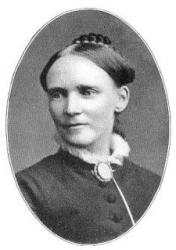
1836 - 1879 Person Name: Frances R. Havergal Topics: The Kingdom of God on Earth Stewardship Author of "Lord, speak to me, that I may speak" in The Hymnal Havergal, Frances Ridley, daughter of the Rev. W. H. Havergal, was born at Astley, Worcestershire, Dec. 14, 1836. Five years later her father removed to the Rectory of St. Nicholas, Worcester. In August, 1850, she entered Mrs. Teed's school, whose influence over her was most beneficial. In the following year she says, "I committed my soul to the Saviour, and earth and heaven seemed brighter from that moment." A short sojourn in Germany followed, and on her return she was confirmed in Worcester Cathedral, July 17, 1853. In 1860 she left Worcester on her father resigning the Rectory of St. Nicholas, and resided at different periods in Leamington, and at Caswall Bay, Swansea, broken by visits to Switzerland, Scotland, and North Wales. She died at Caswell Bay, Swansea, June 3, 1879.
Miss Havergal's scholastic acquirements were extensive, embracing several modern languages, together with Greek and Hebrew. She does not occupy, and did not claim for herself, a prominent place as a poet, but by her distinct individuality she carved out a niche which she alone could fill. Simply and sweetly she sang the love of God, and His way of salvation. To this end, and for this object, her whole life and all her powers were consecrated. She lives and speaks in every line of her poetry. Her poems are permeated with the fragrance of her passionate love of Jesus.
Her religious views and theological bias are distinctly set forth in her poems, and may be described as mildly Calvinistic, without the severe dogmatic tenet of reprobation. The burden of her writings is a free and full salvation, through the Redeemer's merits, for every sinner who will receive it, and her life was devoted to the proclamation of this truth by personal labours, literary efforts, and earnest interest in Foreign Missions.
[Rev. James Davidson, B.A.]
Miss Havergal's hymns were frequently printed by J. & R. Parlane as leaflets, and by Caswell & Co. as ornamental cards. They were gathered together from time to time and published in her works as follows:—
(1) Ministry of Song, 1869; (2) Twelve Sacred Songs for Little Singers, 1870; (3) Under the Surface, 1874; (4) Loyal Responses, 1878; (5) Life Mosaic, 1879; (6) Life Chords, 1880; (7) Life Echoes, 1883.
About 15 of the more important of Miss Havergal's hymns, including "Golden harps are sounding," "I gave my life for thee," "Jesus, Master, Whose I am," "Lord, speak to me," "O Master, at Thy feet," "Take my life and let it be," "Tell it out among the heathen," &c, are annotated under their respective first lines. The rest, which are in common use, number nearly 50. These we give, together with dates and places of composition, from the Havergal mss. [manuscript], and the works in which they were published. Those, and they are many, which were printed in Parlane's Series of Leaflets are distinguished as (P., 1872, &c), and those in Caswell’s series (C., 1873, &c).
1. A happy New Year! Even such may it be. New Year. From Under the Surface, 1874.
2. Certainly I will be with thee. Birthday. Sept. 1871, at Perry Barr. (P. 1871.) Published in Under the Surface, 1874, and Life Mosaic, 1879.
3. Church of God, beloved and chosen. Sanctified in Christ Jesus, 1873. (P. 1873.) Published in Under the Surface, 1874, and Life Mosaic, 1879.
4. God Almighty, King of nations. Sovereignty of God. 1872. Published in Under the Surface, 1874, and Life Mosaic, 1879.
5. God doth not bid thee wait. God faithful to His promises. Oct. 22, 1868, at Oakhampton. (P. 1869.) Published in Ministry of Song, 1869, and Life Mosaic, 1879.
6. God of heaven, hear our singing. A Child's hymn for Missions. Oct. 22, 1869, at Leamington. Published in her Twelve Sacred Songs for Little Singers, 1870, and her Life Chords, 1880.
7. God will take care of you, All through the day. The Good Shepherd. In Mrs. Brock's Children's Hymn Book, 1881.
8. God's reiterated all. New Year. 1873, at Winterdyne. (C. 1873.) Published in Loyal Responses, 1878, and Life Mosaic, 1879.
9. Have you not a word for Jesus? Boldness for the Truth. Nov. 1871, at Perry Barr. (P. 1872.) Published in Under the Surface, 1874, and Life Mosaic, 1879.
10. He hath spoken in the darkness. Voice of God in sorrow. June 10,1869, at Neuhausen. (P. 1870.) Published in Under the Surface, 1874, and in Life Mosaic, 1879.
11. Hear the Father's ancient promise. Promise of the Holy Spirit. Aug. 1870. Published in Under the Surface, 1874, and Life Mosaic, 1879.
12. Holy and Infinite! Viewless, Eternal. Infinity of God. 1872. Published in Under the Surf ace, 1874, and L. Mosaic, 1879.
13. Holy brethren, called and chosen. Election a motive for Earnestness. 1872. Published in Snepp's Songs of Grace & Glory, 1876.
14. I am trusting Thee, Lord Jesus. Faith. Sept. 1874, at Ormont Dessona. (P. 1874.) Published in Loyal Responses, 1878, and Life Chords, 1880. Miss Havergal’s tune, Urbane (Snepp's Songs of Grace & Glory, 1048), was composed for this hymn. The hymn was the author's "own favourite," and was found in her pocket Bible after her death.
15. I bring my sins to Thee. Besting all on Jesus. June, 1870. (P. 1870.) Printed in the Sunday Magazine, 1870, and Home Words, 1872. Published in Under the Surface, 1874, and Life Chords, 1880.
16. I could not do without Thee. Jesus All in All. May 7, 1873. (P. 1873.) Printed in Home Words, 1873, and published in Under the Surface, 1874, and Life Mosaic, 1879.
17. In full and glad surrender. Confirmation. Miss Havergal's sister says this hymn was “The epitome of her [Miss F. R. H.'s] life and the focus of its sunshine." It is a beautiful hymn of personal consecration to God at all times.
18. In the evening there is weeping. Sorrow followed by Joy. June 19, 1869, at the Hotel Jungfraublick, Interlaken. "It rained all day, except a very bright interval before dinner. Curious long soft white clouds went slowly creeping along the Scheinige Platte; I wrote “Evening Tears and Morning Songs” (Marg. reading of Ps. xxx. 5.)" (P. 1870.) Published in Under the Surface, 1874.
19. Increase our faith, beloved Lord. Increase of Faith desired. In Loyal Responses, 1878, in 11 stanzas of 4 lines, on St. Luke xvii. 5. It is usually given in an abridged form.
20. Is it for me, dear Saviour? Heaven anticipated. Nov. 1871, at Perry Barr. (P. 1872.) Published in Under the Surface, 1874, and Life Mosaic, 1879.
21. Israel of God, awaken. Christ our Righteousness. May, 1871, at Perry Barr. (P. 1872.) Published in Under the Surface, 1874, and Life Mosaic, 1879.
22. Jehovah's covenant shall endure. The Divine Covenant, 1872. Published in Snepp's Songs of Grace & Glory, 1876.
23 Jesus, blessed Saviour. New Year, Nov. 25, 1872, at Leamington. (P. 1873.) Printed in the Dayspring Magazine, Jan. 1873, and published in Life Chords, 1880.
24. Jesus only! In the shadow. Jesus All in All. Dec. 4, 1870, at Pyrmont Villa. (P. & C. 1871.) Published in Under the Surface, 1874, and in Life Mosaic, 1879.
25. Joined to Christ by [in] mystic union. The Church the Body of Christ. May, 1871, at Perry Barr. (P. 1872.) Published in Under the Surface, 1874, Life Mosaic, 1879.
26. Just when Thou wilt, 0 Master, call. Resignation. In Loyal Responses, 1878, in 5 stanzas of 4 lines, and Whiting's Hymns for the Church Catholic, 1882.
27. King Eternal and Immortal. God Eternal. Written at Perry Villa, Perry Barr, Feb. 11, 1871, and Published in Snepp's Songs of Grace & Glory, 1876; Under the Surface, 1874 ; and Life Mosaic, 1879.
28. Light after darkness, Gain after loss. Peace in Jesus, and the Divine Reward. In Sankey's Sacred Songs and Solos, from her Life Mosaic, 1879.
29. Like a river glorious, Is God's perfect Peace. Peace. In her Loyal Responses, 1878, in 3 st. of 8 1., with the chorus, "Stayed upon Jehovah." In several collections.
30. Master, speak! Thy servant heareth. Fellowship with and Assistance from Christ desired. Sunday evening, May 19, 1867, at Weston-super-Mare. Published in Ministry of Song, 1869, and L. Mosaic, 1879. It is very popular.
31. New mercies, new blessings, new light on thy way. New Life in Christ. 1874, at Winterdyne. (C. 1874.) Published in Under His Shadow, 1879, Life Chords, 1880.
32. Not your own, but His ye are. Missions. Jan. 21, 1867. (C. 1867.) Published in Ministry of Song, 1869; Life Mosaic, 1879; and the Hymnal for Church Missions, 1884.
33. Now let us sing the angels' song. Christmas. In her Life Mosaic, 1879; and W. B. Stevenson's School Hymnal, 1880.
34. Now the daylight goes away. Evening. Oct. 17, 1869, at Leamington. Published in Songs for Little Singers, 1870, and Life Chords, 1880. It originally read, " Now the light has gone away."
35. Now the sowing and the weeping. Sorrow followed by Joy. Jan. 4, 1870, at Leamington. Printed in Sunday at Home, 1870 ; and published in Under the Surface, 1874, and L. Mosaic, 1879.
36. 0 Glorious God and King. Praise to the Father, Feb. 1872. Published in Under the Surface, 1874, and Life Mosaic, 1879.
37. 0 Saviour, precious [holy] Saviour. Christ worshipped by the Church. Nov. 1870, at Leamington. (P. 1870.) Published in Under the Surface, 1874, and Life Mosaic, 1879.
38. O thou chosen Church of Jesus. Election. April 6, 1871. Published in Under the Surface, 1874, and L. Mosaic, 1879.
39. O what everlasting blessings God outpoureth on His own. Salvation everlasting. Aug. 12, 1871, at Perry Barr. (P. 1871.) Published in Under the Surface, 1874, and L. Mosaic, 1879.
40. Our Father, our Father, Who dwellest in light. The blessing of the Father desired. May 14, 1872. Published in Under the Surface, 1874, and Life Mosaic, 1879. Miss Havergal's tune, Tertius, was composed for this hymn.
41. Our Saviour and our King. Presentation of the Church to the Father. (Heb. ii. 13.) May, 1871, at Perry Barr. (P. 1871.) Published in Under the Surface, 1874, and L. Mosaic, 1879.
42. Precious, precious blood of Jesus. The precious Blood. Sept. 1874, at Ormont Dessons. (C.) Published in Loyal Responses, 1878, and Life Chords, 1880.
43. Sing, O heavens, the Lord hath done it. Redemption. In her Life Mosaic, 1879, and the Universal Hymn Book, 1885.
44. Sit down beneath His shadow. Holy Communion. Nov. 27, 1870, at Leamington. (P. 1870.) Published in Under the Surface, 1874, and Life Mosaic, 1879.
45. Sovereign Lord and gracious Master. Grace consummated in Glory. Oct. 22, 1871. (P. 1872.) Published in Under the Surface, 1874, and Life Mosaic, 1879.
46. Standing at the portal of the opening year. New Year. Jan. 4, 1873. Published in Under the Surface, 1874, and Life Chords, 1880.
47. To Thee, 0 Comforter divine. Praise to the Holy Spirit. Aug. 11, 1872, at Perry Barr. Published in Under the Surface 1874, and Life Mosaic, 1879. Miss Havergal's tune, Tryphosa, was written for this hymn.
48. True-hearted, whole-hearted, faithful and loyal. Faithfulness to the Saviour. In her Loyal Responses, 1878, and the Universal Hymn Book, 1885.
49. What know we, Holy God, of Thee? God's Spirituality, 1872. Published in Under the Surface, 1874, and Life Mosaic, 1879.
50. Who is on the Lord's side? Home Missions. Oct. 13, 1877. Published in Loyal Responses, 1878, andLife Chords, 1880.
51. With quivering heart and trembling will. Resignation. July, 10, 1866, at Luccombe Rectory. (P. 1866.) Published in Ministry of Song, 1869, and Life Mosaic, 1879.
52. Will ye not come to Him for life? The Gospel Invitation. 1873. Published in Snepp's Songs of Grace and Glory, 1876.
53. Worthy of all adoration. Praise to Jesus as the Lamb upon the throne. Feb. 26 1867, at Oakhampton. Published in Ministry of Song, 1869, and Life Mosaic, 1874. It is pt. iii. of the "Threefold Praise," and was suggested by the "Worthy is the Lamb," the "Hallelujah" and "Amen" choruses in Handel's Messiah.
54. Ye who hear the blessed call. The Invitation of the Spirit and the Bride. March, 1869, at Leamington. (P. 1869.) Published in Ministry of Song, 1869, and Life Mosaic, 1879. Suggested by, and written for, the Young Men's Christian Association.
55. Yes, He knows the way is dreary. Encouragement. 1867. Published in Ministry of Song, 1869.
Most of these hymns are given in Snepp's Songs of Grace and Glory, 1872]and 1876, his Appendix, 1874, and the Musical edition, 1880, and many of them are also in several other hymnbooks, including Hymns Ancient & Modern, Thring, Church Hymns, Hymnal Companion, &c, and some of the leading American collections.
--John Julian, Dictionary of Hymnology (1907)
==============================
Havergal, Frances Ridley, p. 496, i. Miss Havergal's Poetical Works were published in 2 vols. in 1884 (Lond., J. Nisbet); and the hymns therein are accompanied by notes. From these volumes, and the Havergal manuscript, we gather the following facts concerning additional hymns in common use:
1. In God's great field of labour. Work for Christ.
Written Feb. 27, 1867, and published in her Ministry of Song, I860, and later works. In Snepp's Songs of Grace and Glory, 1872, it begins with stanza ii., "Sing to the little children." “The poem expresses her own life-ministry of song, and relates true incidents" in that life. [Hav. mss.]
2. Only a mortal's power. Consecration of Self to Christ. Published in her Loyal Responses, 1878, in 7 stanzas of 4 lines, and headed "Only.” In Common Praise, 1879, stanzas ii.-vi., are given for Confirmation as, "Only one heart to give."
3. Through the yesterday of ages. Jesus always the same. Written at Leamington, Nov. 1876, and published in her Loyal Responses, 1878.
4. What hast Thou done for me, 0 Thou my mighty Friend. Good Friday. Written at Leamington, Jan. 1877, and pub. in Loyal Responses, 1878.
5. Yes, He knows the way is dreary, p. 498, i. 55. This hymn was written at Shareshill Parsonage, Nov. 17, 1865, and first printed as one of Parlane's leaflets; then in Lyra Britannica, 1867; and later, in several of her books. It was "suggested by a letter from her niece, A. M. S., at school, and written to console her when weary, lonely, and the only absentee at the rejoicings for her brother J. H. S.'s coming of age." [Hav. mss.]
--John Julian, Dictionary of Hymnology, Appendix, Part II (1907)
===================
Havergal, Frances R., pp. 426, ii., 1569, ii. During the past fifteen years Miss Havergal's hymns have been in great request by compilers of hymnals for Missions and Conventions. In addition to the large number already annotated in this Dictionary, the following are also in common use:—
1. Begin at once! in the pleasant days. [Temperance.] From her Poetical Works, vol. i., p. 303, into The Sunday School Hymnary, 1905. In her Poetical Works. It is given as a "Band of Hope Song," and dated "May, 1876."
2. God in heaven, hear our singing. An altered form of her "God of heaven, hear our singing," p. 497, i. 6.
3. Holy Father, Thou hast spoken. [Holy Spirit desired.] Written May 5, 1876. P. Works, 1874, ii., p. 261.
4. I love. I love my Master. [Jesus the object of love.] Written at Fins, Hants., July 16, 1876. In her Loyal Responses, 1878, and her Poetical Works, 18S4, ii., p. 274.
5. I love to feel that I am taught. [Love of Divine Teaching.] Written at Morecambe Bay, Aug., 1867, for her Ministry of Song, 1869. Included in her Poetical Works, 1884, i., p. 36.
6. Jesus, Thy life is mine. [Union with Christ.] Written June 2, 1876. Poetical Works, 1884, ii., p. 268.
7. Looking unto Jesus, Never need we yield. [Jesus, All in All.] Dated 1876. P. Works, 1884, ii., p. 253.
8. Master, how shall I bless Thy Name! [Holy Service.] Written at Whitby, Sept. 27, 1875. A long hymn of 17 stanzas of 6 lines. P. Works, 1884, ii., p. 280.
9. Resting on the faithfulness. [Union with Christ.] A metrical epitome of a dozen or more of the attributes of Our Lord and His manifestation of loving kindness towards men, in which the word "Resting" is used eighteen times. Written June 11, 1876. Poetical Works, 1884, ii., p. 260.
10. Singing for Jesus, our Saviour and King. [Praise of Jesus.] Written at Winterdyne, June 12. 1872; published in her Under the Surface, 1874, p. 94, and her P. Works, 1884, ii., p. 70.
11. Unfurl the Christian Standard with firm and fearless hand. [Courage for the Christian Warfare. This begins with st. iv. of her hymn, "Unfurl the Christian Standard, lift it manfully on high," written at Perry Barr, Sep. 23, 1872 ; published in her Under the Surface, 1874; and her Poetical Works, 1884, ii.
12. Unto him that hath Thou givest. [Growth in Grace.] Written at Leasowes, April 12, 1876. P. Works, 1884, ii. 259.
Of these hymns Nos. 3, 4, 6, 7, 8, 9, and 12 were published in the first instance in J. Mountain's Hymns of Consecration and Faith, 1876. At the present time (1907) the number of Miss Havergal's hymns in common use reaches nearly one hundred.
--John Julian, Dictionary of Hymnology, New Supplement (1907)
Frances Ridley Havergal
Johann Sebastian Bach
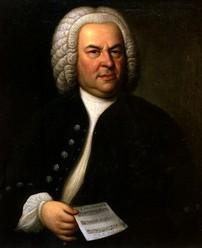
1685 - 1750 Person Name: J. S. Bach Topics: The Kingdom of God on Earth Zion Harmonizer of "WERDE MUNTER" in The Hymnal Johann Sebastian Bach was born at Eisenach into a musical family and in a town steeped in Reformation history, he received early musical training from his father and older brother, and elementary education in the classical school Luther had earlier attended.
Throughout his life he made extraordinary efforts to learn from other musicians. At 15 he walked to Lüneburg to work as a chorister and study at the convent school of St. Michael. From there he walked 30 miles to Hamburg to hear Johann Reinken, and 60 miles to Celle to become familiar with French composition and performance traditions. Once he obtained a month's leave from his job to hear Buxtehude, but stayed nearly four months. He arranged compositions from Vivaldi and other Italian masters. His own compositions spanned almost every musical form then known (Opera was the notable exception).
In his own time, Bach was highly regarded as organist and teacher, his compositions being circulated as models of contrapuntal technique. Four of his children achieved careers as composers; Haydn, Mozart, Beethoven, Mendelssohn, Schumann, Brahms, and Chopin are only a few of the best known of the musicians that confessed a major debt to Bach's work in their own musical development. Mendelssohn began re-introducing Bach's music into the concert repertoire, where it has come to attract admiration and even veneration for its own sake.
After 20 years of successful work in several posts, Bach became cantor of the Thomas-schule in Leipzig, and remained there for the remaining 27 years of his life, concentrating on church music for the Lutheran service: over 200 cantatas, four passion settings, a Mass, and hundreds of chorale settings, harmonizations, preludes, and arrangements. He edited the tunes for Schemelli's Musicalisches Gesangbuch, contributing 16 original tunes. His choral harmonizations remain a staple for studies of composition and harmony. Additional melodies from his works have been adapted as hymn tunes.
--John Julian, Dictionary of Hymnology (1907)
Johann Sebastian Bach
Julia Ward Howe
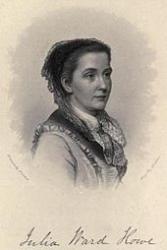
1819 - 1910 Person Name: Julia Ward Howe, 1819-1910 Topics: Kingdom of God on Earth Patriotic Author of "Mine Eyes Have Seen the Glory (Battle Hymn of the Republic)" in African Methodist Episcopal Church Hymnal Born: May 27, 1819, New York City.
Died: October 17, 1910, Middletown, Rhode Island.
Buried: Mount Auburn Cemetery, Cambridge, Massachusetts.
Howe, Julia, née Ward, born in New York City in 1819, and married in 1843 the American philanthropist S. G. Howe. She has taken great interest in political matters, and is well known through her prose and poetical works. Of the latter there are Passion Flower, 1854; Words of the Hour, 1856; Later Lyrics, 1866; and From Sunset Ridge, 1896. Her Battle Hymn of the Republic, "eyes have seen the glory of the coming of the Lord," was written in 1861 at the outbreak of the Civil War, and was called forth by the sight of troops for the seat of war, and published in her Later Lyrics, 1806, p. 41. It is found in several American collections, including The Pilgrim Hymnal, 1904, and others. [M. C. Hazard, Ph.D.]
--John Julian, Dictionary of Hymnology, New Supplement (1907)
============================
Howe, Julia Ward. (New York, New York, May 27, 1819--October 17, 1910). Married Samuel Gridley Howe on April 26, 1843. She was a woman with a distinguished personality and intellect; an abolitionist and active in social reforms; author of several book in prose and verse. The latter include Passion Flower, 1854; Words of the Hours, 1856; Later Lyrics, 1866; and From a Sunset Ridge, 1896.
She became famous as the author of the poem entitled "Battle Hymn of the Republic," which, in spite of its title, was written as a patriotic song and not as a hymn for use in public worship, but which has been included in many American hymn books. It was written on November 19, 1861, while she and her husband, accompanied by their pastor, Rev. James Freeman Clarke, minister of the (Unitarian) Church of the Disciples, Boston, were visiting Washington soon after the outbreak of the Civil War. She had seen the troops gathered there and had heard them singing "John Brown's body lies a-mouldering in the grave" to a popular tune called "Glory, Hallelujah" composed a few years earlier by William Steffe of Charleston, South Carolina, for Sunday School use. Dr. Clarke asked Julie Howe if she could not write more uplifting words for the tune and as she woke early the next morning she found the verses forming in her mind as fast as she could write them down, so completely that later she re-wrote only a line or two in the last stanza and changed only four words in other stanzas. She sent the poem to The Atlantic Monthly, which paid her $4 and published it in its issue for February, 1862. It attracted little attention until it caught the eye of Chaplain C. C. McCable (later a Methodist bishop) who had a fine singing voice and who taught it first to the 122nd Ohio Volunteer Infantry regiment to which he was attached, then to other troops, and to prisoners in Libby Prison after he was made a prisoner of war. Thereafter it quickly came into use throughout the North as an expression of the patriotic emotion of the period.
--Henry Wilder Foote, DNAH Archives
Julia Ward Howe
William B. Bradbury

1816 - 1868 Person Name: William B. Bradbury, 1816-1868 Topics: The Kingdom of God on Earth Missions and World Fellowship Composer of "PROCLAMATION" in The Hymnal William Batchelder Bradbury USA 1816-1868. Born at York, ME, he was raised on his father's farm, with rainy days spent in a shoe-shop, the custom in those days. He loved music and spent spare hours practicing any music he could find. In 1830 the family moved to Boston, where he first saw and heard an organ and piano, and other instruments. He became an organist at 15. He attended Dr. Lowell Mason's singing classes, and later sang in the Bowdoin Street church choir. Dr. Mason became a good friend. He made $100/yr playing the organ, and was still in Dr. Mason's choir. Dr. Mason gave him a chance to teach singing in Machias, ME, which he accepted. He returned to Boston the following year to marry Adra Esther Fessenden in 1838, then relocated to Saint John, New Brunswick. Where his efforts were not much appreciated, so he returned to Boston. He was offered charge of music and organ at the First Baptist Church of Brooklyn. That led to similar work at the Baptist Tabernacle, New York City, where he also started a singing class. That started singing schools in various parts of the city, and eventually resulted in music festivals, held at the Broadway Tabernacle, a prominent city event. He conducted a 1000 children choir there, which resulted in music being taught as regular study in public schools of the city. He began writing music and publishing it. In 1847 he went with his wife to Europe to study with some of the music masters in London and also Germany. He attended Mendelssohn funeral while there. He went to Switzerland before returning to the states, and upon returning, commenced teaching, conducting conventions, composing, and editing music books. In 1851, with his brother, Edward, he began manufacturring Bradbury pianos, which became popular. Also, he had a small office in one of his warehouses in New York and often went there to spend time in private devotions. As a professor, he edited 59 books of sacred and secular music, much of which he wrote. He attended the Presbyterian church in Bloomfield, NJ, for many years later in life. He contracted tuberculosis the last two years of his life.
John Perry
William B. Bradbury
Catherine Winkworth
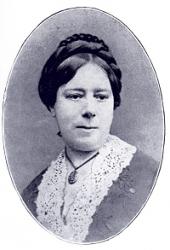
1827 - 1878 Person Name: Catherine Winkworth, 1827-1878 Topics: The Kingdom of God on Earth Home, Marriage, Parents Translator of "Oh, blest the house whate'er befall" in The Hymnal Catherine Winkworth (b. Holborn, London, England, 1827; d. Monnetier, Savoy, France, 1878) is well known for her English translations of German hymns; her translations were polished and yet remained close to the original. Educated initially by her mother, she lived with relatives in Dresden, Germany, in 1845, where she acquired her knowledge of German and interest in German hymnody. After residing near Manchester until 1862, she moved to Clifton, near Bristol. A pioneer in promoting women's rights, Winkworth put much of her energy into the encouragement of higher education for women. She translated a large number of German hymn texts from hymnals owned by a friend, Baron Bunsen. Though often altered, these translations continue to be used in many modern hymnals. Her work was published in two series of Lyra Germanica (1855, 1858) and in The Chorale Book for England (1863), which included the appropriate German tune with each text as provided by Sterndale Bennett and Otto Goldschmidt. Winkworth also translated biographies of German Christians who promoted ministries to the poor and sick and compiled a handbook of biographies of German hymn authors, Christian Singers of Germany (1869).
Bert Polman
========================
Winkworth, Catherine, daughter of Henry Winkworth, of Alderley Edge, Cheshire, was born in London, Sep. 13, 1829. Most of her early life was spent in the neighbourhood of Manchester. Subsequently she removed with the family to Clifton, near Bristol. She died suddenly of heart disease, at Monnetier, in Savoy, in July, 1878. Miss Winkworth published:—
Translations from the German of the Life of Pastor Fliedner, the Founder of the Sisterhood of Protestant Deaconesses at Kaiserworth, 1861; and of the Life of Amelia Sieveking, 1863.
Her sympathy with practical efforts for the benefit of women, and with a pure devotional life, as seen in these translations, received from her the most practical illustration possible in the deep and active interest which she took in educational work in connection with the Clifton Association for the Higher Education of Women, and kindred societies there and elsewhere. Our interest, however, is mainly centred in her hymnological work as embodied in her:—
(1) Lyra Germanica, 1st Ser., 1855. (2) Lyra Germanica, 2nd Ser., 1858. (3) The Chorale Book for England (containing translations from the German, together with music), 1863; and (4) her charming biographical work, the Christian Singers of Germany, 1869.
In a sympathetic article on Miss Winkworth in the Inquirer of July 20, 1878, Dr. Martineau says:—
"The translations contained in these volumes are invariably faithful, and for the most part both terse and delicate; and an admirable art is applied to the management of complex and difficult versification. They have not quite the fire of John Wesley's versions of Moravian hymns, or the wonderful fusion and reproduction of thought which may be found in Coleridge. But if less flowing they are more conscientious than either, and attain a result as poetical as severe exactitude admits, being only a little short of ‘native music'"
Dr. Percival, then Principal of Clifton College, also wrote concerning her (in the Bristol Times and Mirror), in July, 1878:—
"She was a person of remarkable intellectual and social gifts, and very unusual attainments; but what specially distinguished her was her combination of rare ability and great knowledge with a certain tender and sympathetic refinement which constitutes the special charm of the true womanly character."
Dr. Martineau (as above) says her religious life afforded "a happy example of the piety which the Church of England discipline may implant.....The fast hold she retained of her discipleship of Christ was no example of ‘feminine simplicity,' carrying on the childish mind into maturer years, but the clear allegiance of a firm mind, familiar with the pretensions of non-Christian schools, well able to test them, and undiverted by them from her first love."
Miss Winkworth, although not the earliest of modern translators from the German into English, is certainly the foremost in rank and popularity. Her translations are the most widely used of any from that language, and have had more to do with the modern revival of the English use of German hymns than the versions of any other writer.
-- John Julian, Dictionary of Hymnology (1907)
============================
See also in:
Hymn Writers of the Church
Catherine Winkworth
William Pierson Merrill

1867 - 1954 Person Name: William P. Merrill, 1867-1954 Topics: Kingdom of God on Earth Brotherhood Author of "Rise Up, O Men of God" in African Methodist Episcopal Church Hymnal William Pierson Merrill (January 10, 1867 - June 19, 1954) was an American Presbyterian clergyman. He is most remembered for his work on behalf of peace, and for several hymns, most notably "Rise up, O men of God" and "Not alone for mighty empire".
Leland Ross
William Pierson Merrill
James Weldon Johnson
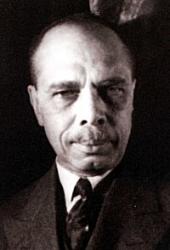
1871 - 1938 Person Name: James Weldon Johnson, 1871-1938 Topics: Kingdom of God on Earth Patriotic Author of "Lift Every Voice and Sing" in African Methodist Episcopal Church Hymnal James Weldon Johnson MA PhD USA 1871-1938. Born at Jacksonville, FL, he attended Clark University, Atlanta, GA, and also spent three months in the backwoods of Georgia., taking in the culture there. While in school he published a paper, ”The daily American newspaper”, which ran for a year until terminated for lack of funding. He graduated in 1894. He then taught at the largest school in Jacksonville, FL, eventually becoming principal and adding 9th & 10th grades there. While there he began preparing for the FL bar exam, taking it in 1897. In 1904 he became treasurer of the Colored Republican Club, becoming its president the following year. He became an author, activist, educator, lawyer, and diplomat. A musician from youth, he collaborated with his brother, Rosamond, also a musician, and Bob Cole to write Broadway songs, and they achieved some success. They also wrote an opera, “Tolosa”, satirizing the U.S. annexation of the Pacific islands. He became a writer and Civil Rights activist. He did the editorial page of the New York Age, an African-American newspaper. In 1916 he became active in the NAACP, and in 1917 he added many chapters to its southern membership. He was its executive secretary (essentially its operating officer) from 1920-1930. He was involved in the campaign to pass the Dyer Anti-lynching Bill. He wrote poems, novels, and anthologies, and collected poems and spirituals from black culture. He wrote the lyrics to the Negro National Anthem, “Lift every voice and sing”, in honor of Booker T Washington, who visited his school and heard the poem recited by 500 school children in his presence, paying tribute to Abraham Lincoln’s birthday. He participated in Theodore Roosevelt’s successful presidential campaign, and was rewarded by receiving an appointment as U.S. Consul to Venezuela (1906-1909), and later to Nicaragua (1909-1913). He married activist,Grace Elizabeth Nail during this period. They had collaborated on a screenwriting project. They had no children. In 1930, after years leading the NAACP, he became professor of creative literature and writing at Fisk University ( a historically black university), Nashville, TN, where he lectured on a wide range of issues. In 1934 he was the first African-American professor hired at New York University, where he taught several classes in literature and culture. He published four works: “Autobiography of an Ex-colored man” (1920) “The book of American negro poetry” (1922/1931), “God’s trombones” (1927), and “Along this way” (1933). In 1938 he supported efforts by Ignatz Waghalter, a Polish-Jewish composer who had escaped the Nazis in Germany, to establish a classical orchestra of African-American musicians. He perished at Wiscasset, ME, while on vacation when the car his wife was driving was hit by a train. She was severely injured, but recovered. More than 2000 people attended his funeral. Several universities named buildings or departments in his honor, as is a community library in St. Petersburg, FL. In 1988 a U.S, postage stamp was printed in his honor.
John Perry
James Weldon Johnson
Ernest Warburton Shurtleff
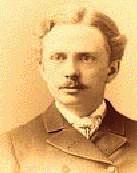
1862 - 1917 Person Name: Rev. Ernest W. Shurtleff Topics: The Kingdom of God on Earth Discipleship and Service Author of "Lead on, O King Eternal" in The Hymnal Before studying at Andover, Ernest W. Shurtleff (Boston, MA, 1862; d. Paris, France, 1917) attended Harvard University. He served Congregational churches in Ventura, California; Old Plymouth, Massachusetts; and Minneapolis, Minnesota, before moving to Europe. In 1905 he established the American Church in Frankfurt, and in 1906 he moved to Paris, where he was involved in student ministry at the Academy Vitti. During World War I he and his wife were active in refugee relief work in Paris. Shurtleff wrote a number of books, including Poems (1883), Easter Gleams (1885), Song of Hope (1886), and Song on the Waters (1913).
Bert Polman
===============
Shurtleff, Ernest Warburton, b. at Boston, Mass., April 4, 1862, and educated at Boston Latin School, Harvard University, and Andover Theo. Seminary (1887). Entering the Congregational Ministry, he was Pastor at Palmer and Plymouth, Mass., and is now (1905) Minister of First Church, Minneapolis, Minn. His works include Poems, 1883, Easter Gleams, 1883, and others. His hymn, "Lead on, O King Eternal" (Christian Warfare), was written as a parting hymn to his class of fellow students at Andover, and was included in Hymns of the Faith, Boston, 1887. It has since appeared in several collections. [M. C. Hazard, Ph.D].
--John Julian, Dictionary of Hymnology, New Supplement (1907)
Ernest Warburton Shurtleff
Henry Van Dyke
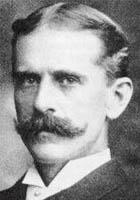
1852 - 1933 Person Name: Rev. Henry van Dyke Topics: The Kingdom of God on Earth The Nation Author of "O Lord, our God, Thy mighty hand" in The Hymnal
See biography and works at CCEL
Henry Van Dyke
William Crotch
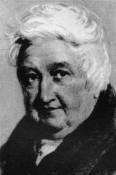
1775 - 1847 Topics: Kingdom of God on Earth, The Missions Adapter of "ST. MICHAEL" in The Hymnbook William Crotch (5 July 1775 – 29 December 1847) was an English composer, organist and artist.
Born in Norwich, Norfolk to a master carpenter he showed early musical talent as a child prodigy. The three and a half year old Master William Crotch was taken to London by his ambitious mother, where he not only played on the organ of the Chapel Royal in St James's Palace, but for King George III. The London Magazine of April 1779 records:
He appears to be fondest of solemn tunes and church musick, particularly the 104th Psalm. As soon as he has finished a regular tune, or part of a tune, or played some little fancy notes of his own, he stops, and has some of the pranks of a wanton boy; some of the company then generally give him a cake, an apple, or an orange, to induce him to play again...
Crotch was later to observe that this experience led him to become a rather spoiled child, excessively indulged so that he would perform.
He was for a time organist at Christ Church, Oxford, from which he was later to graduate with a Bachelor of Music degree.
His composition The Captivity of Judah was played at Trinity Hall, Cambridge, on 4 June 1789; his most successful composition in adulthood was the oratorio Palestine (1812). He may have composed the Westminster Chimes in 1793.
In 1797 Crotch was given a professorship at Oxford University, and in 1799 he acquired a doctorate in music. While at Oxford, he became acquainted with the musician and artist John Malchair, and took up sketching. He followed Malchair's style in recording the exact time and date of each of his pictures, and when he met John Constable in London in 1805, he passed the habit along to the more famous artist.
In 1834, to commemorate the installation of the Duke of Wellington as chancellor of the University of Oxford, Crotch penned a second oratorio titled The Captivity of Judah. The 1834 work bears little resemblance to the oratorio he wrote as a child in 1789.
In 1822, Crotch was appointed to the Royal Academy of Music as its first Principal, but resigned ten years later.[2] He spent his last years at his son's house in Taunton, Somerset, where he died suddenly in 1847. Among his notable pupils were William Sterndale Bennett, Lucy Anderson, Stephen Codman, George Job Elvey, Cipriani Potter, and Charles Kensington Salaman
--en.wikipedia.org/
William Crotch
Pages