

 My Starred Hymns
 My FlexScores
 My Hymnals
 My Purchased Files
Planning worship?
Check out our sister site, ZeteoSearch.org,
for 20+ additional resources related to your search.
- |
User Links
Person Results
Shelly Hamilton
b. 1954 Meter: 8.7.8.7.8.7.7 Arranger (Last st.) of "CWM RHONDDA" in Rejoice Hymns
Shelly Hamilton
David Iliff
? - 2024 Person Name: David Iliff (born 1939) Meter: 8.7.8.7.8.7.7 Composer (descant) and Arranger of "CORDE NATUS" in Hymns for Today's Church (2nd ed.)
David Iliff
Theodore E. Perkins
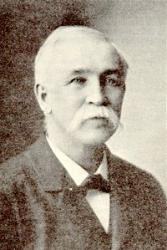
1831 - 1912 Person Name: Theodore Edson Perkins Meter: 8.7.8.7.8.7.7 Composer of "NAGPUR" in The Cyber Hymnal Theodore E. Perkins was born at Poughkeepsie, on the Hudson, N.Y., July 21, 1831. His father was a Baptist clergyman. The family of ten brothers and sisters sang and played various instruments, forming among themselves both choir and orchestra. His musical education began at the early age of three years. During his father's pastorate at Hamilton, N. Y., the choir rehearsals were often held at the parsonage, and the leader used to place the three-year-old on a small stool, on the table around which the choir was assembled, giving him a chance to both see and hear. Later on he played the violincello in church, standing on a stool in order to finger the instrument.
The home gatherings — especially on Thanksgiving Day, are the recollections among the happiest of his childhood. His father became pastor of the Berean Baptist Church in New York City, in 1839, giving him the opportunity of studying the pianoforte, of which he became a proficient player. His fine alto voice soon gave him notoriety. At the age of nineteen while filling a position as clerk in New York, all his spare time was given to the study of voice and piano. In 1851 he went to Hamilton, N. Y., taught music in Madison University (now Colgate), and in the Female Seminary.
In 1854 he went to Port Jervis, N. Y., where he taught singing school, and April 30, 1855, married Mary Frances Caskey, who was for years his soprano soloist in many musical Festivals and Conventions. Soon after marriage he removed to Salem, N. J., where his lifework as singing school teacher really began, including Bridgeton and prominent towns in southern New Jersey. During the summer of 1856 he and his wife were pupils of the Normal Academy of Music at North Reading, Mass., conducted by Drs. Lowell Mason and Geo. F. Root. During 1856-1858 he was given the position of assistant teacher and manager. His association with these two great men gave an inspiration to all his future work.
In 1859 he was co-principal with Wm. B. Bradbury at the Normal Academy of Music, Geneseo, N. Y. He remained at Geneseo until 1863. Professor Perkins also held very successful schools in North Pelham Province of Ontario, Canada, and in 1864-1868 was principal in schools at Tunkhannock and Meadville, Pa.
In 1860, The Olive Branch, his first book of church music, was published by F. J. Huntington, New York City, the sales reaching 100,000. Next was Oriental, which sold over 30,000. The Union, Glees and Anthems, and Sabbath Anthems followed ; then The Sacred Lute, which sold over 300,000. His Sunday-school books commenced with The Evergreen, followed by the Shining Star and New Shining Star. Then came Psalm King, which was the last of the books published by Mr. Huntington. Hallowed Songs was published by Philip Phillips; The Sunday School Banner was published by Wm. B. Bradbury. The Royal Standard was published in Toronto, Canada. The Golden Promise, Sabbath Carols, The Mount Zion Collection were published under his own supervision.
His Free Sunday School Songs several times numbered over 500,000 a month. Coronation Songs with Rev. Dr. Deems as hymn editor was published by A. S. Barnes Co., who also published Psalms and Hymns and Spiritual Songs, in which Dr. C. S. Robinson was hymn editor, who with Professor Perkins edited Calvary Songs, published by the American S. S. Union. Gospel Tent Songs was evangelical. The Safe-Guard Singer was his temperance book.
Mr. Perkins was musical director in the following churches in Brooklyn: The Lafayette Avenue Presbyterian Church, Rev. Dr. Cuyler; Strong Place Baptist Church, Rev. E. E. L. Taylor, D. D.; Madison Avenue Baptist Church, Rev. H. G. Weston, D. D., L. L. D.; Fifth Avenue Presbyterian Church, Rev. Dr. Rice, followed by Dr. John Hall; The Memorial Presbyterian Church, Rev. Dr. C. S. Robinson, who was his close friend; The Church of the Holy Trinity, Rev. Dr. Tyng, Jr. ; Trinity Baptist Church, Rev. Dr. J. B. Simmons, and Washington Square M. E. Church.
In Philadelphia: The Fifth Baptist Church, Rev. Dr. Chase; The Eleventh Baptist Church, Rev. Dr. Colman; The Tabernacle M. E. Church, Rev. George Gaul, D. D. He was leader and singer in Evangelistic Services, at the Rink, The Old Madison Square Garden and Cooper Union, all of New York City. The music of the first great meeting of the world's Evangelical Alliance, held for ten days in New York City, was under his direction, as was the first National Sunday School convention, held in Newark, N. J. He was also conductor at the Golden Anniversary of the Female Guardian Society, leading a chorus of forty-two hundred children. In the opening chorus, Great is the Lord, by Dr. Calcott, the word "Great" was given with so much decision and power that the clergymen on the platform sprang to their feet and remained standing until the chorus was finished.
He taught voice culture in Princeton and Lafayette Universities, The Union Theological Seminary, New York City; Crozer Seminary, Chester, Pa., and organized the music department of Temple University, Philadelphia, continuing in charge four years. He had charge of the children's choir of Howard Mission, New York City, for twenty-five years, and thinks that some of the happiest and most restful of the working hours were spent in teaching the poor children of the fourth and sixth wards to sing the Gospel. Mr. Sankey said to Mr. Perkins that " Jesus of Nazareth was my banner song for eight years." Jesus is Mine has been sung at the Christian's death-bed, the grave, and once as the convict was going to the scaffold.
His Christmas Carol Sweetly Carol had a very large sale in this country, and was republished in England, France, Italy, and Germany.
For a period of forty years he has made the study of the voice special work. The most thorough investigations of the voice and its possibilities were made with the assistance of the late John Howard, extending over a period of twenty-five years, during which he has had the care of over two thousand voices. He published a work entitled, Physiological Yoice Culture, edited by his son, the late T. Edward Perkins, M. D., physician and throat specialist of Philadelphia. Mr. Perkins also completed a method of voice culture based on the principles of John Howard's Physiology of Artistic Singing."
During these years of work he has found time to edit thirty-four books of church, Sunday-school, day-school, and glee music, the larger portion having been previously mentioned. Also songs and ballads in sheet form, and a cantata entitled, The Excursion, libretto by Fanny Crosby, with whom there has existed an unbroken friendship for over forty years.
-Biography of Gospel Song and hymn Writers
Theodore E. Perkins
Severus Gastorius
1646 - 1682 Meter: 8.7.8.7.8.7.7 Composer of "GASTORIUS" in The Cyber Hymnal Severus Gastorius (1647-1682 ) was a cantor in Jena, central Germany.
The son of a Weimar school teacher, Severus was born with the family name Bauchspiess (later Latinised to Gastorius) in Oettern, near Weimar. In 1667, he started studying at the University of Jena. From 1670, he deputized for cantor Andreas Zöll in Jena and married his daughter the following year. Gastorius assumed Zöll's position after his death in 1677. One of his friends, Samuel Rodigast, wrote the hymn "Was Gott tut, das ist wohlgetan" for Gastorius when he was sick (to cheer him up as Rodigast writes in his dedication). Even before he recovered, Gastorius set it to music based on a melody by Werner Fabricius. The tune became widely known in Germany as the cantor students of Jena cantor sang it every week at Gastorius' door as well as when they returned home. Gastorius was buried on 8 May 1682 in Jena's Johanniskirche cemetery. Gastorius had requested that the hymn "Was Gott tut, das ist wohlgetan" be sung at his funeral.
Gastorius is also credited with composing music for the funeral motet Du aber gehe hin bis das Ende komme. It was sung at the funeral of the Jena professor of medicine Johann Arnold Friderici on 2 June 1672.
--en.wikipedia.org/wiki/
Severus Gastorius
Johan Olof Wallin
1779 - 1839 Meter: 8.7.8.7.8.7.7 Author of "Heavenly Light, Benignly Beaming" in The Hymnal and Order of Service Johan Olaf Wallin was born at Stora Tuna, in 1779, and early displayed his poetical powers. In 1805, and again in 1809, he gained the chief prize for poetry at Upsala. In the latter year he became pastor at Solna; here his ability as a preacher was so striking that he was transferred to Stockholm, in 1815, as "pastor primarius," a title for which we have no exact equivalent. In 1818 he was made Dean of Westeras, and set about the task of editing a revised hymn-book for the whole of Sweden. This task he completed in 1819, and published it as, Den Swenska Psalmboken, af Konungen gillad och stadfästad (The Swedish hymn-book, approved and confirmed by the King). To it he contributed some 150 hymns of his own, besides translations and recastings; and the book remains now in the form in which he brought it out. It is highly prized by the Swedes, and is in use everywhere.
--John Julian, Dictionary of Hymnology, p. 1000 (1907)
Johan Olof Wallin
James Drummond Burns
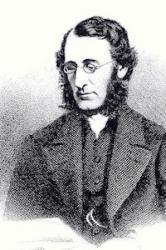
1823 - 1864 Person Name: James D. Burns Meter: 8.7.8.7.8.7.7 Translator of "We Wait For Thee, O Glorious One" in The Cyber Hymnal Burns, James Drummond, M.A., was born at Edinburgh, February 18, 1823. He studied and graduated M.A. at the University of Edinburgh. In 1845 he became Free Church minister of Dunblane, but resigned through failing health, in 1848, and took charge of the Presbyterian Church at Funchal, Madeira. In 1855 he became minister of Hampstead Presbyterian Church, London. Died at Mentone, Nov. 27, 1864, and was buried in Highgate Cemetery, London.
His hymns appeared in:—
(l) The Vision of Prophecy: and other Poems (Edin., Edmonston and Douglas). This was originally published in 1854, and enlarged in 1858. The Poems are distinguished by vivid colouring and poetic imagination, along with directness, delicacy of execution, pensive sweetness, and tenderness. They have never however become widely popular. Included are 29 "Hymns and Meditations," many of which rank among the very best of our modern hymns for beauty, simplicity of diction, and depth of religious feeling. (2) The Evening Hymn (Lond., T. Nelson & Sons), 1857. This consists of an original hymn and an original prayer for every evening in the month— 31 in all. The Hymns and Prayers alike are characterised by reverence, beauty, simplicity, and pathos. Some of the hymns in this volume are now well known; e.g. "Still with Thee, 0 my God," "Hushed was the evening hymn," "As helpless as a child who clings." (3) Memoir and Remains of the late Rev. James D. Burns, M.A., of Hampstead. By the late Rev. James Hamilton, D.D. (London, J. Nisbet & Co.), 1869. Besides 13 Sermons and the Memoir, this work includes 40 “Hymns and Miscellaneous Pieces." A number of these had appeared in periodicals. Some of them are very good though not equal to those previously published. Also 39 translations of German hymns, which appeared in the Family Treasury, &c., are rendered exactly in the metres of the originals and many had not previously been translated. The translations are generally very good. (4) Burns also wrote the article Hymn in the 8th edition of the Encyclopedia Britannica. [Rev. James Mearns, M.A.]
-- John Julian, Dictionary of Hymnology (1907)
=====================
Burns, James Drummond, p, 197, i. Additional hymns in common use are:—
1. Not, Lord, unto that mount of dread. Safety in Christ. From Vision of Prophecy, 1st ed., 1854, p. 266.
2. O Thou whose tender [sacred] feet have trod. Resignation. From Vision of Prophecy, 1st ed., 1854, p. 227.
3. Thou, Lord, art love, and everywhere. Divine Love. From Vision of Prophecy, 2nd ed., 1858, p. 275.
--John Julian, Dictionary of Hymnology, Appendix, Part II (1907)
See also in:
Hymn Writers of the Church
James Drummond Burns
R. F. Davis
1866 - 1937 Meter: 8.7.8.7.8.7.7 Translator (st. 2) of "Of the Father's Love Begotten (Of Eternal Love Begotten)" in Chalice Hymnal Davis, Robert Furley, M.A., was born Jan. 22, 1866, at Nottingham, and educated at St. John's College, Cambridge (B.A. 1888, M.A. 1896). He is now (1906) senior classical master at Campbell College, Belfast, Ireland. He is the author of seven translations in The Hymns of Prudentius, Translated by B. Martin Pope and R. F. Davis, 1905, one of which is in The English Hymnal, 1906, No. 613. [Rev. James Mearns, M.A.]
--John Julian, Dictionary of Hymnology, New Supplement (1907)
R. F. Davis
William H. Walter
1825 - 1893 Person Name: William Henry Walter Meter: 8.7.8.7.8.7.7 Composer of "PRUDENTIUS"
William H. Walter
Ernest White
1899 - 1980 Person Name: Ernest White, 1899- Meter: 8.7.8.7.8.7.7 Arranger of "DIVINUM MYSTERIUM (CORDE NATUS EX PARENTIS)" in Service Book and Hymnal of the Lutheran Church in America
Ernest White
Andrew Daniels
Meter: 8.7.8.7.8.7.7 Harmonizer of "DIVINUM MYSTERIUM" in Celebrating Grace Hymnal
Andrew Daniels
Pages