You help make Hymnary.org possible. More than 10 million people from 200+ countries found hymns, liturgical resources and encouragement on Hymnary.org in 2025, including you. Every visit affirms the global impact of this ministry.

If Hymnary has been meaningful to you this year, would you take a moment today to help sustain it? A gift of any size—paired with a note of encouragement if you wish—directly supports the server costs, research work and curation that keep this resource freely available to the world.

Give securely online today, or mail a check to:
Hymnary.org
Calvin University
3201 Burton Street SE
Grand Rapids, MI 49546

Thank you for your partnership, and may the hope of Advent fill your heart.

Person Results

Topics:god in nature
In:people

Planning worship? Check out our sister site, ZeteoSearch.org, for 20+ additional resources related to your search.
Showing 41 - 50 of 447Results Per Page: 102050

Hugh Wilson

1766 - 1824 Person Name: Hugh Wilson, 1766-1824 Topics: God: His Attributes, Works and Word God in Nature, Providence and Redemption Composer of "MARTYRDOM" in The Book of Praise Hugh Wilson (b. Fenwick, Ayrshire, Scotland, c. 1766; d. Duntocher, Scotland, 1824) learned the shoemaker trade from his father. He also studied music and mathematics and became proficient enough in various subjects to become a part-­time teacher to the villagers. Around 1800, he moved to Pollokshaws to work in the cotton mills and later moved to Duntocher, where he became a draftsman in the local mill. He also made sundials and composed hymn tunes as a hobby. Wilson was a member of the Secession Church, which had separated from the Church of Scotland. He served as a manager and precentor in the church in Duntocher and helped found its first Sunday school. It is thought that he composed and adapted a number of psalm tunes, but only two have survived because he gave instructions shortly before his death that all his music manuscripts were to be destroyed. Bert Polman

Johann Anastasius Freylinghausen

1670 - 1739 Person Name: J. A. Freylinghausen, 1670-1739 Topics: God in Nature Composer of "MONKLAND" in The New English Hymnal Freylinghausen, Johann Anastasius, son of Dietrich Freylinghausen, merchant and burgomaster at Gandersheim, Brunswick, was born at Gandersheim, Dec. 2, 1670. He entered the University of Jena at Easter, 1689. Attracted by the preaching of A. H. Francke and J. J. Breithaupt, he removed to Erfurt in 1691, and at Easter, 1692, followed them to Halle. About the end of 1693 he returned to Gandersheim, and employed himself as a private tutor. In 1695 he went to Glaucha as assistant to Francke; and when Francke became pastor of St. Ulrich's, in Halle,1715, Freylinghausen became his colleague, and in the same year married his only daughter. In 1723 he became also sub-director of the Paedagogium and the Orphanage; and after Francke's death in 1727, succeeded him as pastor of St. Ulrich's and director of the Francke Institutions. Under his fostering care these Institutions attained their highest development. From a stroke of paralysis in 1728, and a second in 1730, he recovered in great measure, but a third in 1737 crippled his right side, while the last, in Nov., 1738, left him almost helpless. He died on Feb. 12, 1739, and was buried beside Francke (Koch, vi. 322-334; Allgemine Deutsche Biographie, vii. 370-71; Bode, pp. 69-70; Grote's Introduction, &c.) Almost all Freylinghausen's hymns appeared in his own hymnbook, which was the standard collection of the Halle school, uniting the best productions of Pietism with a good representation of the older "classical" hymns. This work, which greatly influenced later collections, and was the source from which many editors drew not only the hymns of Pietism, but also the current forms of the earlier hymns (as well as the new "Halle" melodies, a number of which are ascribed to Freylinghausen himself) appeared in two parts, viz.:— i. Geistreiches Gesang-Buch, den Kern alter und neuer Lieder...in sich haltend &c, Halle. Gedrucktund verlegt im Waysen-Hause, 1704 [Hamburg], with 683 hymns and 173 melodies. To the second edition, 1705 [Rostock University], an Appendix was added with Hymns 684-758, and 21 melodies. Editions 3-18 are practically the same so far as the hymns are concerned, save that in ed. 11, 1719 [Berlin], and later issues, four hymns, written by J. J. Rambach at Freylinghausen's request, replaced four of those in eds. 1-10. ii. Neues Geistreiches Gesangbuch,&c, Halle . . . 1714 [Berlin], with 815 hymns and 154 melodies. In the 2nd edition, 1719 [Rostock University], Hymns 816-818, with one melody, were added. In 1741 these two parts were combined by G. A. Francke, seven hymns being added, all but one taken from the first edition, 1718, of the so-called Auszug, which was compiled for congregational use mainly from the original two parts: and this reached a second, and last, edition in 1771. So far as the melodies are concerned, the edition of 1771 is the most complete, containing some 600 to 1582 hymns. (Further details of these editions in the Blätter für Hymnologie, 1883, pp. 44-46, 106-109; 1885, pp. 13-14.) A little volume of notes on the hymns and hymnwriters of the 1771 edition, compiled by J. H. Grischow and completed by J. G. Kirchner, and occasionally referred to in these pages, appeared as Kurzgefasste Nachricht von ältern und ncuern Liederverfassern at Halle, 1771. As a hymnwriter Freylinghausen ranks not only as the best of the Pietistic school, but as the first among his contemporaries. His finest productions are distinguished by a sound and robust piety, warmth of feeling depth of Christian experience, scripturalness, clearness and variety of style, which gained for them wide acceptance, and have kept them still in popular use. A complete edition of his 44 hymns, with a biographical introduction by Ludwig Grote, appeared as his Geistliche Lieder, at Halle, 1855. A number of them, including No. v., are said to have been written during severe attacks of toothache. Two (“Auf, auf, weil der Tag erschienen"; "Der Tag ist hin") are noted under their own first lines. i. Hymns in English common use: -- i. Monarche aller Ding. God's Majesty. 1714, as above, No. 139, in 11 stanzas of 6 lines, repeated in Grote, 1855, p. 88, and as No. 38 in the Berlin Geistliche Lieder, ed. 1863. A fine hymn of Praise, on the majesty and love of God. Translated as:— Monarch of all, with lowly fear, by J. Wesley, in Hymns & Sacred Poems, 1739 (P. Works, 1868-1872, vol. i. p. 104), in 8 stanzas of 4 lines, from st. i., ii., v.-vii., ix.-xi. Repeated in full in the Moravian Hymnbook, 1754, pt. i., No. 456 (1886, No. 176); and in J. A. Latrobe's Collection, 1841. The following forms of this translation are also in common use:-- (1) To Thee, 0 Lord, with humble fear, being Wesley's st. i., iii.-v., vii., viii. altered as No. 156 in Dr. Martineau's Hymns for Christian Church & Home, 1840, and repeated in Miss Courtauld's Psalms, Hymns & Anthems, 1860, and in America in the Cheshire Association Unitarian Collection, 1844. (2) Thou, Lord, of all the parent art, Wesley's, st. iii.-v., vii. altered in the College Hymnal, N. Y., 1876. (3) Thou, Lord, art Light; Thy native ray, Wesley's st. iv., v., vii., in Hymns of the Spirit, 1864. ii. 0 reines Wesen, lautre Quelle. Penitence. Founded on Psalm li. 12, 1714, as above, No. 321, in 7 stanzas of 8 lines, repeated in Grote, 1855, p. 41, and in Bunsen's Versuch, 1833, No. 777 (ed. 1881, No. 435). The only translation in common use is:— Pure Essence: Spotless Fount of Light. A good and full translation by Miss Winkworth in the first series of her Lyra Germanica, 1855, p. 43, and in her Chorale Book for England, 1863, No. 113. iii. Wer ist wohl wie du. Names and offices of Christ. One of his noblest and most beautiful hymns, a mirror of his inner life, and one of the finest of the German "Jesus Hymns." 1704, as above, No. 66, in 14 st. of 6 l., repeated in Grote, 1855, p. 33, and is No. 96 in the Berlin Geistliche Lieder, ed. 1863. The translations in common use are: 1. 0 Jesu, source of calm repose, by J. Wesley, being a free translation of st. i., iii., v., viii., xiii. First published in his Psalms & Hymns, Charlestown, 1737 (Poetical Works, 1868-1872, vol. i. p. 161). Repeated in full as No. 462 in pt. i. of the Moravian Hymnbook, 1754. In the 1826 and later editions (1886, No. 233) it begins, "Jesus, Thou source." The original form was included as No. 49 in the Wesley Hymns & Spiritual Songs , 1753, and, as No. 343, in the Wesley Hymnbook, 1780 (1875, No. 353). Varying centos under the original first line are found in Mercer's Church Psalter & Hymn Book, 1855-1864; Kennedy , 1863; Irish Church Hymnal, 1869-1873; J. L. Porter's Collection, 1876, &c. It has also furnished the following centos:— (1) Messiah! Lord! rejoicing still, being Wesley's st. iv.-vi. altered in Dr. Martineau's Collection of Hymns for Christian Worship, 1840. (2) Lord over all, sent to fulfil, Wesley's st. iv., iii., v., vi. in the American Methodist Episcopal Hymnbook, 1849. 2. Who is like Thee, Who? a translation of st. i., ii., v., vii., x., xiii., as No. 687, in pt. i. of the Moravian Hymnbook, 1754. Translations of st. xi., xiv. were added in 1789, and the first line altered in 1801(1886, No. 234), to "Jesus, who with Thee." The translations of st. i., ii., x., xiv., from the 1801, altered and beginning, "Jesus, who can be," are included in America in the Dutch Reformed Hymns of the Church, 1869; Hymns & Songs of Praise, N. Y., 1874; and Richards's Collection, N.Y., 1881. 3. Who is there like Thee, a good translation of st. i., ii., viii., xiv., by J. S. Stallybrass, as No. 234 in Curwen's Sabbath Hymnbook, 1859, repeated in the Irish Church Hymnal, 1873, and in W. F. Stevenson's Hymns for Church & Home, 1873. 4. Who is, Jesus blest, a translation of stanzas i., ii., v., vi., xii., xiv., by M. Loy, in the Ohio Lutheran Hymnal, 1880. 5. Who, as Thou, makes blest, a good translation, omitting st. vii., ix., x., contributed by Dr. F. W Gotch to the Baptist Magazine, 1857. Repeated in the 1880 Supplement to the Baptist Psalms & Hymns, 1858. The translations not in common use are: — (1) "Whither shall we flee," by Miss Dunn, 1857, p. 55. (2) "Who has worth like Thine," in the U. P. Juvenile Miss. Magazine, 1857, p. 217. (3) "Thou art First and Best," by Miss Winkworth, 1869, p. 267. ii. Hymns translated into English but not in common use:— iv. Herr und Gott der Tag und Nächte. Evening. 1705, as above, No. 755, in 6 stanzas, Grote, p. 105. Translated by H. J. Buckoll, 1842, p. 106, beginning with stanza. ii. v. Mein Herz, gieb dioh rufrieden. Cross and Consolation. First in the Halle Stadt Gesangbuch, 1711, No. 503, in 11 stanzas; repeated 1714, No. 450, and in Grote, p. 71. Translated by Dr. G. Walker, 1860, p. 86. vi. 0 Lamm, das keine Sünde je beflecket. Passiontide. 1714, No. 85, in 19 stanzas, Grote, p. 14. Translated as, (1) "Lamb, for Thy boundless love I praises offer," of st. xii. as stanza i. of No. 1023 in the Supplement of 1808 to the Moravian Hymn Book, 1801 (1849, No. 121). (2) "O Lamb, whom never spot of sin defiled," in the British Magazine, June, 1838, p. 625. vii. 0 Lamm, das meine Sündenlast getragen. Easter Eve. 1714, No. 95, in 8 stanzas; Grote, p. 23. Translated as "Christ Jesus is that precious grain," a translation of st. v. by F. W. Foster, as No. 71 in the Moravian Hymnbook, 1789 (1886, No. 921). viii. Zu dir, Herr Jesu, komme ich. Penitence. Founded on St. Matthew xi. 28-30. 1714, as above, No. 306, in 4 stanzas; Grote, p. 39. Translated by Dr. H. Mills, 1845 (1856, p. 80). [Rev. James Mearns, M.A.] --John Julian, Dictionary of Hymnology (1907)

William Walsham How

1823 - 1897 Person Name: Bishop W. Walsham How Topics: God in Nature Author of "Summer suns are glowing" in The Book of Common Praise William W. How (b. Shrewsbury, Shropshire, England, 1823; d. Leenane, County Mayo, Ireland, 1897) studied at Wadham College, Oxford, and Durham University and was ordained in the Church of England in 1847. He served various congregations and became Suffragan Bishop in east London in 1879 and Bishop of Wakefield in 1888. Called both the "poor man's bishop" and "the children's bishop," How was known for his work among the destitute in the London slums and among the factory workers in west Yorkshire. He wrote a number of theological works about controversies surrounding the Oxford Movement and attempted to reconcile biblical creation with the theory of evolution. He was joint editor of Psalms and Hymns (1854) and Church Hymns (1871). While rector in Whittington, How wrote some sixty hymns, including many for chil­dren. His collected Poems and Hymns were published in 1886. Bert Polman =============== How, William Walsham, D.D., son of William Wybergh How, Solicitor, Shrewsbury, was born Dec. 13, 1823, at Shrewsbury, and educated at Shrewsbury School and Wadham College, Oxford (B.A. 1845). Taking Holy Orders in 1846, he became successively Curate of St. George's, Kidderminster, 1846; and of Holy Cross, Shrewsbury, 1848. In 1851 he was preferred to the Rectory of Whittington, Diocese of St. Asaph, becoming Rural Dean in 1853, and Hon. Canon of the Cathedral in 1860. In 1879 he was appointed Rector of St. Andrew's Undershaft, London, and was consecrated Suffragan Bishop for East London, under the title of the Bishop of Bedford, and in 1888 Bishop of Wakefield. Bishop How is the author of the Society for Promoting Christian Knowledge Commentary on the Four Gospels; Plain Words , Four Series; Plain Words for Children; Pastor in Parochia; Lectures on Pastoral Work; Three All Saints Summers, and Other Poems , and numerous Sermons , &c. In 1854 was published Psalms and Hymns, Compiled by the Rev. Thomas Baker Morrell, M.A., . . . and the Rev. William Walsham How, M.A. This was republished in an enlarged form in 1864, and to it was added a Supplement in 1867. To this collection Bishop How contributed several hymns, and also to the S. P. C. K. Church Hymns , of which he was joint editor, in 1871. The Bishop's hymns in common use amount in all to nearly sixty. Combining pure rhythm with great directness and simplicity, Bishop How's compositions arrest attention more through a comprehensive grasp of the subject and the unexpected light thrown upon and warmth infused into facia and details usually shunned by the poet, than through glowing imagery and impassioned rhetoric. He has painted lovely images woven with tender thoughts, but these are few, and found in his least appreciated work. Those compositions which have laid the firmest hold upon the Church, are simple, unadorned, but enthusiastically practical hymns, the most popular of which, "O Jesu, Thou art standing"; "For all the Saints who from their labours rest," and "We give Thee but Thine own," have attained to a foremost rank. His adaptations from other writers as in the case from Bishop Ken, "Behold, the Master passeth by," are good, and his Children's hymns are useful and popular. Without any claims to rank as a poet, in the sense in which Cowper and Montgomery were poets, he has sung us songs which will probably outlive all his other literary works. The more important of Bishop How's hymns, including those already named, and "Lord, Thy children guide and keep"; "O Word of God Incarnate"; "This day at Thy creating word"; "Who is this so weak and helpless"; and others which have some special history or feature of interest, are annotated under their respective first lines. The following are also in common use:— i. From Psalms & Hymns, 1854. 1. Before Thine awful presence, Lord. Confirmation. 2. Jesus, Name of wondrous love [priceless worth]. Circumcision. The Name Jesus . 3. Lord Jesus, when we stand afar. Passiontide. 4. O blessing rich, for sons of men. Members of Christ. 5. 0 Lord of Hosts, the earth is Thine. In time of War. 6. O Lord, Who in Thy wondrous love. Advent. ii. From Psalms & Hymns, enlarged, 1864. 7. Lord, this day Thy children meet. Sunday School Anniversary. iii. From Supplement to the Psalms & Hymns, 1867. 8. Hope of hopes and joy of joys. Resurrection. 9. 0 daughters blest of Galilee. For Associations of Women. 10. O happy feet that tread. Public Worship. 11. With trembling awe the chosen three. Transfiguration. iv. From Parish Magazine, 1871, and Church Hymns, 1871. 12. O Jesu, crucified for man. Friday. 13. Yesterday, with worship blest. Monday. v. From the S. P. C. K. Church Hymns. 1871. 14. Bowed low in supplication. For the Parish. 15. Great Gabriel sped on wings of light. Annunciation, of the Blessed Virgin Mary. 16. O blest was he, whose earlier skill. St. Luke. 17. O God, enshrined in dazzling light. Omnipresence. Divine Worship . 18. O heavenly Fount of Light and Love. Witsuntide. 19. O Lord, it is a blessed thing. Weekdays. 20. 0 One with God the Father. Epiphany. 21. O Thou through suffering perfect made. Hospitals. 22. Rejoice, ye sons of men. Purification of the B. V. M. 23. Summer suns are glowing. Summer. 24. The year is swiftly waning. Autumn. 25. Thou art the Christ, O Lord. St. Peter. 26. To Thee our God we fly. National Hymn. 27. Upon the holy Mount they stood. Transfiguration and Church Guilds. 28. We praise Thy grace, 0 Saviour. St. Mark. vi. From the S. P. C. K. Children's Hymns, 1872. 29. Behold a little child. Jesus the Child's Example. 30. Come, praise your Lord and Saviour. Children's Praises. 31. It is a thing most wonderful. Sunday School Anniversary. 32. On wings of living light. Easter. Bishop How's hymns and sacred and secular pieces were collected and published as Poems and Hymns, 1886. The Hymns, 54 in all, are also published separately. He d. Aug. 10, 1897. --John Julian, Dictionary of Hymnology (1907) =================== How, W. W., p. 540, i. He died Aug. 10, 1897. His Memoir, by F. D. How, was published in 1898. --John Julian, Dictionary of Hymnology, New Supplement (1907)

George William Warren

1828 - 1902 Person Name: George W. Warren Topics: God in Nature Composer of "NATIONAL HYMN" in Psalter Hymnal (Red) George W. Warren (b. Albany, NY, 1828; d. New York, 1902) received his general education at Racine College in Wisconsin, but as a musician he was largely self-trained. An organist in a number of Episcopal churches, he played the organ for thirty years (1870-1900) at St. Thomas Church in New York City. Warren composed anthems and liturgical service music; his hymn tunes were collected in Warren's Hymns and Tunes as Sung in St. Thomas Church (1888). Bert Polman

Josiah Conder

1789 - 1855 Person Name: Josiah Conder, 1789-1855 Topics: God: His Attributes, Works and Word God in Nature, Providence and Redemption Author of "The Lord is King! lift up thy voice" in The Book of Praise Josiah Conder was born in London, in 1789. He became a publisher, and in 1814 became proprietor of "The Eclectic Review." Subsequently to 1824, he composed a series of descriptive works, called the "Modern Traveller," which appeared in thirty volumes. He also published several volumes of poems and hymns. He was the author of the first "Congregational Hymn Book" (1836). He died in 1855. --Annotations of the Hymnal, Charles Hutchins, M.A. 1872. ========================== Conder, Josiah, fourth son of Thomas Conder, engraver and bookseller, and grandson of the Rev. John Conder, D.D., first Theological Tutor of Homerton College, was born in Falcon Street (City); London, Sept. 17, 1789, and died Dec. 27, 1855. As author, editor and publisher he was widely known. For some years he was the proprietor and editor of the Eclectic Review, and also editor of the Patriot newspaper. His prose works were numerous, and include:— The Modern Traveller, 1830; Italy, 1831; Dictionary of Ancient and Modern Geography, 1834; Life of Bunyan, 1835; Protestant Nonconformity, 1818-19; The Law of the Sabbath, 1830; Epistle to the Hebrews (a translation), 1834; Literary History of the New Testament, 1845, Harmony of History with Prophecy, 1849, and others. His poetical works are:— (1) The Withered Oak,1805; this appeared in the Athenceum. (2) The Reverie, 1811. (3) Star in the East, 1824. (4) Sacred Poems, Domestic Poems, and Miscellaneous Poems, 1824. (5) The Choir and the Oratory; or, Praise and Prayer, 1837. Preface dated Nov. 8, 1836. (6) Hymns of Praise, Prayer, and Devout Meditation, 1856. This last work was in the press at the time of his death, and was revised and published by his son, the Rev. E. R. Conder, M.A. He also contributed many pieces to the magazines and to the Associated Minstrels, 1810, under the signature of " C." In 1838, selections from The Choir and Oratory were published with music by Edgar Sanderson, as Harmonia Sacra. A second volume was added in 1839. To Dr. Collyer’s (q.v.) Hymns, &c, he contributed 3 pieces signed "C"; and to Dr. Leifchild's Original Hymns, 1843, 8 hymns. As a hymn-book editor he was also well known. In 1836 he edited The Congregational Hymn Book: a Supplement to Dr. Watts’s Psalms and Hymns (2nd ed. 1844). To this collection he contributed fifty-six of his own hymns, some of which had previously appeared in The Star in the East, &c. He also published in 1851 a revised edition of Dr. Watts's Psalms and Hymns, and in the game year a special paper on Dr. Watte as The Poet of the Sanctuary, which was read before the Congregational Union at Southampton. The value of his work as Editor of the Congregational Hymn Book is seen in the fact that eight out of every ten of the hymns in that collection are still in use either in Great Britain or America. As a hymn writer Conder ranks with some of the best of the first half of the present century. His finest hymns are marked by much elevation of thought expressed in language combining both force and beauty. They generally excel in unity, and in some the gradual unfolding of the leading idea is masterly. The outcome of a deeply spiritual mind, they deal chiefly with the enduring elements of religion. Their variety in metre, in style, and in treatment saves them from the monotonous mannerism which mars the work of many hymn writers. Their theology, though decidedly Evangelical, is yet of a broad and liberal kind. Doubtless Conder's intercourse with many phases of theological thought as Editor of the Eclectic Review did much to produce this catholicity, which was strikingly shewn by his embodying many of the collects of the Book of Common Prayer, rendered into verse, in his Choir and Oratory. Of his versions of the Psalms the most popular are "How honoured, how dear" (84th), and "O be joyful in the Lord" (100th). His hymns in most extensive use are," Bread of heaven, on Thee I feed; " “Beyond, beyond that boundless sea;" "The Lord is King, lift up thy voice" (this last is one of his best); "Day by day the manna fell;" "How shall I follow him I serve;" "Heavenly Father, to whose eye" (all good specimens of his subdued and pathetic style); and "O shew me not my Saviour dying." This last is full of lyric feeling, and expresses the too often forgotten fact that the Church has a living though once crucified Lord. The popularity of Conder's hymns may be gathered from the fact that at the present time more of them are in common use in Great Britain and America than those of any other writer of the Congregational body, Watts and Doddridge alone excepted. [Rev. W. Garrett Horder] In addition to the hymns named above and others which are annotated under their respective first lines, the following, including two already named (4,16), are also in common use:— i. From Dr. Collyer's Hymns, &c, 1812. 1. When in the hours of lonely woe. Lent. ii. From The Star in the East, &c, 1824. 2. Be merciful, O God of grace. Ps. lxvii. 3. For ever will I bless the Lord. Ps. xxxiv. 4. How honoured, how dear. Ps. lxxxiv. 5. Now with angels round the throne. Doxology. 6. O Thou God, Who hearest prayer. Lent. Dated Sept. 1820. Usually abbreviated. iii. From The Congregational Hymn Book, 1836. 7. Blessed be God, He is not strict. Longsuffering of God. 8. Followers of Christ of every name. Communion of Saints. 9. Grant me, heavenly Lord, to feel. Zeal in Missions desired. 10. Grant, 0 Saviour, to our prayers. Collect 5th S. after Trinity. 11. Head of the Church, our risen Lord. Church Meetings. 12. Holy, holy, holy Lord, in the highest heaven, &c. Praise to the Father. 13. Jehovah's praise sublime. Praise. 14. Leave us not comfortless. Holy Communion. 15. Lord, for Thv Name's sake! such the plea. In National Danger. 16. O be joyful in the Lord. Ps. c. 17. 0 breathe upon this languid frame. Baptism of Holy Spirit desired. 18. 0 give thanks to Him Who made. Thanksgiving for Daily Mercies. 19. 0 God, Protector of the lowly. New Year. 20. 0 God, to whom the happy dead. Burial. 21. 0 God, Who didst an equal mate. Holy Matrimony. 22. 0 God, Who didst Thy will unfold. Holy Scriptures. 23. 0 God, Who dost Thy sovereign might. Prayer Meetings. 24. 0 how shall feeble flesh and blood. Salvation through Christ. 25. 0 how should those be clean who bear. Purity desired for God's Ministers. 26. 0 say not, think not in thy heart. Pressing Onward. 27. 0 Thou divine High Priest. Holy Communion. 28. 0 Thou Who givest all their food. Harvest. 29. 0 Thou Whose covenant is sure. Holy Baptism. 30. Praise on Thee, in Zion-gates. Sunday. 31. Praise the God of all creation. Doxology 32. See the ransomed millions stand. Praise to Christ. 33. The heavens declare His glory. Ps. xix. 34. Thou art the Everlasting Word. Praise to Christ. 35. Thy hands have made and fashioned me. Thanks for Daily Mercies. 36. To all Thy faithful people, Lord. For Pardon. 37. To His own world He came. Ascension. 38. To our God loud praises give. Ps. cxxxvi. 39. Upon a world of guilt and night. Purification of B.V.M. 40. Welcome, welcome, sinner, hear. Invitation to Christ. 41. Wheresoever two or three. Continued Presence of Christ desired. iv. From The Choir and the Oratory, 1837. 42. Baptised into our Saviour's death. Holy Baptism. 43. In the day of my [thy] distress. Ps. xx. 44. 0 comfort to the dreary. Christ the Comforter. v. From Leifchild's Original Hymns, 1843. 45. I am Thy workmanship, 0 Lord. God the Maker and Guardian. 46. 0 Lord, hadst Thou been here! But when. The Resurrection of Lazarus. 47. 'Tis not that I did choose Thee. Chosen of God. This is altered in the Church Praise Book, N. Y., 1882, to “Lord, 'tis not that I did choose Thee," thereby changing the metre from 7.6 to 8.5. vi. From Hymns of Praise, Prayer, &c, 1856. 48. Comrades of the heavenly calling. The Christian race. When to these 48 hymns those annotated under their respective first lines are added, Conder’s hymns in common use number about 60 in all. --John Julian, Dictionary of Hymnology (1907) =================== Conder, Josiah, p. 256, i. Other hymns are:— 1. O love beyond the reach of thought. The love of God. 2. O Thou, our Head, enthroned on high. Missions. 3. Son of David, throned in light. Divine Enlightenment desired. 4. Thou Lamb of God for sinners slain. Christ the Head of the Church. From "Substantial Truth, 0 Christ, Thou art." These hymns are all from his Hymns of Praise, &c, 1856. --John Julian, Dictionary of Hymnology, Appendix, Part II (1907)

James Montgomery

1771 - 1854 Person Name: James Montgomery, 1771-1854 Topics: God: His Attributes, Works and Word God in Nature, Providence and Redemption Author of "Songs of praise the angels sang" in The Book of Praise James Montgomery (b. Irvine, Ayrshire, Scotland, 1771; d. Sheffield, Yorkshire, England, 1854), the son of Moravian parents who died on a West Indies mission field while he was in boarding school, Montgomery inherited a strong religious bent, a passion for missions, and an independent mind. He was editor of the Sheffield Iris (1796-1827), a newspaper that sometimes espoused radical causes. Montgomery was imprisoned briefly when he printed a song that celebrated the fall of the Bastille and again when he described a riot in Sheffield that reflected unfavorably on a military commander. He also protested against slavery, the lot of boy chimney sweeps, and lotteries. Associated with Christians of various persuasions, Montgomery supported missions and the British Bible Society. He published eleven volumes of poetry, mainly his own, and at least four hundred hymns. Some critics judge his hymn texts to be equal in quality to those of Isaac Watts and Charles Wesley . Many were published in Thomas Cotterill's Selection of Psalms and Hymns (1819 edition) and in Montgomery's own Songs of Zion (1822), Christian Psalmist (1825), and Original Hymns (1853). Bert Polman ======================== Montgomery, James, son of John Montgomery, a Moravian minister, was born at Irvine, Ayrshire, Nov. 4, 1771. In 1776 he removed with his parents to the Moravian Settlement at Gracehill, near Ballymena, county of Antrim. Two years after he was sent to the Fulneck Seminary, Yorkshire. He left Fulneck in 1787, and entered a retail shop at Mirfield, near Wakefield. Soon tiring of that he entered upon a similar situation at Wath, near Rotherham, only to find it quite as unsuitable to his taste as the former. A journey to London, with the hope of finding a publisher for his youthful poems ended in failure; and in 1792 he was glad to leave Wath for Shefield to join Mr. Gales, an auctioneer, bookseller, and printer of the Sheffield Register newspaper, as his assistant. In 1794 Mr. Gales left England to avoid a political prosecution. Montgomery took the Sheffield Register in hand, changed its name to The Sheffield Iris, and continued to edit it for thirty-one years. During the next two years he was imprisoned twice, first for reprinting therein a song in commemoration of "The Fall of the Bastille," and the second for giving an account of a riot in Sheffield. The editing of his paper, the composition and publication of his poems and hynms, the delivery of lectures on poetry in Sheffield and at the Royal Institution, London, and the earnest advocacy of Foreign Missions and the Bible Society in many parts of the country, gave great variety but very little of stirring incident to his life. In 1833 he received a Royal pension of £200 a year. He died in his sleep, at the Mount, Sheffield, April 30, 1854, and was honoured with a public funeral. A statue was erected to his memory in the Sheffield General Cemetery, and a stained glass window in the Parish Church. A Wesleyan chapel and a public hall are also named in his honour. Montgomery's principal poetical works, including those which he edited, were:— (1) Prison Amusements, 1797; (2) The Wanderer of Switzerland, 1806; (3) The West Indies, 1807; (4) The World before the Flood, 1813; (5) Greenland and Other Poems, 1819; (6) Songs of Zion, 1822; (7) The Christian Psalmist, 1825; (8) The Christian Poet, 1825; (9) The Pelican Island, 1828; (10) The Poet’s Portfolio, 1835; (11) Original Hymns for Public, Private, and Social Devotion, 1853. He also published minor pieces at various times, and four editions of his Poetical Works, the first in 1828, the second in 1836, the third in 1841, and the fourth in 1854. Most of these works contained original hymns. He also contributed largely to Collyer's Collection, 1812, and other hymnbooks published during the next 40 years, amongst which the most noticeable was Cotterill's Selections of 1819, in which more than 50 of his compositions appeared. In his Christian Psalmist, 1825, there are 100 of his hymns, and in his Original Hymns, 1853, 355 and 5 doxologies. His Songs of Zion, 1822, number 56. Deducting those which are repeated in the Original Hymns, there remain about 400 original compositions. Of Montgomery's 400 hymns (including his versions of the Psalms) more than 100 are still in common use. With the aid of Montgomery's MSS. we have given a detailed account of a large number. The rest are as follows:— i. Appeared in Collyer's Collection, 1812. 1. Jesus, our best beloved Friend. Personal Dedication to Christ. 2. When on Sinai's top I see. Sinai, Tabor, and Calvary. ii. Appeared in Cotterill's Selection, 1819. 3. Come to Calvary's holy mountain. The Open Fountain. 4. God in the high and holy place. God in Nature. The cento in Com. Praise, 1879, and others, "If God hath made this world so fair," is from this hymn. 5. Hear me, O Lord, in my distress. Ps. cxliii. 6. Heaven is a place of rest from sin. Preparation for Heaven. 7. I cried unto the Lord most just. Ps. cxlii. 8. Lord, let my prayer like incense rise. Ps. cxxxix. 9. O bless the Lord, my soul! His grace to thee proclaim. Ps. ciii. 10. Out of the depths of woe. Ps. cxxx. Sometimes "When from the depths of woe." 11. The world in condemnation lay. Redemption. 12. Where are the dead? In heaven or hell? The Living and the Dead. iii. Appeared in his Songs of Zion, 1822. 13. Give glory to God in the highest. Ps. xxix. 14. Glad was my heart to hear. Ps. cxxii. 15. God be merciful to me. Ps. lxix. 16. God is my strong salvation. Ps. xxvii. 17. Hasten, Lord, to my release. Ps. lxx. 18. Have mercy on me, O my God. Ps. li. 19. Hearken, Lord, to my complaints. Ps. xlii. 20. Heralds of creation cry. Ps. cxlviii. 21. How beautiful the sight. Ps. cxxxiii. 22. How precious are Thy thoughts of peace. Ps. cxxxix. 23. I love the Lord, He lent an ear. Ps. cxvi. 24. In time of tribulation. Ps. lxxvii. 25. Jehovah is great, and great be His praise. Ps. xlviii. Sometimes, "0 great is Jehovah, and great is His Name." 26. Judge me, O Lord, in righteousness. Ps. xliii. 27. Lift up your heads, ye gates, and wide. Ps.xxiv. 28. Lord, let me know mine [my] end. Ps. xxxi. 29. Of old, 0 God, Thine own right hand. Ps. lxxx. 30. O God, Thou art [my] the God alone. Ps. lxiii. 31. 0 Lord, our King, how excellent. Ps. viii. Sometimes, "0 Lord, how excellent is Thy name." 32. O my soul, with all thy powers. Ps. ciii. 33. One thing with all my soul's desire. Ps. xxvii. From this, "Grant me within Thy courts a place." 34. Searcher of hearts, to Thee are known. Ps. cxxxix. 35. Thank and praise Jehovah's name. Ps. cvii. 36. Thee will I praise, O Lord in light. Ps. cxxxviii. 37. The Lord is King; upon His throne. Ps. xciii. 38. The Lord is my Shepherd, no want shall I know. Ps. xxiii. 39. The tempter to my soul hath said. Ps. iii. 40. Thrice happy he who shuns the way. Ps. i. 41. Thy glory, Lord, the heavens declare. Ps. xix. 42. Thy law is perfect, Lord of light. Ps. xix. 43. Who make the Lord of hosts their tower. Ps. cxxv. 44. Yea, I will extol Thee. Ps. xxx. iv. Appeared in his Christian Psalmist. 1825. 45. Fall down, ye nations, and adore. Universal adoration of God desired. 46. Food, raiment, dwelling, health, and friends. The Family Altar. 47. Go where a foot hath never trod. Moses in the desert. Previously in the Leeds Congregational Collection, 1822. 48. Green pastures and clear streams. The Good Shepherd and His Flock. 49. Less than the least of all. Mercies acknowledged. 50. Not to the mount that burned with fire [flame]. Communion of Saints. 51. On the first Christian Sabbath eve. Easter Sunday Evening. 52. One prayer I have: all prayers in one. Resignation. 53. Our heavenly Father hear. The Lord's Prayer. 54. Return, my soul, unto thy rest. Rest in God. 55. Spirit of power and might, behold. The Spirit's renewing desired. 56. The Christian warrior, see him stand. The Christian Soldier. Sometimes, "Behold the Christian warrior stand." 57. The days and years of time are fled. Day of Judgment. 58. The glorious universe around. Unity. 59. The pure and peaceful mind. A Children's Prayer. 60. This is the day the Lord hath made (q. v.). Sunday. 61. Thy word, Almighty Lord. Close of Service. 62. What secret hand at morning light ? Morning. 63. While through this changing world we roam. Heaven. 64. Within these walls be peace. For Sunday Schools. v. Appeared in his Original Hymns, 1853. 65. Behold yon bright array. Opening a Place of Worship. 66. Behold the book whose leaves display. Holy Scriptures. 67. Come ye that fear the Lord. Confirmation. 68. Home, kindred, friends, and country, these. Farewell to a Missionary. 69. Let me go, the day is breaking. Jacob wrestling. 70. Not in Jerusalem alone. Consecration of a Church. 71. Praise the high and holy One. God the Creator. In common with most poets and hymnwriters, Montgomery strongly objected to any correction or rearrangement of his compositions. At the same time he did not hesitate to alter, rearrange, and amend the productions of others. The altered texts which appeared in Cotterill's Selections, 1819, and which in numerous instances are still retained in some of the best hymnbooks, as the "Rock of Ages," in its well-known form of three stanzas, and others of equal importance, were made principally by him for Cotterill's use. We have this confession under his own hand. As a poet, Montgomery stands well to the front; and as a writer of hymns he ranks in popularity with Wesley, Watts, Doddridge, Newton, and Cowper. His best hymns were written in his earlier years. In his old age he wrote much that was unworthy of his reputation. His finest lyrics are "Angels from the realms of glory," "Go to dark Gethsemane," "Hail to the Lord's Anointed," and "Songs of praise the angels sang." His "Prayer is the soul's sincere desire," is an expanded definition of prayer of great beauty; and his "Forever with the Lord" is full of lyric fire and deep feeling. The secrets of his power as a writer of hymns were manifold. His poetic genius was of a high order, higher than most who stand with him in the front rank of Christian poets. His ear for rhythm was exceedingly accurate and refined. His knowledge of Holy Scripture was most extensive. His religious views were broad and charitable. His devotional spirit was of the holiest type. With the faith of a strong man he united the beauty and simplicity of a child. Richly poetic without exuberance, dogmatic without uncharitableness, tender without sentimentality, elaborate without diffusiveness, richly musical without apparent effort, he has bequeathed to the Church of Christ wealth which could onlv have come from a true genius and a sanctified! heart. --John Julian, Dictionary of Hymnology (1907)

Ralph Vaughan Williams

1872 - 1958 Person Name: R. Vaughan Williams, 1872 - 1958 Topics: God in Nature Harmonizer of "LASST UNS ERFREUEN" in The Book of Praise Through his composing, conducting, collecting, editing, and teaching, Ralph Vaughan Williams (b. Down Ampney, Gloucestershire, England, October 12, 1872; d. Westminster, London, England, August 26, 1958) became the chief figure in the realm of English music and church music in the first half of the twentieth century. His education included instruction at the Royal College of Music in London and Trinity College, Cambridge, as well as additional studies in Berlin and Paris. During World War I he served in the army medical corps in France. Vaughan Williams taught music at the Royal College of Music (1920-1940), conducted the Bach Choir in London (1920-1927), and directed the Leith Hill Music Festival in Dorking (1905-1953). A major influence in his life was the English folk song. A knowledgeable collector of folk songs, he was also a member of the Folksong Society and a supporter of the English Folk Dance Society. Vaughan Williams wrote various articles and books, including National Music (1935), and composed numerous arrange­ments of folk songs; many of his compositions show the impact of folk rhythms and melodic modes. His original compositions cover nearly all musical genres, from orchestral symphonies and concertos to choral works, from songs to operas, and from chamber music to music for films. Vaughan Williams's church music includes anthems; choral-orchestral works, such as Magnificat (1932), Dona Nobis Pacem (1936), and Hodie (1953); and hymn tune settings for organ. But most important to the history of hymnody, he was music editor of the most influential British hymnal at the beginning of the twentieth century, The English Hymnal (1906), and coeditor (with Martin Shaw) of Songs of Praise (1925, 1931) and the Oxford Book of Carols (1928). Bert Polman

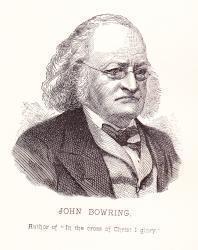
John Bowring

1792 - 1872 Person Name: John Bowring, 1792-1872 Topics: God: His Attributes, Works and Word God in Nature, Providence and Redemption Author of "God is love; His mercy brightens" in The Book of Praise James Bowring was born at Exeter, in 1792. He possessed at an early age a remarkable power of attaining languages, and acquired some reputation by his metrical translations of foreign poems. He became editor of "The Westminster Review" in 1825, and was elected to Parliament in 1835. In 1849, he was appointed Consul at Canton, and in 1854, was made Governor of Hong Kong, and received the honour of knighthood. He is the author of some important works on politics and travel, and is the recipient of several testimonials from foreign governments and societies. His poems and hymns have also added to his reputation. His "Matins and Vespers" have passed through many editions. In religion he is a Unitarian. --Annotations of the Hymnal, Charles Hutchins, M.A., 1872 ======================================= Bowring, Sir John, LL.D., a distinguished man of letters, was born at Exeter, Oct. 17, 1792. His studies extended to philology, poetry, politics, and other branches of learning, whilst as editor of the Westminster Review for some years (he received the appointment in 1825) he did considerable work as a reviewer. He held several official appointments under the Government as Commissioner to France on commercial matters (1831-5); British Consul at Hong Kong (1849); and Governor of Hong Kong (1854). He was twice Member of Parliament, and was knighted in 1854. He died Nov. 23rd, 1872. His published works are very numerous, and display an astonishing acquaintance with various languages. Those specially bearing on poetry include:— (1) Russian Anthology, with Biographical and Critical notices of the Poets of Russia, 1821; (2) Specimens of the Russian Poets, 1823; (3) Ancient Poetry and Romance of Spain, 1824; (4) Batavian Anthology, or Specimens of Dutch Poets, 1824; (5) Servian Popular Poetry, 1821; (6) Specimens of Polish Poets, 1827; (1) Poetry of the Magyars, 1830; (8) History of the Poetical Literature of Bohemia, 1832, &c. In addition to these works, which are mainly translations, Sir John Bowring wrote original verse. This was published interspersed with a few translations, as follows:— (1) Matins and Vespers with Hymns and Occasional Devotional Pieces, Lond., 1823; 2nd edition, enlarged, 1824; 3rd edition, again enlarged, 1841; and the 4th, still further enlarged, in 1851. (2) Hymns: as a Sequel to the Matins, 1825. In addition he contributed to a few Unitarian hymnals, especially that of the Rev. J. R. Beard of Manchester, 1837. In that Collection many of the hymns added to the 3rd edition of Matins, &c, 1841, were first published A selection from these, together with a biographical sketch, was published by Lady Bowring in 1873, as a Memorial Volume of Sacred Poetry. This work contains hymns from the Matins and Vespers, together with others from Periodicals, and from his manuscripts. Of his hymns a very large percentage have come into common use. A few have been adopted by almost all denominations, as, "God is love, His mercy brightens;" "How sweetly flow'd the gospel sound;" "In the Cross of Christ I glory;" "Watchman, tell us of the night;"; and others, but the greater portion are confined to the Unitarian collections of Great Britain and America, of which denomination he was a member. In addition to the more important, which are annotated under their first lines, there are also the following in common use:—- 1. Clay to clay, and dust to dust. Burial. From his Hymns, 1825, into the Hymn & Tune Book, Boston, U.S., 1868, &c. 2. Come the rich, and come the poor. Divine Worship. Contributed to Beard's Collection, 1837, No. 290, and repeated in Bowring's Matins, &c., 3rd edition, 1841. It is in a few American collections. 3. Drop the limpid waters now. Holy Baptism. From Matins and Vespers, 3rd edition, 1841, into Kennedy, 1863. 4. Earth's transitory things decay. The Memory of the Just. From his Hymns, 1825, into Beard, 1837; the American Plymouth Collection, 1855; and the Songs for the Sanctuary, N.Y., 1865, &c. 5. Father, glorify Thy name. The Father glorified. Also from Hymns, 1825, into Beard, 1837; the Hymns of the Spirit, Boston, U.S., 1864, &c. 6. Father and Friend, Thy light, Thy love. Omnipresence. From Matins and Vespers, 2nd edition, 1824, into several collections, and sometimes in an abbreviated form. 7. Father of Spirits, humbly bent before Thee. Also in Hymns, 1825, and Dr. Martineau's Hymns of Praise & Prayer, 1873. In Longfellow and Johnson's Hymns of the Spirit, Boston, U.S., 1864, it is given as, "Father of Spirits, gathered now before Thee." 8. From all evil, all temptation. Preservation implored. Contributed to Beard's Collection, 1837. 9. From the recesses of a lowly spirit. Prayer of trust. From Matins and Vespers, 1st edition, 1823, into several American collections. 10. Gather up, 0 earth, thy dead. Published in his Matins & Vespers, 3rd ed., 1841, in 3 stanzas of 8 lines and repeated, slightly altered, in Kennedy, 1863, No. 753. 11. Gently the shades of night descends Evening. A cento from his poem on "Sunday Evening," in the Matins, &c, 1st edition, 1823, p. 6. It is given in the Boston Hymns of the Spirit, 1864; the Boston Hymn & Tune Book, 1868, and other collections. 12. How dark, how desolate. Hope. 1st published in his Matins, &c, 1823, p. 246. In Dr. Martineau's Hymns of Praise & Prayer, 1873, it is No. 515. 13. How shall we praise Thee, Lord of Light! Evening. A cento from the same poem as No. 7 above. It is given in the Hymns of the Spirit, 1864, and other American collections. 14. Lead us with Thy gentle sway. Divine Guidance desired. Hymns, 1825, into Hymns of the Spirit, 1864, and others. 15. Lord, in heaven, Thy dwelling-place. Praise. Contributed to Beard's Collection, 1837, No. 70, repeated in the author's Matins, &c, 3rd edition 1841, p. 235, and given in a few American collections. In the Hymns of the Spirit, 1864, it is altered to "Lord of every time and place." 16. 0 let my [thy] trembling soul be still. Resignation. From the 1st edition of the Matins, &c, 1823, p. 251, in 3 stanzas of 6 lines, into Beard's Collection, 1837; the Hymns of the Spirit, 1864, and others. It is sometimes given as, "0 let thy," &c. 17. 0, sweet it is to feel and know. Monday Morning. A poem in 16 stanzas of 4 lines, given in his Matins, &c, 1823, p. 60. In 1837 stanzas i.-iii. were given in Beard's Collection as No. 448, and entitled "God near in sorrow." In the 3rd edition of the Matins, &c, 1841, this cento was repeated (p. 245), with the same title, notwithstanding the full poem was in the same book. 18. On the dust I'm doomed to sleep. Resurrection. Appeared in his Matins, &c, 1st edition, 1823, p. 252, in 2 stanzas of 8 lines. In the 2nd edition, 1824, p. 232, it was altered to "In the dust," &c. This was repeated in 1841. In some hymnals it reads:— 19. The heavenly spheres to Thee, 0 God. Evening. This "Hymn to the Deity" appeared in the 2nd edition of his Matins, &c, 1824, pp. 235-6, in 4 stanzas of 4 double lines. It is also in the 3rd edition, 1841; the Boston Hymns of the Spirit, 1864 and other American collections. 20. When before Thy throne we kneel. Divine Worship. From his Hymns, 1825, into Beard's Collection, 1837, No. 93; the Boston Hymn & Tune Book, 1868, No. 21, and others. 21. Where is thy sting, 0 death! Death. Also from the Hymns, 1825, into the same collections as No. 20 above. It will be noted that Beard's Collection, 1837, is frequently named above. The full title of that hymnal is— A Collection of Hymns for Public and Private Worship. Compiled by John R. Board, Lond., John Green, 1837. The Rev. John Relly Beard was an Unitarian Minister in Manchester, and the collection is dedicated "To the Manchester Meeting of Ministers." It contained a large number of original hymns. Bowring contributed 82, of which 33 were published therein for the first time. Some of his hymns are of great merit, and most of them are characterised by great earnestness and deep devotion. -- John Julian, Dictionary of Hymnology (1907) ================== Bowring, Sir John, p. 166, i. In the article on Bowring the hymns numbered therein as 4 and 20 are stated to have appeared in his Hymns, 1825, but in error. The earliest date to which we can positively trace them is Beard's Collection, 1837. From the Hymns, 1825, we find, however, that the following are in modern hymnals:— 1. Our God is nigh. Divine Presence. 2. 'Tis not the gift; but 'tis the spirit. Outward and Inward Virtue. 3. When the storms of sorrow gather. God our Guide. From the various editions of his Matins and Vespers additional hymns arc also in modern use:— 4. If all our hopes and all our fears. Heaven Anticipated. (1823.) 5. In Thy courts let peace be found. Public Worship. (1841.) 6. The offerings to Thy throne which rise. Heart Worship. (1824.) 7. Who shall roll away the stone? Easter. In Beard's Collection, 1837, and Matins & Vespers, 1841. --John Julian, Dictionary of Hymnology, Appendix, Part II (1907)

John Wesley

1703 - 1791 Person Name: John Wesley, 1703-1791 Topics: God: His Attributes, Works and Word God in Nature, Providence and Redemption Author of "Before Jehovah's awful throne" in The Book of Praise John Wesley, the son of Samuel, and brother of Charles Wesley, was born at Epworth, June 17, 1703. He was educated at the Charterhouse, London, and at Christ Church, Oxford. He became a Fellow of Lincoln College, Oxford, and graduated M.A. in 1726. At Oxford, he was one of the small band consisting of George Whitefield, Hames Hervey, Charles Wesley, and a few others, who were even then known for their piety; they were deridingly called "Methodists." After his ordination he went, in 1735, on a mission to Georgia. The mission was not successful, and he returned to England in 1738. From that time, his life was one of great labour, preaching the Gospel, and publishing his commentaries and other theological works. He died in London, in 1791, in his eighty-eighth year. His prose works are very numerous, but he did not write many useful hymns. It is to him, however, and not to his brother Charles, that we are indebted for the translations from the German. --Annotations of the Hymnal, Charles Hutchins, M.A., 1872 ====================== John Wesley, M.A., was born at Epworth Rectory in 1703, and, like the rest of the family, received his early education from his mother. He narrowly escaped perishing in the fire which destroyed the rectory house in 1709, and his deliverance made a life-long impression upon him. In 1714 he was nominated on the foundation of Charterhouse by his father's patron, the Duke of Buckingham, and remained at that school until 1720, when he went up, with a scholarship, from Charterhouse to Christ Church, Oxford. Having taken his degree, he received Holy Orders from the Bishop of Oxford (Dr. Potter) in 1725. In 1726 he was elected Fellow of Lincoln College, and remained at Oxford until 1727, when he returned into Lincolnshire to assist his father as curate at Epworth and Wroot. In 1729 he was summoned back to Oxford by his firm friend, Dr. Morley, Rector of Lincoln, to assist in the College tuition. There he found already established the little band of "Oxford Methodists" who immediately placed themselves under his direction. In 1735 he went, as a Missionary of the Society for the Propagation of the Gospel, to Georgia, where a new colony had been founded under the governorship of General Oglethorpe. On his voyage out he was deeply impressed with the piety and Christian courage of some German fellow travellers, Moravians. During his short ministry in Georgia he met with many discouragements, and returned home saddened and dissatisfied both with himself and his work; but in London he again fell in with the Moravians, especially with Peter Bohler; and one memorable night (May 24, 1738) he went to a meeting in Aldersgate Street, where some one was reading Luther's preface to the Epistle to the Romans. There, "About a quarter before nine, while he was describing the change which God works in the heart through faith in Christ, I felt my heart strangely warmed. I felt I did trust in Christ, Christ alone, for salvation; and an assurance was given me, that He had taken away my sins, even mine, and saved me from the law of sin and death." From that moment his future course was sealed; and for more than half a century he laboured, through evil report and good report, to spread what he believed to be the everlasting Gospel, travelling more miles, preaching more sermons, publishing more books of a practical sort, and making more converts than any man of his day, or perhaps of any day, and dying at last, March 2, 1791, in harness, at the patriarchal age of 88. The popular conception of the division of labour between the two brothers in the Revival, is that John was the preacher, and Charles the hymnwriter. But this is not strictly accurate. On the one hand Charles was also a great preacher, second only to his brother and George Whitefield in the effects which he produced. On the other hand, John by no means relegated to Charles the exclusive task of supplying the people with their hymns. John Wesley was not the sort of man to depute any part of his work entirely to another: and this part was, in his opinion, one of vital importance. With that wonderful instinct for gauging the popular mind, which was one element in his success, he saw at once that hymns might be utilized, not only for raising the devotion, but also for instructing, and establishing the faith of his disciples. He intended the hymns to be not merely a constituent part of public worship, but also a kind of creed in verse. They were to be "a body of experimental and practical divinity." "In what other publication," he asks in his Preface to the Wesleyan Hymn Book, 1780 (Preface, Oct. 20,1779), "have you so distinct and full an account of Scriptural Christianity; such a declaration of the heights and depths of religion, speculative and practical; so strong cautions against the most plausible errors, particularly those now most prevalent; and so clear directions for making your calling and election sure; for perfecting holiness in the fear of God?" The part which he actually took in writing the hymns, it is not easy to ascertain; but it is certain that more than thirty translations from the German, French and Spanish (chiefly from the German) were exclusively his; and there are some original hymns, admittedly his composition, which are not unworthy to stand by the side of his brother's. His translations from the German especially have had a wide circulation. Although somewhat free as translations they embody the fire and energy of the originals. It has been the common practice, however for a hundred years or more to ascribe all translations from the German to John Wesley, as he only of the two brothers knew that language; and to assign to Charles Wesley all the original hymns except such as are traceable to John Wesley through his Journals and other works. The list of 482 original hymns by John and Charles Wesley listed in this Dictionary of Hymnology have formed an important part of Methodist hymnody and show the enormous influence of the Wesleys on the English hymnody of the nineteenth century. -- Excerpts from John Julian, Dictionary of Hymnology (1907) =================== See also in: Hymn Writers of the Church

Thomas Sanders Dupuis

1733 - 1796 Person Name: Thomas Sanders Dupuis, 1730-1796 Topics: God: His Attributes, Works and Word God in Nature, Providence and Redemption Composer of "[We praise Thee, O God]" in The Book of Praise

Pages


Export as CSV
It looks like you are using an ad-blocker. Ad revenue helps keep us running. Please consider white-listing Hymnary.org or getting Hymnary Pro to eliminate ads entirely and help support Hymnary.org.