You help make Hymnary.org possible. More than 10 million people from 200+ countries found hymns, liturgical resources and encouragement on Hymnary.org in 2025, including you. Every visit affirms the global impact of this ministry.

If Hymnary has been meaningful to you this year, would you take a moment today to help sustain it? A gift of any size—paired with a note of encouragement if you wish—directly supports the server costs, research work and curation that keep this resource freely available to the world.

Give securely online today, or mail a check to:
Hymnary.org
Calvin University
3201 Burton Street SE
Grand Rapids, MI 49546

Thank you for your partnership, and may the hope of Advent fill your heart.

Person Results

Text Identifier:"^jesus_thyself_to_us_reveal$"
In:people

Planning worship? Check out our sister site, ZeteoSearch.org, for 20+ additional resources related to your search.
Showing 1 - 5 of 5Results Per Page: 102050

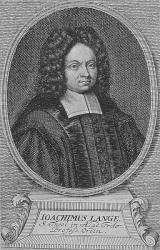
Joachim Lange

1670 - 1744 Person Name: Joachim Lange, 1670-1742 Author (stanza 2) of "Jesus, Thyself to Us Reveal" in Hymnal and Liturgies of the Moravian Church Lange, Joachim, D.D., son of Mauritius Lange, senior councillor at Gardelegen in the Altmark, was born at Gardelegen, Oct. 26, 1670. He entered the University of Leipzig in the autumn of 1689, where he shared rooms with A. H. Francke; and in 1690 followed Francke to Erfurt, and in 1692 to Halle. By the recommendation of J. O. Schade he was appointed, in 1693, tutor to the only son of F. R. L. von Canitz, at Berlin. Subsequently he became, in 1696, rector of the school at Coslin in Pomerania; in 1698 rector of the Friedrichswerder Gymnasium at Berlin, and in 1699 pastor of the Friedrichstadt church; and in 1709, professor of theology at Halle (D.D. 1717), where he d. May 7,1744 (Koch, iv. 343; Allg. Deutsche Biographie, xvii. 634, &c). In his day Lange was best known as a commentator on the whole Bible (Biblisches Licht und Recht, &c, 7 folio vols., Halle, 1730-1738); as a defender of Pietism against the “Orthodox” Lutheran controversialists of the early 18th century; and as the author of over 100 theological works. Only two hymns are known by him, one of which is:— O Jesu, süsses Licht. Morning. First published in the Geistreiches Gesang-Buch, Halle, 1697, p. 4, in 8 stanzas of 8 lines. Repeated in Freylinghausen's Gesang-Buch, 1704, No. 608, and recently, as No. 469, in the Unverfälschter Leidersegen, 1851. Translated as:— Jesu, Thy light again I view. A free translation, in 7 stanzas of 6 lines, by J. Wesley, in Hymns & Sacred Poems, 1739 (Poetical Works, 1868-72, vol. i. p. 159) ; repeated as No. 661 in pt. i. of the Moravian Hymn Book, 1754 (1886, No. 344, abridged). The form most used is that in the Wesleyan Hymn Book, 1780, No. 419, where st. i. is omitted; and it begins with st. ii., altered to "O God, what offering shall I give." This form is in Mercer, 1857 and 1864, Kennedy, 1863, and others; and in America, in the Methodist Episcopal Hymns, 1849, Evang. Association Hymn Book, 1882, &c. In the American Sabbath Hymn Book, 1858, a cento from Wesley's stanzas iii., vi., vii., is given as No. 917, beginning, "Now, O my God, Thou hast my soul." Other translations are: (1) "O let me always think Thou'rt near," by J. Swertner, of st. vii., as No. 430 in the Moravian Hymn Book, 1789. In the 1801 and later editions. (1886, No. 567) it is altered, and begins, "O let us always think Thee near." (2) "O Jesu, welcome Light," by H. J. Buckoll, 1842, p. 47. (3) "O Jesu, Light most sweet." In the Family Treasury, 1879, P- 230. [Rev. James Mearns, M.A.] --John Julian, Dictionary of Hymnology, Appendix, Part II (1907)

John Swertner

1746 - 1813 Person Name: John Swertner, 1746-1813 Translator (stanza 2) of "Jesus, Thyself to Us Reveal" in Hymnal and Liturgies of the Moravian Church Swertner, John, b. Sept. 12, 1746, at Haarlem, in Holland, Moravian minister at various places in England and Ireland; d. at Bristol, March 11, 1813. --John Julian, Dictionary of Hymnology, New Supplement (1907)

Johannes de Watteville

1718 - 1788 Person Name: Johannes de Watteville, 1718-1788 Author (stanza 1) of "Jesus, Thyself to Us Reveal" in Hymnal and Liturgies of the Moravian Church Johannes de Watteville, was the son-in-law of Nicholas Ludwig, Graf von Zinzendorf, married to Zinzendorf's daughter Benigna. He was a Moravian bishop in Germany. He originated the Christingle tradition in 1747 when he gave each child in his church a lighted candle wrapped in a red ribbon with a prayer that said "Lord Jesus, kindle a flame in these dear children's hearts." ================ Watteville, Johannes von, originally Johann Michael Langguth, but adopted by F. von Watteville, b. Oct. 18, 1718, at Walschleben near Erfurt. Member of the Unity's Direction, 1764. d. Oct. li, 1788, at Gnadenfrei, Silesia. --John Julian, Dictionary of Hymnology (1907)

Anna Nitschmann

1715 - 1760 Person Name: Anna Nitschmann, 1715-1760 Author (stanza 3) of "Jesus, Thyself to Us Reveal" in Hymnal and Liturgies of the Moravian Church Nitschmann, Anna, daughter of David Nitschmann, cartwright, at Kunewald, near Fulnek, Moravia, was born at Kunewald, Nov. 24, 1715. Her cousin, David Nitschmann (the first Bishop, 1735, of the renewed Brethren's Unity) while on a visit to Kunewald in the beginning of 1725, persuaded her father to remove to Herrnhut, where the family arrived on Feb. 25, 1725. On March 17, 1730, Anna was appointed Unity-Elder, with the care of the unmarried sisters; on May 4, 1730, joined with Anna Dober in founding the Jungfrauenbund (see p. 304, ii.); and in 1733 entered the unmarried sisters' house at Herrnhut. In 1735 she became companion to Zinzendorf s daughter, the Countess Benigna, and accompanied her, in 1737, to England. During the summer of 1740 she went with her own father to America, arriving in Pennsylvania Dec. 5, 1740. After the arrival of Zinzendorf and the Countess Benigna, in 1741, Anna joined with them in work among the Indians. She returned to Germany in 1743. After the death of his first wife on June 19, 1756, Zinzendorf married Anna at Berthelsdorf on June 27, 1757. When on May 5, 1760, Zinzendorf felt his fatal illness, she also succumbed, and after his death, on May 9, gradually sank and died, May 21, 1760, at Herrnhut (Allgemeine Deutsche Biographie xxiii. 709; MS. from Diaconus J. T. Muller, Herrnhut, &c). Her hymns were written 1735-1748; the earlier in Herrnhut, some in Pennsylvania, others from 1743 to 1748. They appeared in the various Appendices to the Herrnhut Gesang-Buch of 1735. Only two have passed into use outside of the English Moravian Hymn Book. These are:— i. Ich bin das arme Würmlein dein. Humility. First published as No. 1592 in Appendix x. circa l741 to the Herrnhut Gesang-Buch, 1735, in 12 stanzas of 4 lines. When repeated in the Brüder Gesang-Buch, 1778, No. 851, st. i., 11. 1, 2; iv., 11. 1, 2; ii.; iii.; xii. were selected with alterations, and a stanza by C. Gregor (which begins “Mein Heiland! dass ich ohne dich") was prefixed. The translation in common use is:— My Saviour, that I without Thee. Translated in full by F. W. Foster, from the text of 1778, and given as No. 450 in the Moravian Hymn Book , 1189 (1886, No. 580). Included, omitting st. v., in J. A. Latrobe's Collection, 1841. ii. Mein König, deine Liebe. Christian Work. Appeared as No. 1233 in Appendix vii. circa 1737 to the Herrnhut Gesang-Buch, 1735, in 14 st. of 6 1. In the Brüder Gesang-Buch,1778, No. 1355, reduced to 6 stanzas (st. v. in 1778 is by N. L. Zinzendorf). Another translation is: "Thou our exalted first-born Brother." This is a tr. of st. xiv. in the Moravian Hymn Book, pt. ii., 1746, p. 798. In 1754, pt. ii., p. 365, altered to "0 Thou our first-born Brother " (1849, No. 852, st. ii.). [Rev. James Mearns, M.A.] --John Julian, Dictionary of Hymnology (1907)

Heinrich Isaac

1450 - 1517 Person Name: Heinrich Isaak, c. 1450-1517 Composer of "INNSBRUCK" in Hymnal and Liturgies of the Moravian Church Heinrich Isaac; b. about 1450, Germany; organist in Florence, Italy; supposed to have died there abour 1517 Evangelical Lutheran Hymnal, 1908

Export as CSV
It looks like you are using an ad-blocker. Ad revenue helps keep us running. Please consider white-listing Hymnary.org or getting Hymnary Pro to eliminate ads entirely and help support Hymnary.org.