

 My Starred Hymns
 My FlexScores
 My Hymnals
 My Purchased Files
Planning worship?
Check out our sister site, ZeteoSearch.org,
for 20+ additional resources related to your search.
- |
User Links
Search Results


O König aller Ehren
Author: Martin Böhm, 1557-1622 Appears in 29 hymnals Used With Tune: [O König aller Ehren]
O König aller Ehren


[O König aller Ehren]
Appears in 321 hymnals Composer and/or Arranger: W. H. Doane Incipit: 33455 65511 13455 Used With Text: O König aller Ehren
[O König aller Ehren]
[O Kónig aller ehren]
Appears in 22 hymnals Composer and/or Arranger: Bartholomäus Helder Tune Key: D Major Incipit: 15543 21122 43215 Used With Text: O König aller Ehren
[O Kónig aller ehren]


O König aller Ehren
Author: Martin Behm Hymnal: Evangelisches Gesangbuch (Bayern, Mitteldeutschland, Thüringen) #71 (2014) First Line: O Kónig aller ehren Lyrics: 1 O König aller Ehren,
Herr Jesu, Davids Sohn,
dein Reich soll ewig währen,
im Himmel ist dein Thron:
hilf, daß allhier auf Erden
den Menschen weit und breit
dein Reich bekannt mög werden
zur Seelen Seligkeit.
2 Von deinem Reich auch zeugen
die Leut aus Morgenland;
die Knie sie vor dir beugen,
weil du ihn' bist bekannt.
Der neu Stern auf dich weiset,
dazu das göttlich Wort.
Drum man zu Recht dich preiset,
daß du bist unser Hort.
3 Du bist ein großer König,
wie uns die Schrift vermeld't,
doch achtest du gar wenig
vergänglich Gut und Geld,
prangst nicht mit teurem Rosse,
trägst keine güldne Kron,
sitzt nicht im festen Schlosse;
hier hast du Spott und Hohn.
4 Doch du bist schön gezieret,
dein Glanz erstreckt sich weit,
dein Güt allzeit regieret
und dein Gerechtigkeit.
Du wollst die Frommen zchützen
durch dein Macht und Gewalt,
daß sie im Frieden sitzen,
die Bösen stürzen bald.
5 Du wollst dich mein erbarmen,
in dein Reich nimm mich auf;
dein Güte schenk mir Armen
und segne meine Lauf.
Mein' Feinden wollst du wehren,
dem Teufel, Sünd und Tod,
daß sie mich nicht versehren;
rett mich aus aller Not.
6 Du wollst in mir entzünden
dein Wort, den schönen Stern,
daß falsche Lehr und Sünden
sein meinem Herzen fern.
Hilf, daß ich dich erkenne
und mit der Christenheit
dich meinen König nenne
jetzt und in Ewigkeit. Topics: Das Kirchenjahr Epiphanias Languages: German Tune Title: [O Kónig aller ehren]
O König aller Ehren
O König aller Ehren
Author: Martin Böhm, 1557-1622 Hymnal: Liederkranz für Sonntags-Schulen und Jugend-Vereine #136 (1898) Languages: German Tune Title: [O König aller Ehren]
O König aller Ehren
O König aller Ehren
Author: Martin Behm Hymnal: Kirchenbuch für Evangelisch-Lutherische Gemeinden #56 (1877) Lyrics: 1. O König aller Ehren,
Jesu Christ, Davids Sohn,
Dein Reich soll ewig währen,
Im Himmel ist dein Thron:
Hilf, daß allhier auf Erden
Den Menschen weit und breit
Dein Reich bekannt mög werden
Zur Seelen Seligkeit.
2. Von deinem Reich auch zeugen
Die Leut aus Morgenland,
Die Knie sie vor dir beugen,
Weil du ihn' bist bekannt.
Der neu Stern auf dich weiset,
Dazu das göttlich Wort,
Drum man dich billig preiset,
Daß du bist unser Hort.
3. Du bist ein großer König,
Wie uns die Schrift vermeldt,
Doch achtest du gar wenig
Vergänglich Gut und Geld,
Prangst nicht mit teurem Rosse,
Trägst keine güldne Kron,
Sitzt nicht im festen Schlosse,
Hier hast du Spott und Hohn.
4. Doch du bist schön gezieret,
Dein Glanz erstreckt sich weit,
Dein Güt allzeit florieret
Und dein Gerechtigkeit.
Du wollst die Frommen Schützen
Durch dein Macht und Gewalt,
Daß sie im Frieden sitzen,
Die Bösen stürzen bald.
5. Du wollst dich mein erbarmen,
In dein Reich nimm mich auf;
Dein Güte schenk mir Armen
Und segne meine Lauf.
Mein' Feinden wollst du wehren,
Dem Teufel, Sünd und Tod,
Daß sie mich nicht versehren:
Rett mich aus aller Not.
6. Du wollst in mir entzünden
Dein Wort, den Schönen Stern,
Daß falsche Lehr und Sünden
Sein von meim Herzen fern,
Hilf, daß ich dich erkenne
Und mit der Christenheit
Dich meinen König nenne
Jetzt und in Ewigkeit. Topics: Erscheinung Christi Languages: German
O König aller Ehren


W. Howard Doane
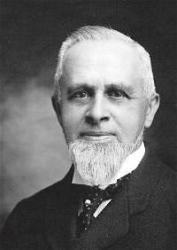
1832 - 1915 Person Name: W. H. Doane Composer of "[O König aller Ehren]" in Liederkranz für Sonntags-Schulen und Jugend-Vereine An industrialist and philanthropist, William H. Doane (b. Preston, CT, 1832; d. South Orange, NJ, 1915), was also a staunch supporter of evangelistic campaigns and a prolific writer of hymn tunes. He was head of a large woodworking machinery plant in Cincinnati and a civic leader in that city. He showed his devotion to the church by supporting the work of the evangelistic team of Dwight L. Moody and Ira D. Sankey and by endowing Moody Bible Institute in Chicago and Denison University in Granville, Ohio. An amateur composer, Doane wrote over twenty-two hundred hymn and gospel song tunes, and he edited over forty songbooks.
Bert Polman
============
Doane, William Howard, p. 304, he was born Feb. 3, 1832. His first Sunday School hymn-book was Sabbath Gems published in 1861. He has composed about 1000 tunes, songs, anthems, &c. He has written but few hymns. Of these "No one knows but Jesus," "Precious Saviour, dearest Friend," and "Saviour, like a bird to Thee," are noted in Burrage's Baptist Hymn Writers. 1888, p. 557.
--John Julian, Dictionary of Hymnology, Appendix, Part II (1907)
===================
Doane, W. H. (William Howard), born in Preston, Connecticut, 1831, and educated for the musical profession by eminent American and German masters. He has had for years the superintendence of a large Baptist Sunday School in Cincinnati, Ohio, where he resides. Although not a hymnwriter, the wonderful success which has attended his musical setting of numerous American hymns, and the number of his musical editions of hymnbooks for Sunday Schools and evangelistic purposes, bring him within the sphere of hymnological literature. Amongst his collections we have:—
(1) Silver Spray, 1868; (2) Pure Gold, 1877; (3) Royal Diadem, 1873; (4) Welcome Tidings, 1877; (5) Brightest and Best, 1875; (6) Fountain of Song; (7) Songs of Devotion, 1870; (8) Temple Anthems, &c.
His most popular melodies include "Near the Cross," "Safe in the Arms of Jesus," "Pass me Not," "More Love to Thee," "Rescue the Perishing," "Tell me the Old, Old Story," &c.
- John Julian, Dictionary of Hymnology (1907)
W. Howard Doane
Martin Behm
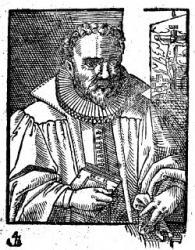
1557 - 1622 Person Name: Martin Böhm, 1557-1622 Author of "O König aller Ehren" in Liederkranz für Sonntags-Schulen und Jugend-Vereine Behm, Martin, son of Hans Behm [Bohme, Boehm, Behemb, Behem, Boheim, Bohemus or Bohemius], town-overseer of Lauban in Silesia, was born at Lauban, Sept. 16, 1557. During a protracted famine, 1574, Dr. Paul Fabricius, royal physician at Vienna, a distant kinsman, took him to Vienna, where he acted as a private tutor for two years, and then went to Strassburg, where, from Johann Sturm, Rector of the newly founded University, he received much kindness. Returning home at his mother's request after his father's death, May, 1580, he was, at Easter, 1581, appointed assistant in the Town School, and on Sept. 20, ordained diaconus of the Holy Trinity Church. After his senior had been promoted to Breslau the Town Council kept the post nominally vacant for two years, and then, in June, 1586, appointed Behm chief pastor. For 36 years ho held this post, renowned as a preacher, as a faithful pastor in times of trouble (famine 1590, pestilence 1613, war 1619), and as a prolific author. After preaching on the tenth Sunday after Trinity, 1621, he was seized with illness, and after he had lain for twenty-four weeks on a sick bed, there was ministered to him, on Feb. 5, 1622, the abundant entrance of which he sings in his hymn, "O Jesu Christ, meins Lebenslichtr” (Koch, ii. 227-234; Allg. Deutsche Biographie,ii. 282).
He was one of the best hymn-writers of his time. His hymns are true and deep in feeling, dwelling specially on the Passion of Our Lord. They speedily passed into the hymn-books, and long held their place therein. Of about 480 hymns which he composed, the most important appeared in his:—
(1) Centuria precationum rhythmicarum, Wittenberg, 1606 (2nd ed., 1611).
(2) Centuria secunda precationum rhythmicarum, Wittenberg, 1608 (2nd ed., 1611).
(3) Centuria precationum rhythmicarum, "Wittenberg, 1615 (complete edition of the Three Centuries, Jena and Breslau, 1658). A selection of 79 Hymns, ed., with an introduction, by W. Noldeke, appeared at Halle in 1857.
Four of his hymns have been translated into English, three being in English common use:—
i. O Heilige Dreifaltigkeit. [Morning.] First published in his Kriegesman, Leipzig, 1593, in 7 st. of unequal length, repeated in 1608, as above, in 8 stanzas of 4 lines. Both forms are in Wackernagel, v. p. 197; and the second in Noldeke, 1857, p. 53; and, omitting stanzas vi.-viii., as No. 1126 in the Berlin G. L. S., ed. 1863. In 1593 it was entitled " The ancient Sancta Trinitas et adoranda (Jnitas in German;" but it is rather a versification of the Prayer for Wednesday evening in J. Habermann's Gebet Buck (Wittenberg, 1567). The translations in common use, both of the second form, are:—
1. O Thou most Holy Trinity. A very good translation of stanzas i., iii.-v., by A. T. Russell, as No. 2 in his Ps. and Hys., 1851, and thence in Kennedy, 1863, and Dr. Thomas's Augustine H. Bk., 1866.
2. O holy, blessed Trinity, Divine. A good translation of stanzas i.-v. by Dr. C. H. L. Schuette, as No. 295 in the Ohio Luth. Hymnal, 1880.
3. O holy, holy, holy Three, by H. J. Bucholl, 1842, p. 21.
ii. O Jesu Christ, meins Lebens Licht. [For the Dying.] His finest hymn. First pub.lished in a collection entitled Christliche Gebet, 1610, and then in his Zehen Sterbegebet, appended to his Centuria secunda, 1611 (see above), in 14 stanzas of 4 1., entitled " Prayer fora happy journey home, founded upon the sufferings of Christ." Thence in Wackernagel, v. p. 235, Noldeke, 1857, p. 79, and the Unv. L. S., 1851, No. 835. The translations in common use are:—
1. Lord Jesus Christ, my Life, my Light. A very good translation by Miss Winkworth in her Lyra Ger., 2nd Series, 1858, p. 213, st. v., x. being omitted and viii., ix. combined as one stanza. In her Chorale Book for England, 1863, No. 190, she omitted her stanzas v., vi., and united her stanzas iv., vii. as iv. This translation is included more or less abridged in Wilson's Service of Praise, 1865, and in America in the Baptist Hymn Book, Phil, 1871, the Methodist Episcopal Hymnal, 1878/and the Ohio Lutheran Hymnal, 1880, &c.
2. Lord Jesus Christ, my soul's desire. A good and full translation by Dr. John Ker in the Juv. Miss. Mag. of the U. P. Church, May, 1858, p. 25. Stanzas i., iii, v., vii. form No. 49 in the Ibrox Hymnal, 1871.
Other translations are:—
(l) "Lord Jesu, fountain of my life." by J. C. Jacobi, 1725, p. 52 (1732, p. 195), and repeated in the Moravian hymn books combined in 1826 with J. Cennick's "Though I'm in body full of pain." (2) "Jesu, my light and sure defence," as No. 54 in the Moravian Hymn Book 1742. (3) “O Jesu, life-light of my way," by Miss Warner, 1858 (ed. 1861, p. 176).
iii. O Konig aller Ehren. [Epiphany.] Founded on St. Matthew ii., and first published 1606 as above, in 6 stanzas of 8 lines. Thence in Wackernagel, v. p. 210, Noldeke, 1857, p. 31, and the Unv. Leidersegen, 1851, No. 79. The translations in common use are:—
1. O King of Glory, David's Son. A double C. M. version of stanzas i., ii., v., vi. by Miss Winkworth in her Lyra Germanica, 2nd Series, 1858, p. 20, and thence in Dr. Pagenstecher's Collection, 1864, No. 33. Her 2nd translation:—
2. O Jesu, King of Glory, No. 37 in her Chorale Book for England, 1863, is the above version rewritten to the original metre. In the Ohio Lutheran Hymnal, 1880, No. 54, with translation of st. iii., iv. added.
iv. Das wait Gott Vater und Gott Sohn. [Morning Prayer.] First published 1608 as above, in 11 st., and thence in Wackernagel, v. p. 215, in Noldeke, 1857, p. 51. Translated as "O God Almighty, Father, Son," by H. J. Buckoll, 1842, p. 15.
-John Julian, Dictionary of Hymnology (1907)
Martin Behm
Bartholomaüs Helder
1585 - 1635 Person Name: Bartholomäus Helder Composer of "[O Kónig aller ehren]" in Evangelisches Gesangbuch (Bayern, Mitteldeutschland, Thüringen) Helder, Bartholomäus, son of Johann Helder, Superintendent in Gotha, became, in 1607, schoolmaster at Friemar, and in 1616, pastor of Bemstadt, near Gotha, where he died of the pestilence, Oct. 28, 1635 (Koch, iii. 114, 115, 248; Allgemeine Deutsche Biographie, xi. 684, 685, &c).
Helder published two works (both in the Royal Library, Berlin). (1) Cymbalum Genethliacum. Erfurt, 1615 ; and (2) Cymbalum Davidicum. Erfurt, 1620. The first contains 15 Christmas and New Year Hymns, and the second 25, mostly Psalm versions. In the Cantionale Sacrum, Gotna, 1646-48, over 50 hymns are given with his name as composer of the music and without definite ascription as regards the words.
Two of these have passed into English, viz.:—
i. In meiner Noth ruf ich zu dir. Supplication. A prayer for grace, which appeared in the Cantionale Sacrum, pt. ii., Gotha, 1648, No. 71, in 3 st. of 6 1. Translated by Miss Manington, 1863, p. 1, as "From out my woe I cry to Thee."
ii. O Lämmlein Gottes, Jesu Christ. St. John Baptist's Day. Founded on St. John i. 29. Appeared as No. 103 in the Cantionale Sacrum, Gotha, 1646, in 4 stanzas of 4 lines, entitled, "On St. John's Day." Included as No. 391 in the Unverfälschter Liedersegen. 1851. The only translation in common use is "O Jesus, Lamb of God, who art," in full, by A. Crull, as No. 120 in the Ohio Lutheran Hymnal, 1880. [Rev. James Mearns, M.A.]
--John Julian, Dictionary of Hymnology (1907)
Bartholomaüs Helder