You help make Hymnary.org possible. More than 10 million people from 200+ countries found hymns, liturgical resources and encouragement on Hymnary.org in 2025, including you. Every visit affirms the global impact of this ministry.

If Hymnary has been meaningful to you this year, would you take a moment today to help sustain it? A gift of any size—paired with a note of encouragement if you wish—directly supports the server costs, research work and curation that keep this resource freely available to the world.

Give securely online today, or mail a check to:
Hymnary.org
Calvin University
3201 Burton Street SE
Grand Rapids, MI 49546

Thank you for your partnership, and may the hope of Advent fill your heart.

Search Results

Text Identifier:"^who_is_this_in_silence_bending$"

Planning worship? Check out our sister site, ZeteoSearch.org, for 20+ additional resources related to your search.

Texts

text icon
Text authorities
Page scans

Jesus wept! those tears are over

Author: E. Denny Appears in 110 hymnals Used With Tune: REGENT SQUARE Text Sources: [Words Ed.]

Tunes

tune icon
Tune authorities
Audio

LUX PRIMA

Meter: 8.7.8.7.7.7 Appears in 163 hymnals Composer and/or Arranger: Charles Gounod Tune Key: F Major or modal Incipit: 11132 1715 Used With Text: Jesus Wept
Page scansAudio

[Jesus wept, those tears are over]

Appears in 310 hymnals Incipit: 57111 71221 13533 Used With Text: Jesus wept, those tears are over
Page scansAudio

REGENT SQUARE

Appears in 996 hymnals Composer and/or Arranger: Henry Smart, London Tune Key: C Major Incipit: 53153 21566 51432 Used With Text: Jesus wept! those tears are over

Instances

instance icon
Published text-tune combinations (hymns) from specific hymnals
Page scan

Who Is This?

Hymnal: Joy Bells #75 (1878) First Line: Who is this in silence bending Languages: English Tune Title: [Who is this in silence bending]
Page scan

Who Is This?

Hymnal: New Joy Bells #75 (1880) First Line: Who is this in silence bending Languages: English Tune Title: [Who is this in silence bending]
Page scan

Who is this in silence bending

Hymnal: Crown of Life #95 (1875) Languages: English

People

person icon
Authors, composers, editors, etc.

Henry Thomas Smart

1813 - 1879 Person Name: Henry Smart, London Composer of "REGENT SQUARE" in African Methodist Episcopal hymn and tune book Henry Smart (b. Marylebone, London, England, 1813; d. Hampstead, London, 1879), a capable composer of church music who wrote some very fine hymn tunes (REGENT SQUARE, 354, is the best-known). Smart gave up a career in the legal profession for one in music. Although largely self taught, he became proficient in organ playing and composition, and he was a music teacher and critic. Organist in a number of London churches, including St. Luke's, Old Street (1844-1864), and St. Pancras (1864-1869), Smart was famous for his extemporiza­tions and for his accompaniment of congregational singing. He became completely blind at the age of fifty-two, but his remarkable memory enabled him to continue playing the organ. Fascinated by organs as a youth, Smart designed organs for impor­tant places such as St. Andrew Hall in Glasgow and the Town Hall in Leeds. He composed an opera, oratorios, part-songs, some instrumental music, and many hymn tunes, as well as a large number of works for organ and choir. He edited the Choralebook (1858), the English Presbyterian Psalms and Hymns for Divine Worship (1867), and the Scottish Presbyterian Hymnal (1875). Some of his hymn tunes were first published in Hymns Ancient and Modern (1861). Bert Polman

Anonymous

Person Name: Anon. Author of "Jesus wept! those tears are over" in Good-Will Songs In some hymnals, the editors noted that a hymn's author is unknown to them, and so this artificial "person" entry is used to reflect that fact. Obviously, the hymns attributed to "Author Unknown" "Unknown" or "Anonymous" could have been written by many people over a span of many centuries.

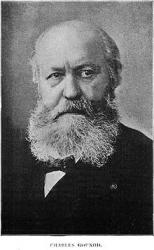
Charles F. Gounod

1818 - 1893 Composer of "GOUNOD" in The Evangelical Hymnal Charles F. Gounod (b. Paris, France, 1818; d. St. Cloud, France, 1893) was taught initially by his pianist mother. Later he studied at the Paris Conservatory, won the "Grand Prix de Rome" in 1839, and continued his musical training in Vienna, Berlin, and Leipzig. Though probably most famous for his opera Faust (1859) and other instrumental music (including his Meditation sur le Prelude de Bach, to which someone added the Ave Maria text for soprano solo), Gounod also composed church music-four Masses, three Requiems, and a Magnificat. His smaller works for church use were published as Chants Sacres. When he lived in England (1870-1875), Gounod became familiar with British cathedral music and served as conductor of what later became the Royal Choral Society. Bert Polman
It looks like you are using an ad-blocker. Ad revenue helps keep us running. Please consider white-listing Hymnary.org or getting Hymnary Pro to eliminate ads entirely and help support Hymnary.org.