You help make Hymnary.org possible. More than 10 million people from 200+ countries found hymns, liturgical resources and encouragement on Hymnary.org in 2025, including you. Every visit affirms the global impact of this ministry.

If Hymnary has been meaningful to you this year, would you take a moment today to help sustain it? A gift of any size—paired with a note of encouragement if you wish—directly supports the server costs, research work and curation that keep this resource freely available to the world.

Give securely online today, or mail a check to:
Hymnary.org
Calvin University
3201 Burton Street SE
Grand Rapids, MI 49546

Thank you for your partnership, and may the hope of Advent fill your heart.

Search Results

Topics:introits

Planning worship? Check out our sister site, ZeteoSearch.org, for 20+ additional resources related to your search.

Texts

text icon
Text authorities
FlexScoreFlexPresent

This Is the Day the Lord Hath Made

Author: Isaac Watts, 1674-1748 Appears in 607 hymnals Topics: Introits Used With Tune: TWENTY-FOURTH
TextPage scans

O bless the Lord, my soul!

Author: James Montgomery Meter: 6.6.8.6 Appears in 195 hymnals Topics: Holy Communion Introits Lyrics: Bless the Lord, my soul! His grace to thee proclaim! And all that is within me join To bless his holy Name! O bless the Lord, my soul! His mercies bear in mind! Forget not all his benefits! The Lord to thee is kind. He will not always chide; He will with patience wait; His wrath is ever slow to rise, And ready to abate. He pardons all thy sins; Prolongs thy feeble breath; He healeth thine infirmities, And ransoms thee from death. 292 He clothes thee with his love; Upholds thee with his truth; And like the eagle he renews The vigor of thy youth. Then bless his holy Name, Whose grace hath made thee whole, Whose loving-kindness crowns thy days! O bless the Lord, my soul! O God, the Father, Son, And Spirit ever blest, The One in Three, the Three in One, Be endless praise addressed. Amen. Scripture: Psalm 103 Used With Tune: ST. THOMAS (WILLIAMS)
TextPage scans

Jesus, where'er Thy people meet

Author: William Cowper Meter: 8.8.8.8 Appears in 526 hymnals Topics: Responses Opening Responses: Introits; Introits; Worship Introits Lyrics: 1 Jesus, where'er Thy people meet, There they behold Thy mercy seat; Where'er they seek Thee, Thou art found, And every place is hallowed ground. 2 Here may we prove the power of prayer To strengthen faith and sweeten care; To teach our faint desires to rise, And bring all heaven before our eyes. Amen. Used With Tune: SIMEON

Tunes

tune icon
Tune authorities
FlexScoreAudio

ST. MARY

Meter: 8.6.8.6 Appears in 68 hymnals Topics: Introits Tune Sources: Melody, Prys' Psalter, 1621 Tune Key: d minor Incipit: 13211 76557 35435 Used With Text: Praise to the Holiest in the Height
Page scansFlexScoreAudio

ST. THOMAS (WILLIAMS)

Meter: 6.6.8.6 Appears in 1,162 hymnals Composer and/or Arranger: Aaron Williams Topics: Holy Communion Introits Tune Key: G Major Incipit: 51132 12345 43432 Used With Text: I love Thy kingdom, Lord
Page scansAudio

WINCHESTER NEW

Meter: 8.8.8.8 Appears in 431 hymnals Topics: Holy Communion Introits Tune Sources: Hamburg, 1690 Tune Key: C Major Incipit: 51566 54334 32554 Used With Text: Before Jehovah's awful throne

Instances

instance icon
Published text-tune combinations (hymns) from specific hymnals
Text

Approach, my soul, the mercy seat

Author: Rev. John Newton Hymnal: The Hymnal #R10 (1950) Meter: 8.6.8.6 Topics: Responses Opening Responses: Introits; Introits; Worship Introits Lyrics: 1 Approach, my soul, the mercy seat, Where Jesus answers prayer; There humbly fall before His feet, For none can perish there. 2 Thy promise is my only plea, With this I venture nigh; Thou callest burdened souls to Thee, And such, O Lord, am I. Amen. Tune Title: DALEHURST
TextPage scan

Come dearest Lord, descend and dwell

Author: Rev. Isaac Watts Hymnal: The Hymnal #R1 (1950) Meter: 8.8.8.8 Topics: Responses Opening Responses: Introits; Introits; Worship Introits Lyrics: 1 Come, dearest Lord, descend and dwell By faith and love in every breast; Then shall we know and taste and feel The joys that cannot be expressed. 2 Come, fill our hearts with inward strength; Make our enlarged souls possess And learn the height, the breadth, and length Of Thine unmeasurable grace. Amen. Tune Title: EIN KIND GEBOREN
TextPage scan

Father, the watches of the night are o'er

Hymnal: The Hymnal #R8 (1950) Meter: 10.10.10.10 Topics: Responses Opening Responses: Introits; Introits; Worship Introits Lyrics: 1 Father, the watches of the night are o'er; To light and life the soul has risen once more; Blessed be Thou, who, through the helpless hours, Hast kept in deepest peace her slumbering powers. 2 Father, the watches of the day are here; More than from those of night have we to fear; By rude cares troubled, by temptations pressed, Through the day watches, Father, give us rest! Amen. Tune Title: LANGRAN

People

person icon
Authors, composers, editors, etc.

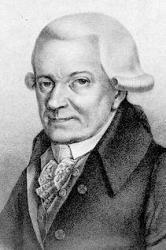
Michael Haydn

1737 - 1806 Person Name: J. Michael Haydn, 1737-1806 Topics: Holy Communion Introits Composer of "LYONS" in The Hymnal Johann Michael Haydn Austria 1737-1806. Born at Rohrau, Austria, the son of a wheelwright and town mayor (a very religious man who also played the harp and was a great influence on his sons' religious thinking), and the younger brother of Franz Joseph Haydn, he became a choirboy in his youth at the Cathedral of St. Stephen in Vienna, as did his brother, Joseph, an exceptional singer. For that reason boys both were taken into the church choir. Michael was a brighter student than Joseph, but was expelled from music school when his voice broke at age 17. The brothers remained close all their lives, and Joseph regarded Michael's religious works superior to his own. Michael played harpsichord, violin, and organ, earning a precarious living as a freelance musician in his early years. In 1757 he became kapellmeister to Archbishop, Sigismund of Grosswardein, in Hungary, and in 1762 concertmaster to Archbishop, Hieronymous of Salzburg, where he remained the rest of his life (over 40 years), also assuming the duties of organist at the Church of St. Peter in Salzburg, presided over by the Benedictines. He also taught violin at the court. He married the court singer, Maria Magdalena Lipp in 1768, daughter of the cathedral choir-master, who was a very pious women, and had such an affect on her husband, trending his inertia and slothfulness into wonderful activity. They had one daughter, Aloysia Josepha, in 1770, but she died within a year. He succeeded Wolfgang Amadeus Mozart, an intimate friend, as cathedral organist in 1781. He also taught music to Carl Maria von Weber. His musical reputation was not recognized fully until after World War II. He was a prolific composer of music, considered better than his well-known brother at composing religious works. He produced some 43 symphonies,12 concertos, 21 serenades, 6 quintets, 19 quartets, 10 trio sonatas, 4 due sonatas, 2 solo sonatas, 19 keyboard compositions, 3 ballets, 15 collections of minuets (English and German dances), 15 marches and miscellaneous secular music. He is best known for his religious works (well over 400 pieces), which include 47 antiphons, 5 cantatas, 65 canticles, 130 graduals, 16 hymns, 47 masses, 7 motets, 65 offertories, 7 oratorios, 19 Psalms settings, 2 requiems, and 42 other compositions. He also composed 253 secular vocals of various types. He did not like seeing his works in print, and kept most in manuscript form. He never compiled or cataloged his works, but others did it later, after his death. Lothar Perger catalogued his orchestral works in 1807 and Nikolaus Lang did a biographical sketch in 1808. In 1815 Anton Maria Klafsky cataloged his sacred music. More complete cataloging has been done in the 1980s and 1990s by Charles H Sherman and T Donley Thomas. Several of Michael Haydn's works influenced Mozart. Haydn died at Salzburg, Austria. John Perry

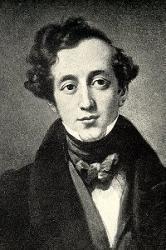
Felix Mendelssohn-Bartholdy

1809 - 1847 Person Name: Felix Mendelssohn Topics: Holy Communion Introits Composer of "TRUST" in The Hymnal Felix Mendelssohn-Bartholdy (b. Hamburg, Germany, 1809; d. Leipzig, Germany, 1847) was the son of banker Abraham Mendelssohn and the grandson of philosopher Moses Mendelssohn. His Jewish family became Christian and took the Bartholdy name (name of the estate of Mendelssohn's uncle) when baptized into the Lutheran church. The children all received an excellent musical education. Mendelssohn had his first public performance at the age of nine and by the age of sixteen had written several symphonies. Profoundly influenced by J. S. Bach's music, he conducted a performance of the St. Matthew Passion in 1829 (at age 20!) – the first performance since Bach's death, thus reintroducing Bach to the world. Mendelssohn organized the Domchor in Berlin and founded the Leipzig Conservatory of Music in 1843. Traveling widely, he not only became familiar with various styles of music but also became well known himself in countries other than Germany, especially in England. He left a rich treasury of music: organ and piano works, overtures and incidental music, oratorios (including St. Paul or Elijah and choral works, and symphonies. He harmonized a number of hymn tunes himself, but hymnbook editors also arranged some of his other tunes into hymn tunes. Bert Polman

Henry Thomas Smart

1813 - 1879 Person Name: Henry Smart Topics: Holy Communion Introits Composer of "HEATHLANDS" in The Hymnal Henry Smart (b. Marylebone, London, England, 1813; d. Hampstead, London, 1879), a capable composer of church music who wrote some very fine hymn tunes (REGENT SQUARE, 354, is the best-known). Smart gave up a career in the legal profession for one in music. Although largely self taught, he became proficient in organ playing and composition, and he was a music teacher and critic. Organist in a number of London churches, including St. Luke's, Old Street (1844-1864), and St. Pancras (1864-1869), Smart was famous for his extemporiza­tions and for his accompaniment of congregational singing. He became completely blind at the age of fifty-two, but his remarkable memory enabled him to continue playing the organ. Fascinated by organs as a youth, Smart designed organs for impor­tant places such as St. Andrew Hall in Glasgow and the Town Hall in Leeds. He composed an opera, oratorios, part-songs, some instrumental music, and many hymn tunes, as well as a large number of works for organ and choir. He edited the Choralebook (1858), the English Presbyterian Psalms and Hymns for Divine Worship (1867), and the Scottish Presbyterian Hymnal (1875). Some of his hymn tunes were first published in Hymns Ancient and Modern (1861). Bert Polman
It looks like you are using an ad-blocker. Ad revenue helps keep us running. Please consider white-listing Hymnary.org or getting Hymnary Pro to eliminate ads entirely and help support Hymnary.org.