You help make Hymnary.org possible. More than 10 million people from 200+ countries found hymns, liturgical resources and encouragement on Hymnary.org in 2025, including you. Every visit affirms the global impact of this ministry.

If Hymnary has been meaningful to you this year, would you take a moment today to help sustain it? A gift of any size—paired with a note of encouragement if you wish—directly supports the server costs, research work and curation that keep this resource freely available to the world.

Give securely online today, or mail a check to:
Hymnary.org
Calvin University
3201 Burton Street SE
Grand Rapids, MI 49546

Thank you for your partnership, and may the hope of Advent fill your heart.

Search Results

Tune Identifier:"^asaph_mendelssohn$"

Planning worship? Check out our sister site, ZeteoSearch.org, for 20+ additional resources related to your search.

Tunes

tune icon
Tune authorities
Page scans

ASAPH

Appears in 11 hymnals Composer and/or Arranger: Felix Mendelssohn Bartholdy Incipit: 51712 34254 31712 Used With Text: Come, Saviour, Jesus, from above

Texts

text icon
Text authorities
TextPage scansFlexScoreFlexPresent

Ride on, ride on in majesty!

Author: Henry Hart Milman Meter: 8.8.8.8 Appears in 523 hymnals Lyrics: 1 Ride on, ride on in majesty! In lowly pomp ride on to die! O Christ, Thy triumphs now begin O'er captive death, and conquered sin. 2 Ride on, ride on in majesty! The angel armies of the sky Look down with sad and wondering eyes To see the approaching Sacrifice. 3 Ride on, ride on in majesty! Thy last and fiercest strive is nigh; The Father on His sapphire throne Expects His own anointed Son. 4 Ride on, ride on in majesty! In lowly pomp ride on to die! Bow Thy meek head to mortal pain, Then take, O God, Thy power, and reign. Topics: Passion Week Palm Sunday; Lent, Sixth Sunday; Lent, Sixth Sunday; Passion Week Used With Tune: ADELAIDE
Page scans

O Thou to whose all searching sight

Author: Rev. John Wesley (1703-1791) Appears in 396 hymnals Used With Tune: ASAPH
TextPage scans

The Great Teacher

Appears in 358 hymnals First Line: How sweetly flowed the gospel sound Lyrics: 1 How sweetly flowed the gospel sound From lips of gentleness and grace, When listening thousands gathered round, And joy and gladness filled the place! 2 From heaven he came, of heaven he spoke, To heaven he led his followers' way; Dark clouds of gloomy night he broke, Unvailing an immortal day. 3 "Come, wanderers, to my Father's home, Come, all ye weary ones, and rest:" Yes, sacred Teacher, we will come, Obey thee, love thee, and be blest! 4 Decay then, tenements of dust; Pillars of earthly pride, decay: A nobler mansion waits the just, And Jesus has prepared the way. Used With Tune: CRAWFORD

Instances

instance icon
Published text-tune combinations (hymns) from specific hymnals
Page scan

O Thou, to whose all-searching sight

Author: Gerhard Tersteegen (1697-1769); Rev. John Wesley (1703-1791) Hymnal: Songs of Praise with Tunes #299 (1889) Meter: 8.8.8.8 Topics: Afflictions Prayer in; Aspirations For Holiness; Grace Sanctifying; Growth in Grace; Pilgrims Prayer of; Sin Indwelling Scripture: Psalm 51:6-7 Tune Title: ASAPH
Page scan

O thou to whose all searching sight

Author: Rev. John Wesley (1703-1791); Gerhard Tersteegen (1697-1769) Hymnal: Carmina Sanctorum, a selection of hymns and songs of praise with tunes #415 (1886) Topics: Pilgrim Songs Scripture: Psalm 139 Languages: English Tune Title: ASAPH
Page scan

O Thou to whose all searching sight

Author: Rev. John Wesley (1703-1791) Hymnal: Carmina Sanctorum #415 (1885) Languages: English Tune Title: ASAPH

People

person icon
Authors, composers, editors, etc.

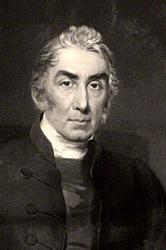
Henry Hart Milman

1791 - 1868 Author of "Ride on, ride on in majesty!" in Church Book Milman, Henry Hart, D.D., the youngest son of Sir Francis Milman (who received his Baronetage as an eminent Court physician), was born Feb. 10th, 1791, and educated at Dr. Burney's at Greenwich, and subsequently at Eton. His career at B. N. C. Oxford, was brilliant. He took a first class in classics, and carried off the Newdigate, Latin Verse, Latin Essay, and English Essay. His Newdigate on the Apollo Belvedere, 1812, is styled by Dean Stanley "the most perfect of Oxford prize poems." His literary career for several years promised to be poetical. His tragedy Fazio was played at Covent Garden, Miss O'Neill acting Bianca. Samor was written in the year of his appointment to St. Mary's, Reading (1817); The Fall of Jerusalem (1820); Belshazzar and The Martyr of Antioch (1822), and Anne Boleyn, gained a brilliant reception from the reviewers and the public. He was appointed Poetry Professor at Oxford in 1821, and was succeeded ten years after by Keble. It must have been before 1823, the date of Heber's consecration to Calcutta, that the 13 hymns he contributed to Heber's Hymns were composed. But his poetry was only the prelude to his larger work. The Bampton Lectures (1827) mark his transition to theological study, and the future direction of it was permanently fixed by his History of the Jews (1829). This book raised a storm of obloquy. It was denounced from the University pulpit, and in the British Critic. "It was the first decisive inroad of German theology into England, the first palpable indication that the Bible could be studied like another book, that the characters and events of the sacred history could be treated at once critically and reverently" (Dean Stanley). In 1835 he was presented by Sir Robert Peel to a Canonry at Westminster and the Rectory of St. Margaret's. In 1839 appeared his valuable edition of Gibbon's Decline and Fall; and in 1840 his History of Christianity to the Abolition of Paganism in the Roman Empire. Among his minor works in a different field were his Life of Keats and his edition and Life of Horace. It was not till 1854 that his greatest work—-for "vast and varied learning, indefatigable industry, calm impartiality, and subtle and acute criticism, among the most memorable in our language" (Quart Rev.)—-Latin Christianity—-appeared. He had been appointed Dean of St. Paul's in 1849. The great services under the dome originated in his tenure of the Deanery. His latest work, published after his death, Sept. 24, 1868, was The Annals of St. Paul’s. Though one of the most illustrious in the school of English liberal theology, he had no sympathy with the extreme speculations of Germany. The "criticism" of Tübingen "will rarely bear criticism." He "should like an Ewald to criticise Ewald." "Christianity will survive the criticism of Dr. Strauss," and the "bright flashing artillery" of Rénan. His historical style has been compared to Gibbon in its use of epigram and antithesis. His narrative is full of rapidity of movement. His long complex paragraphs have often a splendour of imagination as well as wealth of thought. All the varied powers of his mind found vent in his conversation; he was called, after his death, "the last of the great converters." The catalogue of his friends from the days of Heber, "his early friend," to those of Hallam, Macaulay, and Dean Stanley, was long and distinguished. Milman's 13 hymns were published in Heber's posthumous Hymns in 1827, and subsequently in his own Selection of Psalms & Hymns, 1837. The fine hymn for The Burial of the Dead, in Thring's Collection, "Brother, thou art gone before us," is from The Martyr of Antioch (1822). Like Heber's, they aim at higher literary expression and lyric grace. He makes free use of refrains. The structure is often excellent. His style is less florid and fuller of burning, sometimes lurid force than Heber's. His hymn for the 16th Sunday after Trinity, "When our heads are bowed with woe," has no peer in its presentation of Christ's human sympathy; the hymn for the 2nd Sunday in Lent, “Oh! help us, Lord! each hour of need," is a piece of pure deep devotion. "Ride on, ride on in majesty," the hymn for Palm Sunday, is one of our best hymns. And the stanzas for Good Friday, "Bound upon the accursed tree," form one of the finest meditations on the Passion. All his hymns are still in common use. [Rev.H.Leigh Bennett, M.A.] --John Julian, Dictionary of Hymnology (1907)

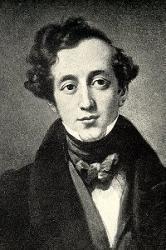
Felix Mendelssohn-Bartholdy

1809 - 1847 Person Name: Felix Mendelssohn-Bartholdy (1800-1847) Composer of "ASAPH" in Songs of Praise with Tunes Felix Mendelssohn-Bartholdy (b. Hamburg, Germany, 1809; d. Leipzig, Germany, 1847) was the son of banker Abraham Mendelssohn and the grandson of philosopher Moses Mendelssohn. His Jewish family became Christian and took the Bartholdy name (name of the estate of Mendelssohn's uncle) when baptized into the Lutheran church. The children all received an excellent musical education. Mendelssohn had his first public performance at the age of nine and by the age of sixteen had written several symphonies. Profoundly influenced by J. S. Bach's music, he conducted a performance of the St. Matthew Passion in 1829 (at age 20!) – the first performance since Bach's death, thus reintroducing Bach to the world. Mendelssohn organized the Domchor in Berlin and founded the Leipzig Conservatory of Music in 1843. Traveling widely, he not only became familiar with various styles of music but also became well known himself in countries other than Germany, especially in England. He left a rich treasury of music: organ and piano works, overtures and incidental music, oratorios (including St. Paul or Elijah and choral works, and symphonies. He harmonized a number of hymn tunes himself, but hymnbook editors also arranged some of his other tunes into hymn tunes. Bert Polman

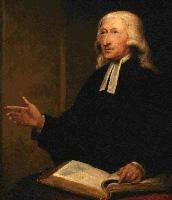
John Wesley

1703 - 1791 Person Name: Rev. John Wesley (1703-1791) Translator of "O Thou, to whose all-searching sight" in Songs of Praise with Tunes John Wesley, the son of Samuel, and brother of Charles Wesley, was born at Epworth, June 17, 1703. He was educated at the Charterhouse, London, and at Christ Church, Oxford. He became a Fellow of Lincoln College, Oxford, and graduated M.A. in 1726. At Oxford, he was one of the small band consisting of George Whitefield, Hames Hervey, Charles Wesley, and a few others, who were even then known for their piety; they were deridingly called "Methodists." After his ordination he went, in 1735, on a mission to Georgia. The mission was not successful, and he returned to England in 1738. From that time, his life was one of great labour, preaching the Gospel, and publishing his commentaries and other theological works. He died in London, in 1791, in his eighty-eighth year. His prose works are very numerous, but he did not write many useful hymns. It is to him, however, and not to his brother Charles, that we are indebted for the translations from the German. --Annotations of the Hymnal, Charles Hutchins, M.A., 1872 ====================== John Wesley, M.A., was born at Epworth Rectory in 1703, and, like the rest of the family, received his early education from his mother. He narrowly escaped perishing in the fire which destroyed the rectory house in 1709, and his deliverance made a life-long impression upon him. In 1714 he was nominated on the foundation of Charterhouse by his father's patron, the Duke of Buckingham, and remained at that school until 1720, when he went up, with a scholarship, from Charterhouse to Christ Church, Oxford. Having taken his degree, he received Holy Orders from the Bishop of Oxford (Dr. Potter) in 1725. In 1726 he was elected Fellow of Lincoln College, and remained at Oxford until 1727, when he returned into Lincolnshire to assist his father as curate at Epworth and Wroot. In 1729 he was summoned back to Oxford by his firm friend, Dr. Morley, Rector of Lincoln, to assist in the College tuition. There he found already established the little band of "Oxford Methodists" who immediately placed themselves under his direction. In 1735 he went, as a Missionary of the Society for the Propagation of the Gospel, to Georgia, where a new colony had been founded under the governorship of General Oglethorpe. On his voyage out he was deeply impressed with the piety and Christian courage of some German fellow travellers, Moravians. During his short ministry in Georgia he met with many discouragements, and returned home saddened and dissatisfied both with himself and his work; but in London he again fell in with the Moravians, especially with Peter Bohler; and one memorable night (May 24, 1738) he went to a meeting in Aldersgate Street, where some one was reading Luther's preface to the Epistle to the Romans. There, "About a quarter before nine, while he was describing the change which God works in the heart through faith in Christ, I felt my heart strangely warmed. I felt I did trust in Christ, Christ alone, for salvation; and an assurance was given me, that He had taken away my sins, even mine, and saved me from the law of sin and death." From that moment his future course was sealed; and for more than half a century he laboured, through evil report and good report, to spread what he believed to be the everlasting Gospel, travelling more miles, preaching more sermons, publishing more books of a practical sort, and making more converts than any man of his day, or perhaps of any day, and dying at last, March 2, 1791, in harness, at the patriarchal age of 88. The popular conception of the division of labour between the two brothers in the Revival, is that John was the preacher, and Charles the hymnwriter. But this is not strictly accurate. On the one hand Charles was also a great preacher, second only to his brother and George Whitefield in the effects which he produced. On the other hand, John by no means relegated to Charles the exclusive task of supplying the people with their hymns. John Wesley was not the sort of man to depute any part of his work entirely to another: and this part was, in his opinion, one of vital importance. With that wonderful instinct for gauging the popular mind, which was one element in his success, he saw at once that hymns might be utilized, not only for raising the devotion, but also for instructing, and establishing the faith of his disciples. He intended the hymns to be not merely a constituent part of public worship, but also a kind of creed in verse. They were to be "a body of experimental and practical divinity." "In what other publication," he asks in his Preface to the Wesleyan Hymn Book, 1780 (Preface, Oct. 20,1779), "have you so distinct and full an account of Scriptural Christianity; such a declaration of the heights and depths of religion, speculative and practical; so strong cautions against the most plausible errors, particularly those now most prevalent; and so clear directions for making your calling and election sure; for perfecting holiness in the fear of God?" The part which he actually took in writing the hymns, it is not easy to ascertain; but it is certain that more than thirty translations from the German, French and Spanish (chiefly from the German) were exclusively his; and there are some original hymns, admittedly his composition, which are not unworthy to stand by the side of his brother's. His translations from the German especially have had a wide circulation. Although somewhat free as translations they embody the fire and energy of the originals. It has been the common practice, however for a hundred years or more to ascribe all translations from the German to John Wesley, as he only of the two brothers knew that language; and to assign to Charles Wesley all the original hymns except such as are traceable to John Wesley through his Journals and other works. The list of 482 original hymns by John and Charles Wesley listed in this Dictionary of Hymnology have formed an important part of Methodist hymnody and show the enormous influence of the Wesleys on the English hymnody of the nineteenth century. -- Excerpts from John Julian, Dictionary of Hymnology (1907) =================== See also in: Hymn Writers of the Church
It looks like you are using an ad-blocker. Ad revenue helps keep us running. Please consider white-listing Hymnary.org or getting Hymnary Pro to eliminate ads entirely and help support Hymnary.org.