

 My Starred Hymns
 My FlexScores
 My Hymnals
 My Purchased Files
Planning worship?
Check out our sister site, ZeteoSearch.org,
for 20+ additional resources related to your search.
- |
User Links
Person Results
Michael Weisse
1480 - 1534 Composer of "CHRISTUS, DER UNS SELIG MACHT" in The Harvard University Hymn Book Michael Weiss was born at Neisse, in Silesia. He was a pastor among the Bohemian Brethren, and a contemporary with Luther. His hymns have received commendation. He died in 1540.
--Annotations of the Hymnal, Charles Hutchins, M.A. 1872.
============
Weisse, Michael (Weiss, Wiss, Wegs, Weys, Weyss), was born circa 1480, in Neisse, Silesia, took priest's orders, and was for some time a monk at Breslau. When the early writings of Luther came into his hands, Weisse, with two other monks, abandoned the convent, and sought refuge in the Bohemian Brethren's House at Leutomischl in Bohemia. He became German preacher (and apparently founder of the German communities) to the Bohemian Brethren at Landskron in Bohemia, and Fulnck in Moravia, and died at Landskron in 1534 (Koch, ii. 115-120; Wackernagel's D. Kirchenlied, i. p. 727; Fontes rerum Austricarum, Scriptores, vol. ii. pt. ii. p. 227, Vienna, 18G3, &c).
Weisse was admitted as a priest among the Brethren at the Synod of Brandeis, in 1531, and in 1532 was appointed a member of their Select Council, but he had previously performed important missions for the Brethren. He was, e.g., sent by Bishop Lucas, in 1522, along with J. Roh or Horn, to explain the views of the Bohemian Brethren to Luther; and again, in 1524, when they were appointed more especially to report on the practices and holiness of life of the followers of the German Reformers. He was also entrusted with the editing of the first German hymn-book of the Bohemian Brethren, which appeared as Ein New Gesengbuchlen at Jungen Bunzel (Jung Bunzlau) in Bohemia in 1531. This contained 155 hymns, all apparently either translations or else originals by himself. The proportion of translations is not very clear. In the preface to the 1531, Weisse addressing the German Communities at Fulnek and Landskron says, "I have also, according to my power, put forth all my ability, your old hymn-book as well as the Bohemian hymn-book (Cantional) being before me, and have brought the same sense, in accordance with Holy Scripture, into German rhyme."
Luther called Weisse "a good poet, with somewhat erroneous views on the Sacrament" (i.e. Holy Communion); and, after the Sacramental hymns had been revised by Roh (1544), included 12 of his hymns in V. Babst's Gesang-Buch, 1545. Many of his hymns possess considerable merit. The style is flowing and musical, the religious tone is earnest and manly, but yet tender and truly devout, and the best of them are distinguished by a certain charming simplicity of thought and expression. At least 119 passed into the German Lutheran hymnbooks of the 16th and 17th centuries, and many are still in use.
The following hymns by Weisse have also passed into English:—
i. Christus ist erstanden. Von des Todes Banden. Easter. First published 1531 as above, and thence in Wackernagel, iii. p. 273, in 7 stanzas of 4 lines. It is suggested by the older hymn, "Christ ist erstanden". In the Unverfälschter Liedersegen, 1851, No. 129. The translation in common use is:—
Christ the Lord is risen again! This is a full and very good translation by Miss Winkworth, in her Lyra Germanica, 2nd Ser., 1858, p. 37, and her Chorale Book for England, 1863, No. 58. It has been included in many recent English and American hymnals. Other translations are:—
(1) "Christ (and 'tis no wonder"). This is No. 260 in pt. i. of the Moravian Hymn Book, 1754. (2) "Christ our Lord is risen," by Dr. H. Mills, 1856, p. 322.
ii. Es geht daher des Tages Schein. Morning. 1531 as above, and thence in Wackernagel, iii. p. 318, in 7 stanzas of 4 lines. In the Unverfälschter Liedersegen, 1851, No. 455. The translations in common use are:—
1. The Light of Day again we see. In full, by H. J. Buckoll in his Hymns from German, 1842, p. 14. His translations of stanzas iii., iv., vi., vii., beginning “Great God, eternal Lord of Heaven," were included in the Rugby School Hymn Book, 1843.
2. Once more the daylight shines abroad. This is a full and very good translation by Miss Winkworth, in her Lyra Germanica, 2nd Ser., 1858, p. 69, and her Chorale Book for England, 1863, No. 18. Repeated in Thring's Collection, 1880-82.
iii. Gelobt sei Gott im höchsten Thron. Easter. 1531 as above, and thence in Wackernagel, iii. p. 265, in 20 stanzas of 3 lines, with Alleluia. The translations in common use are: —
1. Praise God upon His heavenly throne. This is a free translation of stanzas 1, 4, 10, 19, 20, by A. T. Russell, as No. 112, in his Psalms & Hymns, 1851.
2. Glory to God upon His throne. By Mrs. H. R. Spaeth, in the Southern Lutheran Service and Hymns for Sunday Schools , Philadelphia, 1883.
iv. Gott sah zu seiner Zeit. Christmas. 1531 as above, and thence in Wackernagel, iii. p. 244, in 10 stanzas of 9 lines. The translation in common use is:—
When the due Time had taken place. By C. Kinchen, omitting stanza v., as No. 169 in the Moravian Hymn Book, 1742 (1849, No. 20). In the ed. of 1886, No. 954 consists of stanza x., beginning “Ah come, Lord Jesus, hear our prayer."
v. Lob sei dem allmächtigen Gott. Advent. 1531 as above, and thence in Wackernagel, iii. p. 230, in 14 stanzas of 4 lines. Included in V. Babst's Gesang-Buch, 1545, and recently as No. 12 in the Unverfälschter Liedersegen , 1851. In the larger edition of the Moravian Hymn Book, 1886, it is marked as a translation from a Bohemian hymn, beginning "Cirkev Kristova Boha chval." The translations are:—
1. Praise be to that Almighty God. By J. Gambold, omitting stanza xi.-xiii., as No, 246, in pt. i. of the Moravian Hymn Book, 1754. In the 1789 and later eds. (1886, No. 31), it begins “To God we render thanks and praise."
2. O come, th' Almighty's praise declare. By A. T. Russell, of stanzas i.-iii., v., as No. 26 in his Psalms & Hymns, 1851.
vi. O Herre Jesu Christ, der du erschienen bistanza. For Children. On Christ's Example in His early years on earth . 1531 as above, and in Wackernagel, iii. p. 326, in 7 stanzas of 7 lines. The first three stanzas are translated as “Christ Jesus, Lord most dear," in the Moravian Hymn Book, 1754, pt. i., No. 278. The form in common use is that in Knapp's Evangelischer Lieder-Schatz , 1837, No. 2951, which begins "Nun hilf uns, o Herr Jesu Christ," and is in 3 stanzas of 4 lines, entirely recast. This is translated as:—
Lord Jesus Christ, we come to Thee . In full from Knapp, by Miss Winkworth, in her Chorale Book for England , 1863, No. 179.
Hymns not in English common use:—
vii. Den Vater dort oben. Grace after Meat. 1531, and thence in Wackernagel, iii., p. 321, in 5 stanzas of 7 lines. In the Berlin Geistliche Lieder, ed. 1863, No. 1136. Translated as, "Father, Lord of mercy," by J. V. Jacobi, 1122, p. 117. In his edition, 1732, p. 183, slightly altered, and thence in the Moravian Hymn Book, 1754, pt. i., No. 290.
viii. Die Sonne wird mit ihrem Schein. Evening. 1531, and thence in Wackernagel, iii., p. 323, in 6 stanzas of 4 lines. In the Unverfälschter Liedersegen, 1851, No. 517. Translated as, "Soon from our wishful eyes awhile," by H. J. Buckoll, 1842.
ix. Komm, heiliger Geist, wahrer Gott. Whitsuntide . 1531, and in Wackernagel , iii., p. 282, in 9 stanzas of 5 lines From the Bohemian as noted at p. 157, and partly suggested by the "Veni Sancte Spiritus reple " (q.v.). The translations are: (1) “Come, Holy Ghost, Lord God indeed." This is No. 285 in pt. i. of the Moravian Hymn Book, 1754. (2) "Thou great Teacher, Who instructest." This is a translation of stanza vii., as No. 234 in the Moravian Hymn Book, 1801 (1849, No. 267).
x. Lob und Ehr mit stettem Dankopfer. The Creation: Septuagesima . 1531, and in Wackernagel, iii., p. 287, in 5 stanzas of 16 lines. Translated as, “Praise, glory, thanks, be ever paid," by Miss Winkworth, 1869, p. 137.
xi. 0 Jesu Christ, der Heiden Licht. Epiphany. 1531, and in Wackernagel , iii. p. 248, in 2 stanzas of 14 lines. Translated as, "0 Jesus Christ, the Gentiles' Light." This is No. 253 in pt. i. of the Moravian Hymn Book, 1754. In the Brüder Gesang-Buch, 1778, No. 1467, stanza ii. was rewritten. This form begins, "Erscheine alien Auserwahlten," and is in 4 stanzas of 4 lines. Translated as, "Lord, to Thy chosen ones appear," by Miss Winkworth, 1869, p. 139.
xii. Singet lieben Leut. Redemption by Christ. 1531, and in Wackernagel, iii. p. 243, in 16 stanzas of 4 lines. Translated as, "Sing, be glad, ye happy sheep." This is a translation of stanza xiv., by C. G. Clemens, as No. 299 in the Moravian Hymn Book, 1789. In the 1801 and later editions (1849, No. 403) it begins, "O rejoice, Christ's happy sheep." [Rev. James Mearns, M.A.]
-- Excerpts from John Julian, Dictionary of Hymnology (1907)
Michael Weisse
Arthur T. Russell
1806 - 1874 Author of "In the tomb, behold He lies" in The Cyber Hymnal Arthur Tozer Russell was born at Northampton, March 20, 1806. He entered S. John's College, Cambridge, in 1824, took the Hulsean Prize in 1825, and was afterwards elected to a scholarship. He was ordained Deacon in 1829, Priest in 1830, and the same year was appointed Vicar of Caxton. In 1852, he was preferred to the vicarage of Whaddon. In 1863, he removed to S. Thomas', Toxteth Park, near Liverpool, and in 1867, to Holy Trinity, Wellington, Salop. He is the editor and author of numerous publications, among them several volumes of hymns.
--Annotations of the Hymnal, Charles Hutchins, 1872.
=================================
Russell, Arthur Tozer , M.A. He was the son of the Rev. Thomas Clout, who later changed his surname for Russell (Gentlemen’s Magazine, 1848), an Independent or Congregational minister who won for himself a good reputation by editing the works of Tyndale, Frith, Barnes, and Dr. John Owen, &c. He was born at Northampton, March 20, 1806; educated at St. Saviour's School, Southwark, and at the Merchant Taylors' School, London. In 1822-24 he was at Manchester College, York. In 1825 he entered St. John's College, Cambridge, as a sizar, and in his freshman year gained the Hulsean Prize, its subject being, "In what respects the Law is a Schoolmaster to bring men to Christ." In 1829 he was ordained by the Bishop of Lincoln (Kaye), and licensed to the Curacy of Great Gransden, Hunts, and in 1830 was preferred to the Vicarage of Caxton, which he held till 1852. During his ministry here he published the following works: The Claims of the Church of England upon the Affections of the People (1832); Sermons for Fasts and Festivals; A Critique upon Keble's Sermon on Tradition, in opposition. About 1840 appeared his Apology of the Church of England and an Epistle to Seignor Sapio concerning the Council of Trent, translated from the original Latin of Bishop Jewell. About the same time appeared Hymn Tunes, Original and Selected from Ravenscroft and other old Musicians, In 1841 was published A Manual of Daily Prayer. In 1844 Memorials of the Works and Life of Dr. Thomas Fuller….
His first appearance as a hymnwriter was in the 3rd edition of the hymn-book published by his father (1st ed. 1813), and known amongst Congregationalists as Russet's Appendix. In 1847 followed The Christian Life. In 1851 Psalms and Hymns, partly original, partly selected, for the use of the Church of England. … In 1867 he removed to Wrockwardine Wood, Shropshire, where he remained until 1874, when he was presented to the Rectory of Southwick, near Brighton. Here he died after a long and distressing illness, on the 18th of November, 1874. In his earlier years he was an extreme High Churchman, but by the study of St. Augustine his views were changed and he became, and continued to the end, a moderate Calvinist. His original hymns are gracious and tender, thoughtful and devout. His translations on the whole are vigorous and strong, but somewhat ultra-faithful to the original metres, &c. He left behind him a History of the Bishops of England and Wales in manuscript sufficient to form three or four goodly octavos, and numerous MS. Notes on the Text of the Greek Testament; and also a large number of original chants and hymntunes in manuscripts. [Rev. A. B. Grossart, DD. LLD.]
Of Russell's hymns a large number are included i Kennedy, 1863, and several also are in a few of the lesser known collections….Of his original hymns, about 140 in all, including those in Dr. Maurice's Choral Hymn Book, 1861, the following are found in a few collections:—
1. Christ is risen! O'er His foes He reigneth. Easter.
2. Give praise to God our King. Praise.
3. Great is the Lord; 0 let us raise. Ps. xlviii.
4. Hail, 0 hail, Our lowly King. Praise to Christ.
5. Hail, 0 Lord, our Consolation. Christ, the Consoler.
6. Holy Ghost, Who us instructest. Whitsuntide.
7. Holy Spirit given. Whitsuntide.
8. Hosanna, bless the Saviour's Name. Advent.
9. In the mount it shall be seen. Consolation.
10. In the tomb, behold He lies. Easter Eve. Sometimes "In the night of death, He lies."
11. Jesu, at Thy invitation. Holy Communion.
12. Jesu, Thou our pure [chief] delight. Praise for Salvation.
13. Jesu, when I think on Thee. In Afflictio.
14. Jesu, Who for my transgression. Good Friday.
15. Jesu, Lord most mighty. Lent .
16. Lift thine eyes far hence to heaven. Looking Onward. Sometimes "Lift thy longing eyes to heaven."
17. Lo, in 'mid heaven the angel flies. The Message of The Gospel.
18. Lord, be Thou our Strength in weakness. In Affliction.
19. Lord, my hope in Thee abideth. Hope in Jesus.
20. Lord, when our breath shall fail in death. Death anticipated.
21. Lord, Who hast formed me. Self-Consecration.
22. My God, to Thee I fly. In Affliction. Sometimes "Great God, to Thee we fly."
23. Night's shadows falling. Evening.
24. Now be thanks and praise ascending . Praise.
25. Now to Christ, our Life and Light. Evening.
26. 0 glorious, 0 triumphal day. Easter.
27. O God of life, Whose power benign. Trinity. In the Dalston Hymns for Public Worship, &c, 1848.
28. 0 Head and Lord of all creation. Passiontide.
29. 0 Jesu, blest is he. Consolation.
30. O Jesu! we adore Thee. Good Friday.
31. O Saviour, on the heavenly throne. The Divine Guide and Protector.
32. O Thou Who over all dost reign. Church Defence.
33. Praise and blessing, Lord, be given. Praise to Jesus.
34. Praise the Lord: praise our King. Advent.
35. The Lord unto my Lord thus said. Ps. cx.
36. The Morning [promised] Star appeareth. Christmas.
37. The night of darkness fast declineth. Missions.
38. The way to heaven Thou art, O Lord. Jesus the Way, Truth, and Life. Sometimes "Thou art the Way: Heaven's gate, O Lord."
39. Thou Who hast to heaven ascended. Ascension.
40. To Him Who for our sins was slain. Praise to Jesus, the Saviour. Written Friday, Jan. 24, 1851.
41. We praise, we bless Thee. Holy Trinity.
42. What, my spirit, should oppress thee. In Affliction.
43. What though through desert paths Thou leadest? Security and Consolation in Christ.
44. Whom shall I, my [we our] refuge making. Lent. Sometimes "Whom shall we our Refuge making."
45. Whosoe'er in Me believeth. The Resurrection.
46. Why, O why cast down, my spirit? In Affliction.
47. With awe Thy praise we sinners sing. Lent. Sometimes "With trembling awe Thy praise we sing."
48. With cheerful hope, my soul, arise. Security in God.
49. Ye hosts that His commands attend. Universal Praise of Jesus.
50. Your adoration, O earth and heaven, unite. Universal Praise to Christ.
Unless otherwise stated, all the above appeared in Russell's Psalms & Hymns, 1851. The total number of original hymns contributed by him to Maurice's Choral Hymn Book was 21.
--Exerpts from John Julian, Dictionary of Hymnology (1907)
Arthur T. Russell
Petrus Herbert
1530 - 1571 Author of "Jezusa umęczebue" in Śpiewnik Ewangelicki Herbert, Petrus, seems to have been a native of or resident at Fulnek in Moravia. He was ordained priest of the Brethren's Unity in 1562, became a member of the Select Council in 1567, and was latterly Consenior of the Unity. By the Unity he was entrusted with many important missions. He was sent as a deputy to confer with Calvin: and again in 1562 to arrange with Duke Christoph of Württemberg for the education at Tübingen of young men from the Bohemian Brethren. He was also one of the deputies sent to Vienna to present the revised form of the Brethren's Confession of Faith to the Emperor Maximilian II. in 1564, and in 1566 to present their new German Hymn Book. He died at Eibenschütz in 1571 (Koch, ii. 414, Allgemeine Deutsche Biographie, xiii. 263-264, &c.). Herbert was one of the principal compilers of the enlarged edition of the Brethren's German Hymn Book published in 1566 as their Kirchengeseng, and contributed to it some 90 hymns. In the ed. of 1639 there are 104 hymns marked as his. His hymns are distinguished by simplicity and beauty of style. A number are translations from the Bohemian. His hymns translated into English include:—
i. Die Nacht ist kommen drin wir ruhen sollen. [Evening] Written probably under the pressure of persecution and oppression. In the G. 2?., 1566, as above, in 5 stanzas of 7 lines (the last stanza being a versification of the Lord's Prayer), and thence in Wackernagel, iv. p. 442, and the Unverfälschter Liedersegen, 1851, No. 515. In J. H. Schein's Cantiona, 1627, it appears as No. 99, with an additional stanza not by Herbert, which reads—
Denn wir kein besser Zuflucht konnen haben,
,Als zu dir, 0 Herr, in dem Himmel droben,
Du veriest keinen, gibst Acht auff die deinen.
Die dich recht meyuen,"
This stanza is included as stanza v. in the version in Bunsen's Versuch, 1833, No. 43. Translated as:—
1. The night is come, wherein at last we rest, in full from Bunsen by Miss Winkworth in her Lyra Germanica, 2nd Ser., 1858, p. 77, repeated as No. 105 in R. Minton Taylor's Collection, 1872.
2. Now God be with us, for the night is closing, a good translation from Bunsen, in the original metre, by Miss Winkworth, as No. 170 in her Chorale Book for England, 1863, and repeated in her Christian Singers of Germany, 1869, p. 139. This version has been included in various recent collections, though generally abridged or altered, as in the Hymnary, 1872; Thring's Collection, 1882; and in America in the Evangelical Hymnal, N. Y., 1880, &c. In Laudes Domini, N.Y., 1884, it is in two parts (Nos. 209-210), the second beginning, "Father, Thy name be praised, Thy kingdom given." This is stanza vi. with an added doxology, as in the Hymnary, 1872.
Other translations are:—
(1) "The night comes apace," as No. 293 in pt. i. of the Moravian Hymn Book, 1754. (2) “Lo! evening's shades to sleep invite," by H. J. Buckoll, 1842, p. 64.
ii. 0 Christenmensch, merk wie sichs halt. [Faith] 1566, as above, in 18 stanzas of 4 lines, repeated in Wackernagel, iv. p. 433. In Bunsen's Versuch , 1833, No. 390 Allgemeine Gesang-Buch, 1846, No. 130), the hymn begins with stanza iii. altered to "Der Glaub’ ist ein lebend'ge Kraft," and consists of stanzas iii., viii., xi., xii., xvi., xviii. Bunsen calls it "a noble confession of the true Christian faith." Translated as:—
Faith is a living power from heaven. A good translation from Bunsen by Miss Winkworth in her Lyra Germanica, 2nd ser., 1858, p. 160, and thence in her Chorale Book for England, 1863. It is repeated, more or less altered and abridged, in Kennedy, 1863; and in America in the Presbyterian Hymnal, 1874, Baptist Service of Song, 1871, &c.
ii. Hymns not in English common use:—
iii. Des Herren Wort bleibt in Ewigkeit. [Holy Scripture.] 1566, as above, in 25 stanzas, and in Wackernagel, iv. p. 432. Translated as "God's holy Word, which ne’er shall cease," by J. Swertner, as No. 3 in the Moravian Hymn Book1789 (1849, No. 2).
iv. Fürchtet Gott, 0 lieben Leut. [Martyrs.] 1566, as above, in 13 stanzas, and in Wackernagel, iv. p. 429. The translations are, (i.) "O love God, ye people dear," as No. 267 in pt. i. of the Moravian Hymn Book, 1754. (2) "O exalt and praise the Lord" (from the version in the Brüder Gesang-Buch1778, beginning "Liebet Gott"), as No. 871 in the Moravian Hymn Book, 1789 (1886, No. 1306).
v. Lasst uns mit Lust und Freud aus Olauben singen. [Eternal Life.] A fine hymn on the Joys of Heaven. 1566, as above, in 12 stanzas, and in Wackernagel, iv. p. 447. Translated as "In faith we sing this song of thank-fulness," by Mrs. Bevan, 1858, p. 34.
vi. 0 höchster Trost, heiliger Geist [Whitsuntide.] 1566, as above, in 13 stanzas, and Wackernagel, iv. p. 407. The translations are, (1) "O highest comfort, Holy Ghost," as No. 262 in pt. i. of the Moravian Hymn Book, 1754. (2) "O Comforter, God Holy Ghost," as No. 203 in the Moravian Hymn Book, 1789 (1849, No. 265).
Besides the above a number of hymns by Herbert (all of which appeared in the Kirchengeseng, 1566, and are included in Wackernagel’s vol. iv.) were translated in pt. i. of the Moravian Hymn Book, 1754. The numbers in the 1754 are 166, 259, 263, 264, 265, 266, 274, 277, 281, 287, and 294. [Rev. James Mearns, M.A.]
-- John Julian, Dictionary of Hymnology
Petrus Herbert
Robert Grant
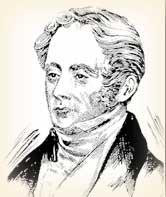
1779 - 1838 Author of "Saviour, when in dust to thee" in The Harvard University Hymn Book Robert Grant (b. Bengal, India, 1779; d. Dalpoorie, India, 1838) was influenced in writing this text by William Kethe’s paraphrase of Psalm 104 in the Anglo-Genevan Psalter (1561). Grant’s text was first published in Edward Bickersteth’s Christian Psalmody (1833) with several unauthorized alterations. In 1835 his original six-stanza text was published in Henry Elliott’s Psalm and Hymns (The original stanza 3 was omitted in Lift Up Your Hearts).
Of Scottish ancestry, Grant was born in India, where his father was a director of the East India Company. He attended Magdalen College, Cambridge, and was called to the bar in 1807. He had a distinguished public career a Governor of Bombay and as a member of the British Parliament, where he sponsored a bill to remove civil restrictions on Jews. Grant was knighted in 1834. His hymn texts were published in the Christian Observer (1806-1815), in Elliot’s Psalms and Hymns (1835), and posthumously by his brother as Sacred Poems (1839).
Bert Polman
========================
Grant, Sir Robert, second son of Mr. Charles Grant, sometime Member of Parliament for Inverness, and a Director of the East India Company, was born in 1785, and educated at Cambridge, where he graduated in 1806. Called to the English Bar in 1807, he became Member of Parliament for Inverness in 1826; a Privy Councillor in 1831; and Governor of Bombay, 1834. He died at Dapoorie, in Western India, July 9, 1838. As a hymnwriter of great merit he is well and favourably known. His hymns, "O worship the King"; "Saviour, when in dust to Thee"; and "When gathering clouds around I view," are widely used in all English-speaking countries. Some of those which are less known are marked by the same graceful versification and deep and tender feeling. The best of his hymns were contributed to the Christian Observer, 1806-1815, under the signature of "E—y, D. R."; and to Elliott's Psalms & Hymns, Brighton, 1835. In the Psalms & Hymns those which were taken from the Christian Observer were rewritten by the author. The year following his death his brother, Lord Glenelg, gathered 12 of his hymns and poems together, and published them as:— Sacred Poems. By the late Eight Hon. Sir Robert Grant. London, Saunders & Otley, Conduit Street, 1839. It was reprinted in 1844 and in 1868.
This volume is accompanied by a short "Notice," dated "London, Juno 18, 1839."
=====================
Grant, Sir R., p. 450, i. Other hymns are:—
1. From Olivet's sequester'd scats. Palm Sunday.
2. How deep the joy, Almighty Lord. Ps. lxxxiv.
3. Wherefore do the nations wage. Ps. ii.
These are all from his posthumous sacred Poems, 1839.
--John Julian, Dictionary of Hymnology, Appendix, Part II (1907)
Robert Grant
Sigmund von Birken
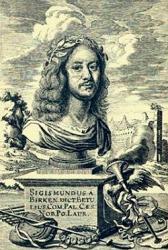
1626 - 1681 Person Name: Siegmund von Birken Author of "Jesu, deine Passion" in Evangelisches Kirchengesangbuch Birken, Sigismund von, son of Daniel Betulius or Birken, pastor at Wildstein, near Eger, in Bohemia, was born at Wildstein, May 5, 1626. In 1629 his father, along with other Evangelical pastors, was forced to flee from Bohemia, and went to Nürnberg. After passing through the Egidien-Gymnasium at Nürnberg Sigismund entered the University of Jena, in 1643, and there studied both Law and Theology, the latter at his father's dying request. Before completing his course in either he returned to Nürnberg, in 1645, and on account of his poetical gifts was there admitted a member of the Pegnitz Shepherd and Flower Order. At the close of 1645 he was appointed tutor at Wolfenbiittel to the Princes of Brunswick-Luneburg, but after a year (during which he was crowned as a poet), he resigned this post. After a tour, during which he was admitted by Philipp v. Zesen as a member of the German Society (or Patriotic Union), he returned to Nürnberg in 1648, and employed himself as a private tutor. In 1654 he was ennobled on account of his poetic gifts by the Emperor Ferdinand III., was admitted in 1658 as a member of the Fruitbearing Society, and on the death of Harsdörffer, in 1662; became Chief Shepherd of the Pegnitz Order, to which from that time he imparted a distinctly religious cast. He died at Nürnberg, June 12, 1681. (Koch, iii. 478-485; Allgemeine Deutsche Biog., ii. 660; Bode, pp. 44-46; the first dating his death, July, and the last dating his birth, April 25). In his 52 hymns he was not able to shake off the artificial influences of the time, and not many of them have retained a place in German common use. Three have been translated into English:—
i. Auf, auf, mein Herz und du mein ganzer Sinn, Wirf alles heut. [Sunday.] First published (not in 1661, but) in Saubert's Gesang-Buch, Nürnberg, 1076, No. 329, in 10 stanzas. Translated as:—
(1) "Arouse thee up! my Heart, my Thought, my Mind," by H. J. Buckoll, 1842, p. 10. (2) "Awake! awake!—to holy thought aspire," by Dr. H. Mills, 1856.
ii. Jesu, deine Passion. [ Passiontide.] His finest hymn, first published in Saubert's Gesang-Buch, Nürnberg, 1676, No. 83, in 6 stanzas of 8 lines, and included as No. 240 in the Berlin Geistliche Lieder ed., 1863. It did not appear in 1653. Translated as:—
Jesu! be Thy suffering love. A good translation of stanzas i.-iv., by A. T. Russell, as No. 87 in his Psalms and Hymns, 1851. Another translation is:—
"Jesus, on Thy dying love," by W. Reid, in the British Herald, March, 1865, p. 46, repeated in his Praise Book, 1872, No. 435.
iii. Lasset uns mit Jesu ziehen. [Passiontide .] First published in J. M. Dilherr's Heilige Karwochen, Nürnberg, 1653, p. 412, in 4 stanzas of 8 lines. Included as No. 250 in the Berlin Geistliche Lieder, ed. 1863. The only translation in common use is:—
Let us hence, on high ascending . Good and full, by A. T. Russell, as No. 184 in his Psalms & Hymns, 1851. His translations of stanzas iii., iv., were adopted and altered to "Let us now with Christ be dying," as No. 635 in Kennedy, 1863. [Rev. James Mearns, M.A.]
-- John Julian, Dictionary of Hymnology (1907)
Sigmund von Birken
Cyprjan Bazylik
1535 - 1591 Person Name: Bazylik Cyprian Author of "Z Ochoty szczerej" in Śpiewnik Ewangelicki
Cyprjan Bazylik




