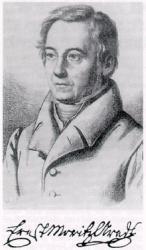
1769 - 1860 Person Name: E. M. Arndt Author of "Gotts süsse Liebe" in Evangeliums-Lieder 1 und 2 (Gospel Hymns) Arndt, Ernst Moritz, son of Ludwig Nicolaus Arndt, estate manager for Count Putbus, in the island of Rugen, was b. at Schoritz in Rugen, Dec. 26, 1769. After studying at the Universities of Greifswald and Jena, where he completed his theological course under Paulus, he preached for two years as a candidate, but in 1798 abandoned theology. After a pedestrian tour through South Germany, Hungary, Northern Italy, France, and Belgium, he became, at Easter 1800, lecturer at the University of Greifswald, and in 1805 professor of history there. But in 1806, lamenting over the tyranny of France, he wrote his fiery Gent der Zeit (pt. ii. 1809, iii. 1813, iv. 1818) which awakened the patriotism of his countrymen, but drew on him the hatred of Napoleon, so that he had to flee to Sweden, and was not able to return to Greifswald till 1810. He again left Greifswald in 1812, and found a home with Baron v. Stein at St. Petersburg. After various wanderings, daring which he wrote many pamphlets inciting his countrymen, as none else could, to deeds of valour, and composed his well-known songs (all of date 1813),
" Der Gott, der Eisen wachsen Hess.
O du Deutschland, ich muss marscbieren.
Was blasen die Trompeten?
Was ist des Deutschen Vaterland ?"
which were said to have done more to inspire the troops than a victory wou, he settled for some time at Cologne as editor of a patriotic newspaper. In 1818 he was appointed professor of history in the newly-founded University of Bonn, Being accused by the Conservative leaders then in power of teaching Republicanism, he was, in 1820, unjustly deposed (though his salary was continued to him), and was not restored till the accession of Friedrich Wilhelm IV. to the throne of Prussia in 1840. In token of respect he was elected Rector of the University 1840-1841, and lectured as professor till 1854. He continued his tranquil life at Bonn, varied by delusive hopes of better things from the Revolutionary periods of 1848 and 1859, till after having passed his ninety-first birthday (when he received some three hundred messages of congratulation which he personally answered) he departed (o the Heavenly Fatherland, Jan. 29,1860.A man of learning, a true patriot, a distinguished poet, and a man greatly revered and beloved of the people, he was a worthy modern representative of the "old Arndt," author of the True Christianity; a man of deep religious feeling, and a true-hearted and earnest witness for the Evangelical Faith. By his well-known Von dem Wort und von dem Kirchenliede, Bonn, 1819, he was one of the prime movers in the reaction which has now rescued most of the German lands from the incubus of xviii. cent. Rationalistic hymn-books. To this pamphlet he annexed 33 hymns, his best known. Of the remaining 50 some 37 appeared in his Geistliche Lieder, Berlin, 1855, and the rest in the Frankfurt, 1818, and later editions of his Gedichte—the so-called complete edition of which, pub. at Berlin 1860, contains 427 secular and sacred pieces, ranging from 1787 to 1859, with a preface dated in Christmas week 1859. (Koch, vii. 140-148; Allg. Deutsche Biog., i. 540-548.)The following 14 hymns by him have been tr. into English :—
i. Der heil'ge Christ ist kommen. [Christmas] 1st pub. in 1818, vol. i. p. 319, and tr. as "The blessed Christ is coming," by C. T Astley, 1860, p. 24, in 4 st. of 8 1.
ii. Dich Geiat der Wahrheit, Oeist der Kraft. [Whitsuntide.] A Prayer to the Holy Spirit. 1st pub. 1819 (No. 32), "as above, in 8 st. of 4 1. Tr. by J. Kelly, 1885, p. 67, "O Spirit, Thou of love and might."
iii, Die Welt thut ihre Augen zu. [Child's Evening Hymn.] 1st pub. 1818 (vol. i. p. 265), as above, in 4 st. of 8 1. Tr. by J. Kelly, 1885, p. 109, " The busy world its eyes doth close."
iv. Es lebt ein Geist, durch welchen alles lebt. [The Spirit of God.] 1st pub. 1818 (vol. i. p. 281) as above in 5 st. of 4 1., and tr. as:— " There is a Spirit—universal Source," by C. T. Astley, 1860, p. 14.
v. Gegangen ist dat Sonnenlicht. [Evening.] Written in 1813, and 1st pub. 1818 (vol. ii. p. 230) as above, in 5 st. of 8 1., entitled: " The traveller's evening hymn." Tr. as (1) " The sunlight has departed," by Dr. Maguire, 1883, p. 49; (2) "The fields and woods all silence keep," by J. Kelly, 1885, p. 112.
vi. Geht nun hin und grabt mein Grab. [Burial of the Dead.] Written in 1818, and 1st pub. 1819 (No. 19) as above in 9 st. of 6 1., and included in Bunsen's Versuch, 1833, and since in many other collections, e.g. Unv. L. S. 1851, No. 815. It is the most popular of his hymns and was sung at his own funeral at Bonn, Feb. 1, 1860 (Koch, vii. 147). The trs. in C. U. are :—
(1) Go and dig my grave today! A good and full tr. in the 1st Series, 1855, of Miss Winkworth's Lyra Ger., p. 241 (ed. 1856, p. 243), and repeated as No. 188 in her C. B.for England, 1863. In Schaffs Christ in Song, ed. 1879, p. 536.
(2) Weary now of wandering here. A tr. of st. i., iv., vi., ix., signed "F. C. C.," as No. 280, in Dr. Pagenstecher's Coll.. 1864.
Other trs. are: (1) “Go! and let my grave be made," by Miss Cox, 1841, p. 83 (1861, p. 83); (2) “Prepare me now my narrow bed," by Lady Eleanor Fortescue, 1843 (1847, p. 26); (3) "Go now, my friends, and dig my grave," by Dr. G. Walker, 1860, p. 109; (4) " Now go forth and dig my grave," by A. M. Jeaffreson, in Golden Hours, 1873, p. 52.
vii. Oott, deine Kindlein treten. [Children.] 1st pub. 1818 (vol. i. p. 275) as above, in 5 st. of 4 1. It is tr. as " Oh, gracious God ! Thy children come before Thee," by C. T. Astley, 1860, p. 38.
viii. Ich weiss, woran ich glaube. [The Rock of Salvation.] Written in 1818, and 1st pub. 1819 (No. 28) as above in 6 st. of 8 1. In Knapp's Ev. L. S., 1837, No. 1396 (ed. 1865, No. 1348), it begins "Ich weiss, an wen ich glaube” The trs. in C. U. are:—
(1) I know in Whom I put my trust. A good tr. of st. i., iv.-vi. of Knapp's text in the 2nd Series, 1858, of Miss Winkworth's Lyra Ger., p. 162. Included as No. 1170 in Kennedy, 1863, and recently in Schaff’s Christ in Song, ed. 1879, p. 426, and Lib. of Rel. Poetry, ed. 1883, p. 670.
(2) I know Whom I believe in, a tr. from Knapp, omitting st. ii., iii-, as No. 288 in the Ohio Luth. Hymnal, 1880.
ix. Xann ich beten, 1st in Nothen. [The Power of Prayer.] Written in 1818, and 1st pub. 1819 (No. 29) ns above in 8 st. of 7 1., and tr. " When I can pray, Without delay," by C. T. Astley, 1860, p. 10.
x. Und klingst du immer Liebe wieder. [The Love of Christ.] 1st pub. 1855, as above, p. 57, in 5 st. of 6 1. Tr. by J. Kelly, 1885, p. 34, “ And dost thou always love proclaim."
xi. Und willst du gar verzagen. [Trust in God.] Written in 1854, and 1st pub. as above, 1855, p. 81, in 6 st. of 81. It is tr. as " And art thou nigh despairing," in the Family Treasury, 1877, p. 110.
xii. Was ist die Macht, was ist die Kraft. [Holy Scripture.] Written in 1818, and 1st pub. 1819 (No. 30) as above in 6 st. of 6 1., and included in Hofer's Pilgerharfe, Basel, 1863, No. 31. Tr. (1) "What is the Christian's power and might ?" by R. Massie, in the British Herald, April, 1865, p. 61. (2) " What is the Christian soldier's might, What is," by R. Massie in the Day of Rest, 1878, vol. viii. p. 335.
xiii. Wenn aus dem Dunkeln ich mich sehne. [Hope in God.] Written in 1818, and 1st pub. 1819 (No. 18) as above, in 7 st. of 6 1. Included, omitting st. ii., as No. 2401 in Knapp's Ev. L. S. 1837 (ed. 1865, No. 2128). Tr. as " When in the depths of night I'm sighing," in the British Herald, Aug. 1866, p. 312, repeated as No. 410, in Reid's Praise Bk., 1872.
xiv. Wer hat den Sand gezahlt, welcher ixn Wasser haust. [The Almighty God.] 1st pub. 1818 (i. p. 297) and included in 1819 (No. 6) as above, in 4 st. of 8 1. Tr. as " Who can on the seashore," in Dr. Dwlcken's Golden Harp, 1864, p. 32. There is also a free tr. in the Unitarian Hys. for Children, Glasgow, 1855, No. 28, beginning :—" Who has counted the leaves that fall?”
- John Julian, Dictionary of Hymnology (1907)
=====================
Arndt, E. M., p. 80, No. 10. "Und klingst du" was written in 1836, and first published in his Gedichte, 1840, p. 570.
--John Julian, Dictionary of Hymnology, Appendix, Part II (1907)
Ernst Moritz Arndt


 My Starred Hymns
 My FlexScores
 My Hymnals
 My Purchased Files






