If you regularly use Hymnary.org, enhance your experience with Hymnary Pro—ad-free browsing plus powerful tools for planning, discovery and customization.
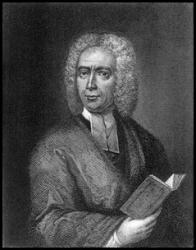
Isaac Watts was the son of a schoolmaster, and was born in Southampton, July 17, 1674. He is said to have shown remarkable precocity in childhood, beginning the study of Latin, in his fourth year, and writing respectable verses at the age of seven. At the age of sixteen, he went to London to study in the Academy of the Rev. Thomas Rowe, an Independent minister. In 1698, he became assistant minister of the Independent Church, Berry St., London. In 1702, he became pastor. In 1712, he accepted an invitation to visit Sir Thomas Abney, at his residence of Abney Park, and at Sir Thomas' pressing request, made it his home for the remainder of his life. It was a residence most favourable for his health, and for the prosecution of his literary… Go to person page >
Adapter: Joëlle Gouel
(no biographical information available about Joëlle Gouel.) Go to person page >
Alterer: Roger Barilier
(no biographical information available about Roger Barilier.) Go to person page >
LASST UNS ERFREUEN derives its opening line and several other melodic ideas from GENEVAN 68 (68). The tune was first published with the Easter text "Lasst uns erfreuen herzlich sehr" in the Jesuit hymnal Ausserlesene Catlwlische Geistliche Kirchengesänge (Cologne, 1623). LASST UNS ERFREUEN appeared…
Display Title: À l'Éternel, Dieu Tout-puissantFirst Line: A l'Eternel, Dieu tout-puissantTune Title: LASST UNS ERFREUENAuthor: Isaac Watts (1674-1719); Joëlle Gouel; Roger BarilierDate: 2001
It looks like you are using an ad-blocker. Ad revenue helps keep us running.
Please consider white-listing Hymnary.org or getting Hymnary Pro
to eliminate ads entirely and help support Hymnary.org.