
If you regularly use Hymnary.org, enhance your experience with Hymnary Pro—ad-free browsing plus powerful tools for planning, discovery and customization.
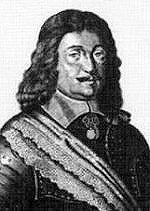
Wilhelm (II. or IV.), Duke of Sachse-Weimar, son of Duke Johann of Sachse-Weimar, was born in the castle of Altenburg, April 11, 1598. He studied for some time at the University of Jena, devoting himself especially to music and mathematics. On the outbreak of the Thirty Years War he espoused the cause of Friedrich V. of the Palatinate. At the battle of the Weisse Berg, near Prague, he was severely wounded, and at the battle fought near Stadtlohn, in Westphalia (Aug., 1623), he was at first left for dead, and then taken prisoner by Tilly. In 1625 the Emperor allowed him to go free, and he assumed the government of Weimar. When Gustavus Adolphus came to Germany (1630), Wilhelm did not join him till after the battle of Breitenfeld (Sept., 1631… Go to person page >
Initially Luther used the folk melody associated with his first stanza as the tune for this hymn. Later he composed this new tune for his text. VOM HIMMEL HOCH was first published in Valentin Schumann's Geistliche Lieder in 1539. Johann S. Bach (PHH 7) used Luther's melody in three places in his wel…
Display Title: Lord Jesus Christ, Be With Us NowFirst Line: Lord Jesus Christ, be with us nowTune Title: [Lord Jesus Christ, be with us now]Author: Wilhelm II. Duke of Saxe-WeimarMeter: L. M.Date: 1927Subject: Opening Hymns |
Display Title: Lord Jesus Christ, Be With Us NowFirst Line: Lord Jesus Christ, be with us nowAuthor: Wilhelm II. Duke of Saxe-WeimarMeter: L. M.Date: 1928Subject: Opening Hymns |
Display Title: Lord Jesus Christ, be with us nowFirst Line: Lord Jesus Christ, be with us nowTune Title: [Lord Jesus Christ, be with us now]Author: William August II., Duke of Saxe WeimarDate: 1935
It looks like you are using an ad-blocker. Ad revenue helps keep us running.
Please consider white-listing Hymnary.org or getting Hymnary Pro
to eliminate ads entirely and help support Hymnary.org.