May the grace of Christ our Savior
and the Father's boundless love,
with the Holy Spirit's favor,
rest upon us from above.
Thus may we abide in union
with each other and the Lord,
and possess in sweet communion
joys which earth cannot afford.
Source: Psalms and Hymns to the Living God #432
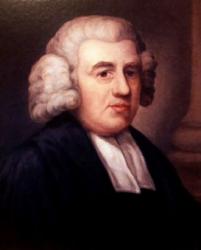
John Newton (b. London, England, 1725; d. London, 1807) was born into a Christian home, but his godly mother died when he was seven, and he joined his father at sea when he was eleven. His licentious and tumultuous sailing life included a flogging for attempted desertion from the Royal Navy and captivity by a slave trader in West Africa. After his escape he himself became the captain of a slave ship. Several factors contributed to Newton's conversion: a near-drowning in 1748, the piety of his friend Mary Catlett, (whom he married in 1750), and his reading of Thomas à Kempis' Imitation of Christ. In 1754 he gave up the slave trade and, in association with William Wilberforce, eventually became an ardent abolitionist. After becoming a tide… Go to person page >| First Line: | May the grace of Christ our Savior, And the Father's boundless love |
| Title: | May the Grace of Christ Our Savior |
| Author: | John Newton (1779) |
| Meter: | 8.7.8.7 |
| Place of Origin: | United Kingdom |
| Language: | English |
| Copyright: | Public Domain |
May the grace of Christ our [the] Saviour; And the Father's, &c. J. Newton. [Close of Service.] This paraphrase of 2 Cor. xiii. 14, appeared in the Olney Hymns, 1779, Bk. iii., No. 101, in 1 stanza of 8 lines. As a short hymn for the close of Divine Service it has become very popular, and is in use in all English-speaking countries, and sometimes as "May the grace of Christ the Saviour." It has also been translated into several languages. The Latin translation "Gratia nostri Salvatoris," is in Bingham's Hymnologia Christiana Latina, 1871.
--John Julian, Dictionary of Hymnology (1907)
My Starred Hymns