1 My God, I am thine;
What a comfort divine,
What a blessing to know that my Jesus is mine!
Refrain:
Hallelujah, send the glory!
Hallelujah, amen!
Hallelujah, send the glory!
Revive us again.
2 In the heavenly Lamb
Thrice happy I am,
And my heart it doth dance at the sound of his name.
3 True pleasures abound
In the rapturous sound,
And whoever has found it hath Paradise found.
4 My Jesus to know,
And feel his blood flow,
‘Tis Life everlasting, ‘tis Heaven below.
5 Yet onward I haste
To the heavenly feast,
That, that is the fulness, but this is the taste.
6 And this I shall prove,
Till with joy I remove
To the Heaven of heavens in Jesus’ love.
Source: The Song Book of the Salvation Army #355
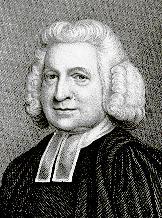
Charles Wesley, M.A. was the great hymn-writer of the Wesley family, perhaps, taking quantity and quality into consideration, the great hymn-writer of all ages. Charles Wesley was the youngest son and 18th child of Samuel and Susanna Wesley, and was born at Epworth Rectory, Dec. 18, 1707. In 1716 he went to Westminster School, being provided with a home and board by his elder brother Samuel, then usher at the school, until 1721, when he was elected King's Scholar, and as such received his board and education free. In 1726 Charles Wesley was elected to a Westminster studentship at Christ Church, Oxford, where he took his degree in 1729, and became a college tutor. In the early part of the same year his religious impressions were much deepene… Go to person page >| First Line: | My God, I am Thine, What a comfort divine |
| Title: | My God, I Am Thine |
| Author: | Charles Wesley |
| Meter: | 11.12.11.12 |
| Language: | English |
| Copyright: | Public Domain |
My God, I am Thine; What a comfort divine. C. Wesley. Peace with God.] Appeared in Hymns and Sacred Poems, 1749, vol. i., as No. 16 of "Hymns for Believers," in 6 stanzas of 3 lines (Poetical Works, 1868-72, vol. v. p. 24). It was republished in the Wesleyan Hymn Book, 1780, No. 197, and thence passed into most of the Methodist hymnbooks throughout all English-speaking countries. Few hymns amongst the Methodists have equalled it in the influence which it has had upon the sick and dying. Numerous instances of great interest are given in G. J. Stevenson's Methodist Hymn Book Notes, 1883, p. 167. The stanzas most frequently quoted are, i. "My God, I am Thine," and iv., "My Jesus to know; And feel His blood flow." Outside of the Methodist bodies its use is limited.
--John Julian, Dictionary of Hymnology (1907)

My Starred Hymns