You help make Hymnary.org possible. More than 10 million people from 200+ countries found hymns, liturgical resources and encouragement on Hymnary.org in 2025, including you. Every visit affirms the global impact of this ministry.

If Hymnary has been meaningful to you this year, would you take a moment today to help sustain it? A gift of any size—paired with a note of encouragement if you wish—directly supports the server costs, research work and curation that keep this resource freely available to the world.

Give securely online today, or mail a check to:
Hymnary.org
Calvin University
3201 Burton Street SE
Grand Rapids, MI 49546

Thank you for your partnership, and may the hope of Advent fill your heart.

Quiet, Lord, my froward heart

Representative Text

1 Quiet, Lord, my froward heart;
Make me teachable and mild,
Upright, simple, free from art;
Make me as a weaned child,
From distrust and envy free,
Pleased with all that pleases Thee.

2 What Thou shalt to-day provide
Let me as a child receive;
What to-morrow may betide
Calmly to Thy wisdom leave:
'Tis enough that Thou wilt care;
Why should I the burden bear?

3 As a little child relies
On a care beyond his own,
Knows he's neither strong nor wise,
Fears to stir a step alone,--
Let me thus with Thee abide,
As my Father, Guard, and Guide.

4 Thus preserved from Satan's wiles,
Safe from dangers, free from fears,
May I live upon Thy smiles
Till the promised hour appears,
When the sons of God shall prove
All their Father's boundless love.

Amen.

Source: The Hymnal: published by the Authority of the General Assembly of the Presbyterian Church in the U.S.A. #712

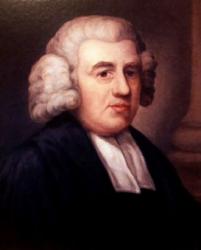
Author: John Newton

John Newton (b. London, England, 1725; d. London, 1807) was born into a Christian home, but his godly mother died when he was seven, and he joined his father at sea when he was eleven. His licentious and tumul­tuous sailing life included a flogging for attempted desertion from the Royal Navy and captivity by a slave trader in West Africa. After his escape he himself became the captain of a slave ship. Several factors contributed to Newton's conversion: a near-drowning in 1748, the piety of his friend Mary Catlett, (whom he married in 1750), and his reading of Thomas à Kempis' Imitation of Christ. In 1754 he gave up the slave trade and, in association with William Wilberforce, eventually became an ardent abolitionist. After becoming a tide… Go to person page >

Notes

Quiet, Lord, my froward heart. J. Newton. [Resignation.] Appeared in the Olney Hymns, 1779, Book iii., No. 65, in 4 stanzas of 6 lines, and headed "The Child." It has passed into a large number of hymnbooks. In some it begins "Jesus, make my froward heart," but this form of the text is not popular.

--John Julian, Dictionary of Hymnology (1907)

Hymnary Pro Subscribers
Access an additional article on the Canterbury Dictionary of Hymnology:
Hymnary Pro subscribers have full access to the Canterbury Dictionary of Hymnology. Get Hymnary Pro

Tune

REPOSE (Kücken)


GUIDE (Wells)

Converted to Christianity as a youth at a mission in Buffalo, New York, Marcus Morris Wells (b. Cooperstown, NY, 1815; d. Hartwick, NY, 1895) spent most of his life near Hartwick as a farmer and maker of farm implements. He is remembered in hymnody for writing both the text and tune of "Holy Spirit,…

Go to tune page >


Timeline

Media

The Cyber Hymnal #5721
  • Adobe Acrobat image (PDF)
  • Noteworthy Composer score (NWC)
  • XML score (XML)

Instances

Instances (1 - 4 of 4)

Christian Science Hymnal #563

Christian Science Hymnal #564

Spurgeon's Own Hymn Book #131

TextScoreAudio

The Cyber Hymnal #5721

Include 246 pre-1979 instances
Suggestions or corrections? Contact us
It looks like you are using an ad-blocker. Ad revenue helps keep us running. Please consider white-listing Hymnary.org or getting Hymnary Pro to eliminate ads entirely and help support Hymnary.org.