You help make Hymnary.org possible. More than 10 million people from 200+ countries found hymns, liturgical resources and encouragement on Hymnary.org in 2025, including you. Every visit affirms the global impact of this ministry.

If Hymnary has been meaningful to you this year, would you take a moment today to help sustain it? A gift of any size—paired with a note of encouragement if you wish—directly supports the server costs, research work and curation that keep this resource freely available to the world.

Give securely online today, or mail a check to:
Hymnary.org
Calvin University
3201 Burton Street SE
Grand Rapids, MI 49546

Thank you for your partnership, and may the hope of Advent fill your heart.

Person Results

Tune Identifier:"^cambridge_harrison$"
In:person

Planning worship? Check out our sister site, ZeteoSearch.org, for 20+ additional resources related to your search.
Showing 31 - 36 of 36Results Per Page: 102050

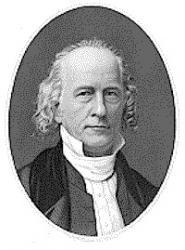
George Washington Doane

1799 - 1859 Person Name: George W. Doane Author of "Belovèd, It Is Well!" in The Cyber Hymnal Doane, George Washington, D.D. Bishop Doane was born at Trenton, New Jersey, May 27, 1799, and graduated at Union College, Schenectady, New York. Ordained in 1821, he was Assistant Minister at Trinity Church, New York, till 1824. In 1824 he became a Professor at Trinity College, Hartford, Conn.; in 1828 Rector of Trinity Church, Boston; and, in 1832, Bishop of New Jersey. He founded St. Mary's Hall, Burlington, 1837, and Burlington College, Burlington, 1846. Died April 27, 1859.  Bishop Doane's exceptional talents, learning, and force of character, made him one of the great prelates of his time. His warmth of heart secured devoted friends, who still cherish his memory with revering affection. He passed through many and severe troubles, which left their mark upon his later verse. He was no mean poet, and a few of his lyrics are among our best. His Works, in 4 volumes with Memoir by his son, were published in 1860. He issued in 1824 Songs by the Way, a small volume of great merit and interest. This edition is now rare. A second edition, much enlarged, appeared after his death, in 1859, and a third, in small 4to, in 1875. These include much matter of a private nature, such as he would not himself have given to the world, and by no means equal to his graver and more careful lyrics, on which alone his poetic fame must rest.The edition of 1824 contains several important hymns, some of which have often circulated without his name. Two of these are universally known as his, having been adopted by the American Prayer Book Collection, 1826:-- 1. Softly now the light of day. Evening. This, in addition to its use in American hymnals, is also found in the English Collections, including Snepp's Songs of Grace & Glory.   Written in 1824. 2. Thou art the way, to Thee alone. Christ the Way. This, in the judgment of many, is the first of American hymns, and one of the most admirable and useful in the English language. In the United States its use is most extensive, and since its introduction into the English Collections by Bickersteth in 1833, Hall in his Mitre, in 1836, and others, it has grown in favour until it ranks with the most popular of the great English hymns. Near in merit to the foregoing stands a companion piece in the same work, which deserves to be better known :— 3.  Lord, should we leave Thy hallowed feet. The next three have been overlooked at home, but have obtained considerable circulation in English Collections. 4.  Father of mercies hear,  Thy pardon we implore.    Ash Wednesday or Lent.    A translation of "Audi, benigne Conditor" q.v.), published in his Songs by the Way, 1824, together with several other translations, thus anticipating by twelve years the great English movement in that direction.   Original translation in his Songs by the Way, 1875Miller (S. & S., p. 12) attributes this translation to Dr. Neale in error. 5.  Return and come to God.   Invitation.   In his Songs, &c, 1824.   It is found in  Hall’s Mitre, 1836; the Baptist Hymnal, 1879, and several others. 6.  To thee, 0 Lord, with dawning light.  Morning.    This hymn is attributed to Heber by Miller (S. & S. , p. 381) in error.  It is included in the Society for Promoting Christian Knowledge Hymns, 1852; in Windle and others.    It is from the Songs, &c, 1824. His later hymns, the dates of which are generally preserved in the last edition of his Songs by the Way, include the following, which are more or less in use :— 7.  Beloved, it is well.   All well in Christ.   This is entitled "To my wife"; is dated Mar. 12, 1833, and was written in a copy of Dr. Bedell's "It is well."    It is given in Kennedy, 1863. 8.  Broken-hearted, weep no more.    Assurance of Peace.    The date of this hymn is not preserved. It is found as early as 1829, when it appeared in the 2nd edition of Cleland's (Baptist) Hymns. 9.  Fling out the banner, let it float.    Missions, Home & Foreign.    This hymn, sometimes dated 1824 in error, was written at Riverside, 2nd Sunday in Advent, 1848, and is one of the author's latest effusions.    It is in extensive use both in Great Britain and America. 10.  He came not with His heavenly crown.   The two Advents. In his Songs by the Way, edition 1875, this poem is dated Dec. 1827.    In Dale's English Hymnbook, 1879, it is given with the omission of stanza iii., and in the American Protestant Episcopal  Hymnal,   1871,  it begins  with stanza iv., "Once more, O Lord, Thy sign shall be."    Full text in Lyra Sac. Amer., p. 92. 11.  Lift not thou the wailing voice.   Burial.   A funeral hymn, adopted by the Anglican Hymnbook, but dated 1826 in error, for 1830. 12.  What is that, mother?  The lark, my child. This is not a hymn, but a familiar and long popular song. 13.  "When darkness erst [once] at God's command. Israel in Egypt.    In Kennedy, 1863, No. 722. 14.  Young and happy while thou art.    Youth for Christ.   A favourite piece in many juvenile collections.   It is dated Sept., 1827, and is given in Songs by the Way, 1875. The Lyra Sacra Americana also contains the following:— 15.  Brightness of the Father's glory.    Morning. A tr. of "Consors Paterni luminis " (q.v.).   It is from the Songs, &c, 1824. 16.  Child that kneelest meekly there.     Child at Prayer.    Suggested by a cast from a piece of sculpture by Greenough representing a child at prayer. 17.  Grant me, Lord, Thy graces three.    Faith, Hope, and Charity desired. 18.  Perfect through suffering may it be.     Uses of suffering.    Dated in Songs by the Way, "The Breakers, June 1, 1853." 19.  Yes, it is a faithful saying.   Redemption. In his Songs, &c, 1824.             [Rev. F. M. Bird, M.A.] -- John Julian, Dictionary of Hymnology (1907)

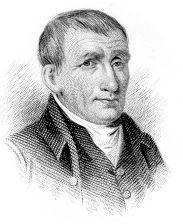
Hugh Bourne

1772 - 1852 Author of "Light Of The Gentile Race" in The Cyber Hymnal Bourne, Hugh, the principal founder of the Primitive Methodist Society, and the editor of their first hymn-books, was born at Fordhays, Stoke-on-Trent, April 3, 1772. His father, Joseph Bourne, a person in humble circumstances, was a member of the Church of England, whilst his mother belonged to the Wesleyan Society. His education, for his circumstances, was fairly good; and by earnest application to study he acquired some knowledge of Hebrew, Greek, and Latin. His mind was of a strongly devotional cast, and the Methodist movement of those days had such attractions for him that he joined himself thereto in 1709. The following year he went to reside near the Mow Cop Colliery, near Burslem, where he had secured an engagement. There, with two or three men of kindred spirit, he carried on a system of Prayer Meetings which culminated in a great Camp Meeting, after the American fashion, upon the Mow Cop Mountain, on Sunday, May 31st, 1807. Other camp meetings followed, but were condemned by the Wesleyan Conference later in the same year. Hugh Bourne, however, continued his evangelistic work in connection with the Wesleyan Society until June 27, 1808, when he was excommunicated, without notice or trial, by the Quarterly Meeting held at Burslem on that day. Subsequent acts of coolness and indifference on the part of the Wesleyan authorities, together with continued success in his evangelistic work, led him gradually to organize the Primitive Methodist Connexion. The decisive break occurred in 1810. From that date to his death, on the 11th Oct., 1852, Bourne gave himself to the work of extending and building up the Society of which he was practically the founder. He was the first editor of its magazine, and the first to compile a hymnal for its use. Hugh Bourne's first effort in hymnology was the published of a very small General Collection of Hymns and Spiritual Songs for Camp Meetings, Revivals, &c. 1809. This was enlarged and improved in 1819, 1820, 1821,1822, and again in 1824. To these editions he contributed 10 hymns. In 1829 a second collection was added by him to the foregoing, to which he contributed another 20 hymns. This is the Large Hymn Book, for the Use of the Primitive Methodists. From the first collection one hymn only is still retained in common use:—"Camp-meetings with success are crown'd,” altered to “Camp-meetings God has richly own'd," also rewritten by J. Flesher as, "This meeting with Thy presence crown," in the authorised hymnal of the Connexion; and from the second collection two hymns as follows:— 1. O Righteous Father, Lord of all. Prayer for Children. 2. We have a great High Priest. H. P. of Christ. To the Large Hymn Book 146 hymns were also contributed which bore the signatures sometimes of "H. B. & W. S." and again "W. S. & H. B." In a note we are informed that the hymns with these ascriptions were by "Hugh Bourne and Wm. Sanders, jointly." Of these the following are at present in the authorized Primitive Methodist Hymn Book, 1853, and, in common with most of the hymns in that book, are greatly mutilated, and attributed now to Wm. Sanders and again to H. Bourne, without any apparent reason:— 1. A Pharisee unwisely stood. Lent. 2. Almighty God, of love divine. Praise. 3. Assist us, O Almighty Lord. Missions. 4. Come, let us lift our heart and voice. Christmas. 5. Come, with your sore diseases. Invitation. 6. Encouraged by Thy gracious word. Prayer. 7. Great Jehovah, Sovereign Lord. Prayer. 8. Hark, the Gospel news is sounding. Invitation. 9. Jesus, my Lord, was crucified. Passiontide. 10. Jesus, Who spilt His precious blood. The Advocate. 11. Led by the God of truth and grace. Seeking Heaven. 12. Light of the Gentile race. Missions. 13. My brethren in the Lord. Altered to— Ye foll'wers of the Lord. Faithfulness. 14. My soul is now united, &c. Altered to— By faith I am united. Union with Christ. 15. Now, Lord, I on Thy truth depend. Altered to— O Lord, I on Thy truth depend. Divine Aid. 16. Now, Lord, Thy blessing we implore. D. Blessing. 17. O, heavenly Zion, rise and shine. Altered to— Arise, O Zion, rise, &c. Missions. 18. See, in the mountain of the Lord. Missions. 19. Tho' in a world of sickness. Altered to— While in this world of sickness. Confidence. 20. To Thee, great Source of light. Confidence. 21. To Thee, O God of power divine. Goodness of God. 22. We now are journeying [going] to the place. Heavenward. 23. We read in Thy most holy word. Holy Baptism. 24. Ye sleeping souls, arise. Exhortation. In addition to these, all of which are given in the official Collection of the Primitive Methodist Society, there is also:— 25. Welcome, 0 Saviour, to my heart. Prayer— which is well known to the American hymnals. From a literary point of view these hymns are not worthy of the position which has been accorded to them for so many years. Their simplicity is their redeeming feature. -- John Julian, Dictionary of Hymnology (1907) =================== Bourne, Hugh, p. 165. ii., Nos. 14, "My soul is now united," and 19, "Tho' in a world of sickness," appeared in theSmall Hymn Book, 1821. Another hymn by Bourne and Sanders in the Primitive Methodist Hymnal, 1887, "Behold a sinner at Thy feet" (Penitence), is compiled from hymns 493 and 118 in the P. M. Large Hymn Book, 1824. --John Julian, Dictionary of Hymnology, Appendix, Part II (1907)

W. E. Cousins

Author of "Mba manampia anay" in Protestant Madagascar Hymnal, 2001

William Sanders

b. 1799 Author of "Light Of The Gentile Race" in The Cyber Hymnal Sanders, William, a Primitive Methodist minister, who was alive in 1881, but concerning whom we have no later information, left the home connexion after some years of labour, and undertook pastoral duty at Pottsville, U.S.A., in 1838. In the early days of the Primitive Methodist movement Sanders assisted H. Bourne (p. 165, i.) in compiling the hymn-books for the use of the Connexion. In hymn-writing they often worked together, and numerous hymns in the old collections of the denomination are signed jointly as, "H. B. & W. S.," and again as “W. S. & H. B." In the Primitive Methodist Hymnal of 1887 the following hymns are by him from the Collection of Hymns for Camp Meetings, &c, 1821, in which they are signed "W. S.":— 1. Behold, what wondrous love and grace. The Love of God. 2. Servants of the great Jehovah. Missions. 3. We seek a glorious rest above. Seeking Heaven. 4. Where shall my soul begin to sing? Love of Jesus. In the Primitive Methodist Large Hymn Book, 1824, the following, also in their Hymnal of 1887, are signed jointly by Bourne and Sanders:— 5. While passing through this vale of woe. Death Anticipated. 6. Why do I wander from my God? Lent. At p. 165, ii., "Hark! the Gospel news is sounding," is attributed to Bourne and Sanders jointly. In the Large Hymn Book, 1824, the signature is "H. B. & W. S." Why Dorricott and Collins attribute this hymn in their Lyric Studies solely to Sanders we cannot say. --John Julian, Dictionary of Hymnology, Appendix, Part II (1907)

Henry A. Martin

1831 - 1911 Person Name: Rev. H. A. Martin Author of "The heavenly King must come" in The Hymnal, Revised and Enlarged, as adopted by the General Convention of the Protestant Episcopal Church in the United States of America in the year of our Lord 1892 Martin, Henry Arthur, M.A., son of George Martin, Chancellor and Canon of Exeter, born at Exeter July 30, 1831, and educated at Eton, and Christ Church, Oxford, graduating B.A. 1855, and M.A. 1857. On taking Holy Orders he became Curate of Hallow, near Worcester, 1856, and Vicar of Laxton with Moorhouse, Nottinghamshire, 1858. In 1871 he contributed the following hymns to Church Hymns:— 1. Lord of the frost-bound winter. Harvest. Written in 1859. 2. O Rock of Ages, One Foundation. St. Peter. Written in 1871. 3. Sound aloud Jehovah's praises. Holy Trinity. Written in 1870, in 8 stanzas, four of which only are given in Church Hymns. 4. The heavenly King must come. St. John Baptist. Written in 1871. -- John Julian, Dictionary of Hymnology (1907) ======================= Martin, H. A., p. 715. ii. In the 1904 ed. of Hymns Ancient & Modern a new hymn by Mr. Martin is included for Passiontide, "Alone Thou trodd'st the wine press, and alone." It was written in Holy Week, 1878. All Mr. Martin's hymns given on p. 715, ii., are still in common use. --John Julian, Dictionary of Hymnology, New Supplement (1907)

Harold Horton

Author of "Blow, Pentecostal Breeze" in Redemption Hymnal

Pages


Export as CSV
It looks like you are using an ad-blocker. Ad revenue helps keep us running. Please consider white-listing Hymnary.org or getting Hymnary Pro to eliminate ads entirely and help support Hymnary.org.