You help make Hymnary.org possible. More than 10 million people from 200+ countries found hymns, liturgical resources and encouragement on Hymnary.org in 2025, including you. Every visit affirms the global impact of this ministry.

If Hymnary has been meaningful to you this year, would you take a moment today to help sustain it? A gift of any size—paired with a note of encouragement if you wish—directly supports the server costs, research work and curation that keep this resource freely available to the world.

Give securely online today, or mail a check to:
Hymnary.org
Calvin University
3201 Burton Street SE
Grand Rapids, MI 49546

Thank you for your partnership, and may the hope of Advent fill your heart.

Person Results

Tune Identifier:"^erhalt_uns_herr_klug$"
In:person

Planning worship? Check out our sister site, ZeteoSearch.org, for 20+ additional resources related to your search.
Showing 41 - 50 of 80Results Per Page: 102050

Henry L. Lettermann

1932 - 1996 Person Name: Henry L. Lettermann, b. 1932 Translator of "Lord, Open Now My Heart to Hear" in Lutheran Worship The youngest of four children, Henry L. Lettermann was born February 28, 1932, to Henry Christopher Lettermann and Anna (née Gerstacker) Lettermann, at Pittsburgh, Pennsylvania. His primary level education took place at First Evangelical Lutheran School in Sharpsburg, Pennsylvania, where his father served as principal. It was in this setting where the riches of the church’s song would be imprinted on the young heart and mind of Henry Lettermann. After his education at First Lutheran, he attended Concordia High School, matriculating to Concordia Teachers College (now Concordia University) in River Forest, Illinois, where he received the bachelor of science degree in 1954. It was at Concordia where Lettermann’s love for literature and poetry, especially the poetry of Americans Walt Whitman, Emily Dickinson, and Robert Frost, began to be formed.In 1959 Lettermann received his master of arts degree from the University of Chicago, subsequently receiving his doctor of philosophy degree from Loyola University, Chicago, in 1974. Eventually Dr. Lettermann achieved the rank of full professor at Concordia. Lettermann’s talent for poetry and his genuine interest in education resulted in a number of fruitful unions. A number of his texts appeared in the Concordia Music Education Series, published in the 1960s by Concordia Publishing House, while numerous hymns and carols appeared in Lutheran Education—the official journal of the Lutheran Education Association. From 1979 to 1987 Lettermann served as a member and secretary of the Hymn Text and Music Committee of the Lutheran Church–Missouri Synod’s Commission on Worship which prepared Lutheran Worship (1982). As a member of this committee he contributed both original texts and translations from the German. As a servant of the church at large, Lettermann wrote texts on commission from various congregations as well. Excerpted from "The Precious Gift: The Hymns and Carols and Translations of Henry L. Lettermann" by Scott M. Hyslop, used with permission

Sir Walter Scott

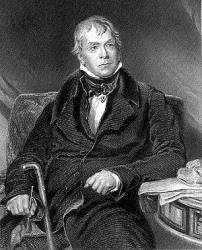
1771 - 1832 Person Name: Thomas of Celano Author of "That day of wrath, that dreadful day" in The Lutheran Hymnary Walter Scott was born in Edinburgh, August 15, 1771. In 1786, he commenced his apprenticeship as writer to the Signet. In 1796, he first appeared before the public in a translation of Burger's "William and Helen." Many poetical works followed, until in 1814, he began the series of "Waverly Novels." He died at Abbotsford, September 21, 1832. It is related that on his death-bed he distinctly repeated portions of the Latin original, upon which "That day of wrath, that dreadful day" is based. --Annotations of the Hymnal, Charles Hutchins, M.A., 1872 ====================== Scott, Sir Walter, Bart., was born in Edinburgh, Aug. 15, 1771, and died at Abbotsford, Sept. 21, 1832. Although so successful and widely known as a poet, he made no direct contributions to hymnody whatever. His condensed rendering of the “Dies Irae", and his hymn of Rebecca in Ivanhoe, "When Israel of the Lord beloved" (q.v.) were utilized as hymns for congregational use by others, but were never intended for such a purpose by himself. His work and rank as poet, novelist, and historian are fully set forth in his Life by J. G. Lockhart. --John Julian, Dictionary of Hymnology (1907)

Olive W. Spannaus

1916 - 2018 Person Name: Olive Wise Spannaus (b. 1916) Author of "Lord of All Nations, Grant Me Grace" in Moravian Book of Worship Olive Wise Spannaus died May 10, 2018 in Seattle.

John Needham

? - 1786 Author of "The Day, The Solemn Day Shall Come" in The Cyber Hymnal Needham, John, was the son of John Needham, Baptist Minister, of Hitchin, Herts, but the date of his birth is unknown. He would doubtless be educated by his father, who was a tutor and in repute as a learned man. In 1750 Needham became co-pastor with John Beddome at the Baptist meetinghouse in the Pithay, Bristol; but, two years later, Beddome having retired through age, a violent controversy arose in the Church with regard to a continuance of the plan of co-pastorship. As the result, Needham and a number of his friends removed to a Baptist meetinghouse in Callowhill Street, where a Mr. Foot was pastor. For a time the two societies used the same builing at different hours, but in 1755 they were united, with Mr. Needham and Mr. Foot as co-pastors. It is known that up to 1774 this arrangement continued, and it is also known that in 1787, both Mr. Needham and Mr. Foot having died, the Callowhill Street Church became extinct, but which of the two pastors was the survivor is not known. The date of Needham's death is unknown. It was probably circa 1786. In 1768 he published Hymns Devotional and Moral on various Subjects, collected chiefly from the Holy Scriptures, &c, Bristol, S. Farley, 1768. These hymns are 263 in all, and whilst none of them possess great excellence, yet several are of a pleasing and useful character. During the past 120 years several have appeared in Nonconformist hymnbooks, and specially in those of the Baptists. Of these the following are still in common use:— 1. Ashamed of Christ! my soul disdains. Not ashamed of Christ. 2. Awake, my tongue, thy tribute bring. The Divine Perfections. 3. Glory to God, Who reigns above. Jesus, the Messiah. 4. Great author of the immortal mind. Imitation of God's Moral Perfections. From "flow matchless, Lord, Thy glories are." 5. Happy the man whose cautious steps. Christian Moderation. 6. Holy and reverend is the Name. Reverence in Worship. 7. Kind are the words that Jesus speaks. Christ the Strengthener. 8. Lord,ere [Now Lord] the heavenly seed is sown. Parable of the Sower. 9. Methinks the last great day is come. The Judgment. 10. Rise, O my soul, pursue the path. The Example of the Saints. 11. See how the little toiling ant. Youth for Christ. 12. Thou art, O God, a Spirit pure. God a Spirit. 13. To praise the ever bounteous Lord. Harvest. 14. When some kind shepherd from his fold. The Lost Sheep. From this “O how divine, how sweet the joy," in Hatfield's Church Hymn Book, New York, 1872, is taken. [Rev. W. R. Stevenson, M.A.] --John Julian, Dictionary of Hymnology (1907)

M. B. Landstad

1802 - 1880 Person Name: Landstad Translator of "Hold oppe, Gud, hos os dit Ord" in M. B. Landstads Kirkesalmebog og "Nokre Salmar" ved Professor Dr. E. Blix, samt følgende tillæg Magnus Brostrup Landstad (born 7 October 1802 in Måsøy, Norway and died 8 October 1880 in Kristiania) was a Norwegian minister, psalmist and poet who published the first collection of authentic Norwegian traditional ballads in 1853. This work was criticized for unscientific methods, but today it is commonly accepted that he contributed significantly to the preservation of the traditional ballads. Landstad lived with his father Hans Landstad (1771–1838) who was also a minister, first in 1806 to Øksnes, to Vinje in 1811 and to Seljord in 1819. He took a theological degree (cand. theol) in 1827, and worked after that as the resident chaplain in Gausdal for six years. After that he worked in different parishes in Telemark, Østfold before he became minister of Sandar in Vestfold in 1859. He married Wilhelmine Margrete Marie Lassen, in 1828. He is well known for introducing popular, contemporary Norwegian language into the hymns he wrote, contributing significantly to the spirit of Norwegian romantic nationalism which grew in Norway in this period. His greatest single achievement was the Landstad Hymnbook (Kirkepsalmebog), which with later revisions was used in Norwegian (bokmål) parishes from 1869 until 1985. The current official church hymnbook contains a lot of his hymns and his translations of foreign hymns. He was the cousin of Hans Peter Schnitler Krag. The Landstad-institute, which lies in Seljord, is named after him. He was a great grandfather of Magny Landstad, also a famous writer. Publications-- 1852: Norske Folkeviser. 3 vols. Christiania: C. Tönsberg, [1852-]1853. 1869: Kirkesalmebok: efter offentlig Foranstaltning. Kristiania: J. W. Cappelens Forlag, 1871 --http://en.wikipedia.org/wiki/ See also in: Wikipedia

Jan Gross

Person Name: ks. Jan Gross Translator of "Zachowaj nas przy Słowie swym" in Śpiewnik Ewangelicki

Joseph Klug

1500 - 1552 Person Name: J. Klug Composer of "WITTENBERG" in American Lutheran Hymnal Born: Circa 1500, possibly at Nuremberg, Germany. Died: 1552, Wittenberg, Germany. Little is known of Klug, other than he was a publisher in Wittenberg. He was active from at least 1529 to 1552. His works include: Geistliche Lieder, edited by Martin Luther (Wittenberg, Germany: 1529) --www.hymntime.com/tch

Paul Eber

1511 - 1569 Author of "When in the Hour of Utmost Need" in The Hymnal and Order of Service Eber, Paul, son of Johannes Eber, master tailor at Kitzingen, Bavaria, was born at Kitzingen, Nov. 8, 1511. He was sent in 1523 to the Gymnasium at Ansbach, but being forced by illness to return home, was on his way thrown from horseback and dragged more than a mile, remaining as a consequence deformed ever after. In 1525 he entered the St. Lorentz school at Nürnberg, under Joachim Camerarius, and in 1532 went to the University of Wittenberg, where he graduated 1536, and thereafter became tutor in the Philosophical Faculty. He was appointed Professor of Latin in 1544, then in 1557 Professor of Hebrew and Castle preacher, and in 1558 Town preacher and General Superintendent of the Electorate, receiving in 1559 the degree D.D. from the University. He died at Wittenberg, Dec. 10, 1569 (Koch, i. 271-278; Allgemeines Deutsche Biog., v. 529). At Wittenberg he was a close friend of Melanchthon, was privy to all his plans, and conducted the greater part of his correspondence. After Melanchthon's death in 1560, he became leader of his party, and had to engage in various controversies with the Crypto-Calvinists, &c.; the seeds of his fatal illness being sown on his return journey from the fruitless conference held at Altenburg with the theologians of Jena, which lasted from Oct. 20, 1568, to March 9, 1569. Eber was, next to Luther, the best poet of the Wittenberg school. His hymns, some of them written for his own children to sing to Luther's melodies, are distinguished for their child-like spirit and beautiful simplicity. Seventeen hymns have been attributed to him, four of which are certainly his, and probably two others. Of these six, five have been translated into English, one of which is noted under "Dicimus grates," and the others are:— i. Herr Jesu Christ, wahr Mensch und Gott. For the Dying. The first hymnbook in which this simple and beautiful hymn has been found is the Low German Enchiridion, published at Hamburg, 1565, where it is in 8 stanzas of 6 lines., entitled "A prayer to Christ for a happy departure from this troublous life," and marked as "D. Paulus Eberus Filiolis suis faciebat MDLVII. Wackernagel, iv. p. 4, gives this and a second form in High German from the Psalmen, Geystliche Lieder und Gesänge, Strassburg, 1569. In his Bibliographie, 1855, p. 233, Wackernagel describes an undated broadsheet, which he would date 1550, and at p. 279 says it forms the first of Neun Schöne Geistliche Lieder, Nürnberg N.D., c. 1556. G. Döring, in his Choralkunde, Danzig, 1865, p. 434, says it appeared as "Panie Jezu ty's czlowiek i Bog" in the Polish Cantional, edited by Pastor Seklucyan, and published at Königsberg, 1559. Lauxmann, in Koch, viii, 591-594, adds that it comforted Eber himself while he lay a-dying, Dec. 10, 1569; was repeated by Hugo Grotius a few minutes before his death, Aug. 28, 1645; and was a favourite hymn of Prince Wolfgang of Anhalt (d. 1566), Christian I., Elector of Saxony (d. 1591), of the Margrave Georg Friedrieh of Brandenburg-Kulmbach (d. 1603), &c. Included as No. 820 in the Unv. L. S., 1851. The translations in common use are:— 1. Lord Jesus Christ, true Man and God, Who borest. Good and full, by Miss Winkworth in the first Ser. of her Lyra Germanica, 1855, p. 239. Of this stanzas i.-iv. appear in the Psalms & Hymns., Bedford, 1859; i., ii., viii. in the Harrow School Hymn Book, 1866 ; and i.-iii., v., viii. in the Pennsylvania Lutheran Church Book,1868. A cento from stanza ii., line 3-6, iii., 11. 1-4, vii., 1line 3-6, beginning, "When from my sight all fades away," is No. 1181 in the American Sabbath Hymn Book, 1858. 2. Lord Jesus Christ, true Man and God, Thou Who. A translation by E. Cronenwett, in nine stanzas of L.M., based on stanzas i., ii., iv.-viii., as No. 434, in the Ohio Lutheran Hymnal 1880. Other translations are, (1) "0 God, support me, death is near," by Dr. G. Walker, 1860, p. 103. (2) "Lord Jesus Christ, true Man and God, who hast”, by E. Massie, 1867, p. 10. ii. Wenn wir in höchsten Nöthen sein. In Trouble. Founded on a hymn by Joachim Camerarius, his former master at Nürnberg [b. at Bamberg, April 12, 1500, d. as Professor of Greek and Latin at Leipzig, April 17, 1574], which in Wackernagel, i. p. 324, runs thus:— "In tenebris nostrae et densa caligine mentis, Cum nihil est toto pectore consilii, Turbati erigimus, Deus, ad Te lumina cordis Nostra, tuamque fides solius erat opem. Tu rege consiliis actus, Pater optime, nostros, Nostrum opus ut laudi serviat omne Tuae." These lines comforted Melanchthon in 1546; and Lauxmann, in Koch, viii. 161-165, thinks probably Eber also. He relates that on Ascension Day, 1547, after the battle of Mühlberg, the Wittenbergers having received a message from the captive Elector to deliver their city to the Emperor Charles V. assembled for prayer in church; and quotes a portion of the prayer by Bugenhagen which greatly resembles Eber's hymn. But that the hymn was written then we have no proof, and the earliest source quoted by Wackernagel, iv. p. 6, is the Naw Betbüchlein, Dresden 1566, in 7 stanza of 4 line., though in his Bibliographie, 1855, p. 312, he describes a broadsheet printed at Nürnberg, N.D., c. 1560. In M. Moller's Meditationes sanctorum Patrum, Görlitz, 1584, it is entitled "A beautiful prayer of the venerable Dr. Paul Eber, which he composed on the beautiful words of King Jehoshaphat, 2 Chron. xx. 12." Included as No. 583 in the Unv. L. S., 1851. A "Cry from the depths," though not in despair but in trustful confidence in God, it is one of the finest and most widely used hymns of the Reformation period. Lauxmann relates how the singing of this hymn and the prayers of Martin Rinkart (q.v.), Archidiaconus of Eulenburg near Leipzig, prevailed to move the heart of the Swedish Lieutenant-Colonel, who on Feb. 21, 1635, had demanded from the inhabitants a ransom of £4500, but eventually accepted 2000 florins; says that in commemoration of a similar deliverance from the Swedish army in 1642 the hymn was long sung at the end of the Sunday afternoon service at Pegau, near Leipzig, and adds other incidents regarding its use. The only translation in common use is :— When in the hour of utmost need. A full and very good translation by Miss Winkworth in the 2nd Ser. of her Lyra Germanica, 1858, p. 180, and thence as No. 141 in her Chorale Book for England, 1863. Included in full in the American Presbyterian Hymnal 1874, and the Ohio Lutheran Hymnal, 1880. In full, though slightly altered, as No. 233, in Hymns Ancient & Modern, 1861, but omitted in the revised edition, 1875. In the Hymnary, 1871, Psalmist, 1878, J. L. Porter's Collection, 1876, Thring's Collection, 1882, and the Evangelical Hymna, N. Y., 1880, st. v. is omitted. Other translations are, (1) "When we are under great distress," by J. C. Jacobi, 1720, p. 19 (1722, p. 119; 1732, p. 184, altered, and thence as No. 140 in p. i. of the Moravian Hymn Book, 1754). (2) "When neither help nor counsel's nigh," by Dr. G. Walker, 1860, p. 89. (3) "When all our way is hedged around," by N. L. Frothingham, 1870. His hymns not in English common use are:— iii. Helft mir Gottes Güte preisen. [New Year.] Written on the name Helena, borne both by his wife and his daughter, the initial letters of each stanza composing it. Wackernagel, iv. p. 6, quotes it from Eichorn's Geistliche Lieder, Frankfurt a. Oder, c. 1580, in 6 st. of 8 l., entitled, "A Thanksgiving and Prayer for the New Year, in remembrance of God's goodness, for the Children." Older but less correct forms are noted by Mützell, p. 486, as in the Copenhagen GesangBuch,1511, and the Stettin, 1576. Included as No. 68 in the Unv. L. S., 1851. It is translation as, "Ye Christians in this nation," by J. C. Jacobi, 1722, p. 11 (1732, p. 10, altered and beginning, "Come, let us all, with Fervour.") iv. In Christi Wunden schlaf ich ein. [For the Dying.] Appears in Jeremias Weber's Gesang-Buch, Leipzig, 1638, p. 797, marked as "Another" (the hymn immediately preceding is ascribed to Eber), in 3 st. of 4 1. In the Berlin Geistlicher Lieder Schatz, ed. 1863, No. 1468, the text is slightly varied, and arranged in 2 st. of 6 1. It was first ascribed to Eber in the Nürnberg Gesang-Buch, 1676. Lauxmann, in Koch, viii. 595-601, says of it, "That the hymn is much older than the date of its appearance [i.e. than 1638] seems obvious; that it breathes the childlike spirit of Eber is certain. More than this we cannot say." St. i., 11. 3-6, "Ja Christi Blut und Gerechtigkeit," has been adopted by many pious Germans, young and old, as a prayer in life and death, and Lauxmann relates many interesting incidents regarding its use by A. G. Spangenberg, by Wilhelm Hey, and others. These four lines were adopted by N. L. von Zinzendorf, as the first stanza of his well-known hymn, "Christi Blut und Gerechtigkeit" (q. v.). It is translation as, "I fall asleep in Jesus' arms," by Miss Winkworth, i860, p. 121. [Rev .James Mearns] -- John Julian, Dictionary of Hymnology (1907)

Helen Otte

b. 1931 Person Name: Helen Otte, 1931- Paraphraser of "Rebuke me not in anger, Lord" in The Book of Praise Helen Ann (Brink) Otte Walter (b. Grand Rapids, MI, 1931) versified this psalm in 1982 for the Psalter Hymnal. She received her education at Calvin College, Grand Rapids, Michigan, and has worked as a teacher, proofreader, and librarian. She was a member of the Poets' Workshop that worked with the revision committee to prepare psalm versifications for the 1987 Psalter Hymnal. After her first husband died and she remarried, she remained active as a freelance writer, especially of children's stories and dramas, some of which have been published in Reformed Worship under the name Helen Walter. Bert Polman

Pauline Martin

Translator (French) of "Erhalt uns, Herr, bei deinem Wort" in Cantate Domino

Pages


Export as CSV
It looks like you are using an ad-blocker. Ad revenue helps keep us running. Please consider white-listing Hymnary.org or getting Hymnary Pro to eliminate ads entirely and help support Hymnary.org.