

 My Starred Hymns
 My FlexScores
 My Hymnals
 My Purchased Files
Planning worship?
Check out our sister site, ZeteoSearch.org,
for 20+ additional resources related to your search.
- |
User Links
Person Results
Justus Gesenius
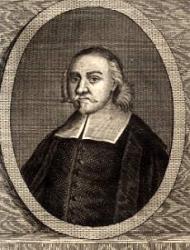
1601 - 1673 Author of "O Death, Where Is Thy Cruel Sting" in American Lutheran Hymnal Gesenius, Justus, D.D., son of Joachim Gesenius, pastor at Esbeck, near Lauenstein, Hannover; was born at Esbeck, July 6, 1601. He studied at the Universities of Helmstedt and Jena, graduating M.A at Jena in 1628. In 1629 he became pastor of St. Magnus's Church, Brunswick; in 1636 court chaplain and preacher at the Cathedral in Hildesheim; and in 1642 chief court preacher, consistorialrath, and general superintendent at Hannover. He died at Hannover, Sept. 18, 1673 (Koch, iii 230-237; Allgemeine Deutsche Biographie, ix. 87-88; Bode, p. 76, &c).
Gesenius was an accomplished and influential theologian, a famous preacher, and distinguished himself by his efforts to further the catechetical instruction of the children of his district. Along with D. Denicke (q.v.) he edited the Hannoverian hymnbooks of 1646-1660. Both he and Denicke aimed at reducing the older German hymns to correctness of style according to the poetical canons of Martin Opitz; not so much interfering with the theology or making the authors speak a terminology foreign to them. Consequently their recasts, while setting a bad example, and while often destroying much of the force and freshness of the originals, were not by any means so objectionable as the recasts of the Rationalistic period, and moreover were soon widely accepted.
As no authors' names are given in the Hannoverian hymnbooks, it is difficult to assign the authorship of the new hymns and recasts therein contained. The following is generally, and apparently with reason, ascribed to Gesenius:
Wenn meine Sünd' mich kränken. Passiontide. His finest hymn as regards depth, warmth, and finish. First published in the Hannover Gesang-Buch 1646, No. 49, in 8 stanzas of 7 lines. It has been called a recast of the hymn "Hilf Gott, dass mir gelinge," but bears not the slightest resemblance to it. Included in Crüger's Praxis, 1656, and many later collections, as the Berlin Geistliche Lieder S., ed. 1863, No. 277. By a not unjust retribution it was soon recast, and appeared in the Lüneburg Gesang-Buch, 1661, as "Wenn mich die Sunden kränken." Translated as:—
1. When guilt and shame are raising. In full, by J. C. Jacobi, in pt. ii., 1725, of his Psalter Germanica, p. 4 (1732, p. 34). In the Moravian HymnBook of 1789, No. 106, it is altered to “O Lord, when condemnation"; and in the edition 1886, it begins with st. v., "Lord, let Thy bitter passion." A cento of stanzas ii., iii., v., from the Moravian Hymn Book, 1801, was adopted by Montgomery in his Christian Psalmist, 1825, beginning, "O wonder far exceeding," and this is in the New Zealand Hymnal. 1872.
2. 0 Lord, when my sins grieve me. A good translation of stanzas i., ii., iv., v., by A. T. Russell, as No. 81 in his Psalms & Hymns, 1851.
3. When sorrow and remorse. In full, by Miss Winkworth in her Lyra Germanica, 1st Ser., 1855, p. 74. A cento consisting of lines 1-4 of stanzas i., iv.—vi., and of stanza vii., rewritten to S.M., is in the Pennsylvanian Lutheran Church Book, 1868.
4. 0 Lord, when condemnation. A full and good translation, included as No. 84 in the 1857 ed. of Mercer's The Church Psalter and Hymnbook. Probably by Mr. Mercer, but mainly taken from the Moravian Hymnbook, 1789, and from Miss Winkworth. Repeated, abridged, in his Oxford ed., 1864, No. 149, and in the Toronto HymnBook, 1862.
5. When o'er my sins I sorrow. A good translation, based on her 1855 version, and omitting stanzas ii.—iv., by Miss Winkworth, as No. 48 in her Chorale Book for England, 1863. [Rev. James Mearns, M.A.]
-- John Julian, Dictionary of Hymnology (1907)
Justus Gesenius
Valentin Schumann
? - 1542 Composer of "[Allein Gott in der Höh' sei Ehr']" in Gesangbuch der Bischöflichen Methodistenkirche
Valentin Schumann
Johann Andreas Cramer
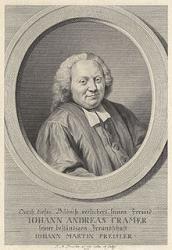
1723 - 1788 Person Name: J. A. Cramer Author of "Der Herr ist Gott, und keiner mehr" in Deutsches Lieder- und Melodienbuch Cramer, Johann Andreas, born Jan. 27, 1723, at Jönstadt or Johann-Georgen-Stadt, in the Saxon Harz, where his father was pastor. After studying at the University of Leipzig, where he graduated M.A. in 1745, he was in 1748 appointed preacher at Crellwitz, near Lützen, and in 1750 Court Preacher and member of the Consistory at Quedlinburg. Four years later he became German Court Preacher to King Frederick V. of Denmark, at Copenhagen. There he obtained great fame as a preacher and teacher; and was appointed in 1765 Professor of Theology in the University. But after the accession of Charles VII., in 1766, the free-thinking party in the State gradually gained the ascendancy, and procured his removal; whereupon he was appointed, in 1771, Superintendent in Lubeck. When the orthodox party regained power in 1774, he was recalled to Denmark, as Vice-Chancellor, and First Professor of Theology in the University of Kiel, and in 1784 Chancellor. He died at Kiel on the night of June 11-12, 1788 (Koch, vi. 334-344; Allgemeine Deutsche Biographie, iv. 550-551; Bode, pp. 54-55—the last dating his birth, Jan. 29).
Cramer was rather a writer of religious lyrics than of hymns, though at least 80 of his compositions passed Into the hymn-books of his times. Those that have been translated into English are all included either in the Allgemeines Gesang-
Buch, Altona, 1780, which he edited for use in Schleswig-Holstein, or in his Sämmtliche Gedichtet Leipzig, 1782-3.
They are:—
i. Die ihr des Lebens edle Zeit. The duty of the Scholar. 1780, as above, No. 820, in 12 stanzas, repeated 1782, vol. ii. p. 319. Translated as, "O ye, who from your earliest youth," by Miss Winkworth, 1869, p. 321.
ii. Erheb, erheb, 0 meine Seele. Ps. civ. In his Poetische Uebersetzung der Psalmen, Leipzig, 1763, pt. iii., p. 65, in 16 stanzas. Included, 1780, as above, No. 124. The form translated is that in the Württemberg Gesang-Buch 1791, No. 36 (1842, No. 59), beginning with stanza ii. “Herr, dir ist niemand zu vergleichen." Tr. as, "Lord, none to Thee may be compared," by Miss Burlingham, in the British Herald, Jan. 1866, p. 200, repeated in Reid's Praise Book, 1872, No. 373.
iii. Erwachet, Harf’ und Psalter. Morning. Founded on Ps. cviii. First published in Zollikofer's Gesang-Buch, Leipzig, 1766, No. 71, in 6 stanzas. Repeated, 1780, as above, No. 2, and as No. 41 of the hymns appended to his Evangelische Nachahmungen der Psalmen Davids, Kopenhagen, 1769, p. 272. Translated by H. J. Buckoll, 1842, p. 59, as:—"Wake, harp and psaltery sounding."
iv. Schuf mich Gott für Augenblicke. Immortality of the Soul. 1780, as above, No. 136, in 12 St., repeated, 1782, vol. i. p. 181. Tr. (beginning with st. vi., "Geist! das ist mein hoher Name"), by Dr. H. Mills, 1845, as:—"Man were better nam'd a spirit."
v. Sterbend für das Heilder Sunder. Ascension. In the Bayreuth Gesang-Buch, 1779, No. 173, in 4 stanzas. Included, 1780, as above, No. 319, and 1782, vol. ii. p. 33. Translated by Dr. H. Mills, 1845, as:—"Dying a guilty world to save."
vi. Unerforschlich sei mir immer. God's Wisdom. First published in his Andachten in Betrachtungen, Gebeten und Liedern, &c, vol. ii., pt. ii., Schleswig and Leipzig, 1768, and thence in Rambach, v. 54. Included in 1769 (see No. iii.), p. 250, and 1780 as above, No. 78. Translated (1) in Sacred Poems by S. R. Maxwell, 1857, p. 126, as:— “Though inscrutable may ever"; (2) by Dr. G. Walker, 1860, p. 94, as:—" Inscrutable to me although."
[Rev. James Mearns, M.A.]
--John Julian, Dictionary of Hymnology (1907)
Johann Andreas Cramer
Balthasar Münter
1735 - 1793 Person Name: B. Münter Author of "Guds oföränderlighet" in Sions Basun Münter (Muenter), Balthasar , born of Lorenz Münter, merchant in Lübeck, was born at Lübeck, March 24, 1735. He entered the University of Jena as a student of theology in 1754, graduated M.A. in 1757, and thereafter became lecturer and adjunct of the philosophical faculty. In 1760, Duke Friedrich III., of Gotha, appointed him assistant court preacher, and preacher at the Orphanage in Gotha, and then, in 1763, Superintendent at Tonna (Gräfen-Tonna) near Gotha. In 1765 he became first preacher at the German Church of St. Peter in Copen¬hagen, receiving, in 1767, the degree of d.d. from the University. He died at Copenhagen, Oct. 5, 1793 (Koch vi. 348; Allgemeine Deutsche Biographie xxiii. 33, &c).
Münter was a very popular and influential preacher, a true pastor and teacher of practical Christianity, a successful religions instruptor of children, an active friend of the poor, a man of culture and one of the most prominent figures in the literary society of Copenhagen. His hymns, 100 in number, are among the best of the period, were highly esteemed by his contemporaries, and many still survive in German hymnals compiled before 1876 and still in use. They appeared in his two works: (1) Geistliche Lieder. Leipzig, 1772. (2) Zwote Sammlung Geistlicher Lieder . Leipzig, 1774. [Both in Royal Library, Berlin.] In 1773, the first 60 were republished at Leipzig set to melodies composed for them by the most famous musicians of the day; and the second 50 were republished at Leipzig in 1774 set to melodies composed for them by J. C. F. Bach, of Bückeburg.
Of Münter's hymns the following have passed into English:—
i. Seht welch' ein Mensch! Wie lag so schwer. Christ before Pilate . 1774, No. 6, p. 21, in 10 st. of 7 1. Included in full in the Schleswig Holstein Gesang-Buch 1780; and, reduced to 5 st., in the Berlin Gesang-Buch, 1829. Translated as :—
Behold the Man! How heavy lay. In full, by Dr. H. Mills, in his Horae Germanica, 1845 (1856, p. 307), repeated, abridged, in the American Lutheran General Synod's Collection , 1850, and the Ohio Lutheran Hymnal, 1880.
ii. Zitternd, doch voll sanfter Freuden. Holy Communion . 1772, No. 19, p. 67, in 9 st. of 8 1., entitled "Communion Hymn” In the Berlin Gesang-Buch
Balthasar Münter
Delores Dufner
b. 1939 Person Name: Delores Dufner, OSB Author of "Life-Giver, Maker, God of All" in Voices Together Delores Dufner is a member of St. Benedict’s Monastery in St. Joseph, Minnesota, with Master's Degrees in Liturgical Music and Liturgical Studies. She is currently a member and a Fellow of The Hymn Society in the United States and Canada, the National Pastoral Musicians (NPM), the American Society of Composers, Authors, and Publishers (ASCAP), and the Monastic Worship Forum.
Delores is a writer of liturgical, scripturally based hymn and song texts which have a broad ecumenical appeal and are contracted or licensed by 34 publishers in the United States, Canada, Great Britain, Australia, and China. She has received more than 50 commissions to write texts for special occasions or needs and has published over 200 hymns, many of which have several different musical settings and appear in several publications. She is the author of three hymn collections: Sing a New Church (1994, Oregon Catholic Press), The Glimmer of Glory in Song (2004, GIA Publications), and And Every Breath, a Song (2011, GIA Publications).
Delores, the middle child of five, was born and raised on a farm in the Red River Valley of North Dakota. She attended a one-room country school in which she learned to read music and play the tonette, later studying piano and organ.
Delores was a school music teacher, private piano and organ instructor, and parish organist/choir director for twelve years. She served as liturgy coordinator for her religious community of 775 members for six years and as Director of the Office of Worship for the Diocese of St. Cloud, Minnesota for fifteen years. She subsequently worked as a liturgical music consultant for the Diocese of Ballarat, Victoria in southeast Australia for fifteen months. At present, she is preparing a fourth hymn collection and assisting with liturgy planning and music leadership at the monastery.
Delores Dufner
Delores Dufner
James Hamilton
1819 - 1896 Author of "Across the Sky the Shades of Night" in The Lutheran Hymnal Hamilton, James, M.A., was born at Glendollar, Scotland, April 18, 1819, and educated at Corpus Christi College, Cambridge. Taking Holy Orders in 1845, he held various charges until 1866, when he became Incumbent of St. Barnabas's, Bristol. In 1867 he was preferred to the Vicarage of Doulting, diocese of Bath and Wells. Mr. Hamilton is the author of a few hymns of great merit. Of these the following are in common use:—
1. Across the sky the shades of night. New Year's Eve. "Written to the old chorale introduced by Mendelssohn into his St. Paul, ‘To God on High be thanks and praise.' " (Hymns Ancient & Modern, tune to 104 by Decius.) It is in Thring's Collection, 1882, &c.
2. O Jesu! Lord most merciful. Passiontide. Contributed to the People's Hymnbook, 1867. In the Hymnary, 1872, it was altered to "O Jesu, our Salvation, Low at Thy Cross," &c. This was repeated in the Parish Hymnbook, 1875, Thring's Collection, 1882, and others, and is the most popular form of the hymn. It was written to Hassler's Passion Chorale, as in Hymns Ancient & Modern, 111.
3. Praise, O praise the Lord of harvest. Harvest. Appeared in Thring's Collection, 1881 and 1882.
--John Julian, Dictionary of Hymnology (1907)
James Hamilton
Johan Olof Wallin
1779 - 1839 Person Name: J. O. Wallin Translator of "Allena Gud i himmelrik" in Svenska Psalm-Boken af År 1819 Johan Olaf Wallin was born at Stora Tuna, in 1779, and early displayed his poetical powers. In 1805, and again in 1809, he gained the chief prize for poetry at Upsala. In the latter year he became pastor at Solna; here his ability as a preacher was so striking that he was transferred to Stockholm, in 1815, as "pastor primarius," a title for which we have no exact equivalent. In 1818 he was made Dean of Westeras, and set about the task of editing a revised hymn-book for the whole of Sweden. This task he completed in 1819, and published it as, Den Swenska Psalmboken, af Konungen gillad och stadfästad (The Swedish hymn-book, approved and confirmed by the King). To it he contributed some 150 hymns of his own, besides translations and recastings; and the book remains now in the form in which he brought it out. It is highly prized by the Swedes, and is in use everywhere.
--John Julian, Dictionary of Hymnology, p. 1000 (1907)
Johan Olof Wallin
William Ball
1784 - 1869 Translator of "To God on high be thanks and praise" in The Harvard University Hymn Book
William Ball
Shududi, As'ad
1826 - 1906 Person Name: اسعد الشدودي Author of "يا نفس قومي هللي" in كتاب الترانيم الروحية للكنائس الإنجيلية Asaad Ibrahim alShdudi, 1826-1906
A Lebanese-born Mathematician, who studied and later worked at the American University of Beirut.
أسعد إبراهيم الشدودي
Shududi, As'ad
Pages