

 My Starred Hymns
 My FlexScores
 My Hymnals
 My Purchased Files
Planning worship?
Check out our sister site, ZeteoSearch.org,
for 20+ additional resources related to your search.
- |
User Links
Person Results
Cecil Frances Alexander
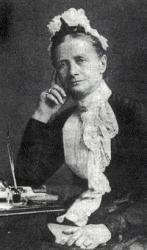
1818 - 1895 Author of "The Golden Gates are lifted up" in Redemption Hymnal As a small girl, Cecil Frances Humphries (b. Redcross, County Wicklow, Ireland, 1818; Londonderry, Ireland, 1895) wrote poetry in her school's journal. In 1850 she married Rev. William Alexander, who later became the Anglican primate (chief bishop) of Ireland. She showed her concern for disadvantaged people by traveling many miles each day to visit the sick and the poor, providing food, warm clothes, and medical supplies. She and her sister also founded a school for the deaf. Alexander was strongly influenced by the Oxford Movement and by John Keble's Christian Year. Her first book of poetry, Verses for Seasons, was a "Christian Year" for children. She wrote hymns based on the Apostles' Creed, baptism, the Lord's Supper, the Ten Commandments, and prayer, writing in simple language for children. Her more than four hundred hymn texts were published in Verses from the Holy Scripture (1846), Hymns for Little Children (1848), and Hymns Descriptive and Devotional ( 1858).
Bert Polman
==================
Alexander, Cecil Frances, née Humphreys, second daughter of the late Major John Humphreys, Miltown House, co. Tyrone, Ireland, b. 1823, and married in 1850 to the Rt. Rev. W. Alexander, D.D., Bishop of Derry and Raphoe. Mrs. Alexander's hymns and poems number nearly 400. They are mostly for children, and were published in her Verses for Holy Seasons, with Preface by Dr. Hook, 1846; Poems on Subjects in the Old Testament, pt. i. 1854, pt. ii. 1857; Narrative Hymns for Village Schools, 1853; Hymns for Little Children, 1848; Hymns Descriptive and Devotional, 1858; The Legend of the Golden Prayers 1859; Moral Songs, N.B.; The Lord of the Forest and his Vassals, an Allegory, &c.; or contributed to the Lyra Anglicana, the S.P.C.K. Psalms and Hymns, Hymns Ancient & Modern, and other collections. Some of the narrative hymns are rather heavy, and not a few of the descriptive are dull, but a large number remain which have won their way to the hearts of the young, and found a home there. Such hymns as "In Nazareth in olden time," "All things bright and beautiful," "Once in Royal David's city," "There is a green hill far away," "Jesus calls us o'er the tumult," "The roseate hues of early dawn," and others that might be named, are deservedly popular and are in most extensive use. Mrs. Alexander has also written hymns of a more elaborate character; but it is as a writer for children that she has excelled.
- John Julian, Dictionary of Hymnology (1907)
===============
Alexander, Cecil F., née Humphreys, p. 38, ii. Additional hymns to those already noted in this Dictionary are in common use:—
1. Christ has ascended up again. (1853.) Ascension.
2. His are the thousand sparkling rills. (1875.) Seven Words on the Cross (Fifth Word).
3. How good is the Almighty God. (1S48.) God, the Father.
4. In [a] the rich man's garden. (1853.) Easter Eve.
5. It was early in the morning. (1853.) Easter Day.
6. So be it, Lord; the prayers are prayed. (1848.) Trust in God.
7. Saw you never in the twilight? (1853.) Epiphany.
8. Still bright and blue doth Jordan flow. (1853.) Baptism of Our Lord.
9. The angels stand around Thy throne. (1848.) Submission to the Will of God.
10. The saints of God are holy men. (1848.) Communion of Saints.
11. There is one Way and only one. (1875.) SS. Philip and James.
12. Up in heaven, up in heaven. (1848.) Ascension.
13. We are little Christian children. (1848.) Holy Trinity.
14. We were washed in holy water. (1848.) Holy Baptism.
15. When of old the Jewish mothers. (1853.) Christ's Invitation to Children.
16. Within the Churchyard side by side. (1848.) Burial.
Of the above hymns those dated 1848 are from Mrs. Alexander's Hymns for Little Children; those dated 1853, from Narrative Hymns, and those dated 1875 from the 1875 edition of Hymns Ancient & Modern.
Several new hymns by Mrs. Alexander are included in the 1891 Draft Appendix to the Irish Church Hymnal.
--John Julian, Dictionary of Hymnology, Appendix, Part II (1907)
=============
Alexander, Cecil F. , p. 38, ii. Mrs. Alexander died at Londonderry, Oct. 12, 1895. A number of her later hymns are in her Poems, 1896, which were edited by Archbishop Alexander.
--John Julian, Dictionary of Hymnology, New Supplement (1907)
See also in:Hymn Writers of the Church
Cecil Frances Alexander
Farid Odeh
1908 - 1982 Person Name: فريد عوده Author of "رسم الصليب قد وضع" in كتاب الترانيم الروحية للكنائس الإنجيلية
Farid Odeh
William J. Pearson
1832 - 1892 Author of "It Is the Blood that Washes White" in The Cyber Hymnal
William J. Pearson
A. W. Godfrey Brown
b. 1936 Person Name: A. W. Godfrey Brown, b. 1936 Author of "O Lord our God, we praise Your name" in The Irish Presbyterian Hymnbook
A. W. Godfrey Brown
Edmund Jones
1722 - 1765 Author of "Come, Humble Sinner" in Hymns of the Christian Life No. 2 Jones, Edmund, son of the Rev. Philip Jones, Cheltenham, was born in 1722, and attended for a time the Baptist College at Bristol. At the age of 19 he began to preach for the Baptist Congregation at Exeter, and two years afterwards he became its pastor. In 1760 he published a volume of Sacred Poems. After a very-useful ministry he died April 15, 1765. From an old manuscript record of the Exeter Baptist Church, it appears that it was under his ministry in the year 1759, that singing was first introduced into that Church as a part of worship. As a hymn-writer he is known chiefly through:—
Come, humble sinner, in whose breast. This hymn appeared in Rippon's Baptist Selection, 1181, No. 355, in 1 stanza of 4 lines, and headed, "The successful Resolve—'I will go in unto the King,' Esther iv. 16." It has undergone several changes, including:—
1. "Come, sinner, in whose guilty breast." In the Methodist Free Church Sunday School Hymn Book, 1860.
2. “Come, trembling sinner, in whose breast." This is in a great number of American hymn-books.
3. “Come, weary sinner, in whose breast." Also in American use.
Miller, in his Singers & Songs of the Church, 1869, p. 333, attributes this hymn to a Welsh Baptist hymn-writer of Trevecca, and of the same name. Rippon, however, says in the first edition of his Selection that Edmund Jones, the author of No. 333, was pastor of the Baptist Church at Exon, Devon. This decides the matter. [Rev. W. R. Stevenson, M.A.]
--John Julian, Dictionary of Hymnology (1907)
================
Jones, Edmund, p. 605, ii. In The Church Book, by L. W. Bacon, N. Y., 1883, No. 279 begins with stanzas ii. of Jones's hymn, "Come, humble sinner, &c," and begins:—"I'll go to Jesus, though my sin." Also note that in that article the words “author of No. 333," should read "author of No. 355."
--John Julian, Dictionary of Hymnology, Appendix, Part II (1907)
Edmund Jones
Joseph Anstice
1808 - 1836 Author of "When came in flesh the Incarnate Word" in The Westminster Abbey Hymn-Book Anstice, Joseph , M.A., son of William Anstice of Madeley, Shropshire, born 1808, and educated at Enmore, near Bridgwater, Westminster, and Ch. Church, Oxford, where he gained two English prizes and graduated as a double-first. Subsequently, at the ago of 22, he became Professor of Classical Literature at King's College, London; died at Torquay, Feb. 29, 1836, aged 28. His works include Richard Coeur de Lion, a prize poem, 1828; The Influence of the Roman Conquest upon Literature and the Arts in Rome (Oxford prize Essay); Selections from the Choice Poetry of the Greek Dramatic Writers, translated into English Verse, 1832, &c. His hymns were printed a few months after his death, as:— Hymns by the late Joseph Anstice, M.A., formerly Student of Christ Church, Oxford, and Professor of Classical Literature, King’s College, London, Bridgwater, 1836, and thus introduced:—
"As none of the following Hymns had the advantage of being corrected and prepared for the press by their lamented Author, his family have not considered themselves at liberty to bring them before the public; but, having reason to believe that a large circle of surviving friends will be gratified by possessing a memorial of the manner in which some of his leisure hours were employed, and of the subjects which chiefly occupied his thoughts, during the last few months of his life, they have consented to their being printed for private distribution.—-Bridgwater, June, 1836."
This work contains 52 hymns on various subjects, together with a poem "To my Hymn Book." The circumstances under which they were written are thus detailed by Mrs. Anstice in a communication to the Rev. Josiah Miller, author of Singers and Songs of the Church:—
"The hymns were all dictated to his wife during the last few weeks of his life, and were composed just at the period of the day (the afternoon) when he felt the oppression of his illness—all his brighter morning hours being given to pupils up to the very day of his death."-—S. & S., p. 495.
A few of the hymns are of a joyful character, but the circumstances under which they were written account for the prevailing tone of sadness by which they are chiefly characterized. About one half of these hymns were included by Mrs. Yonge in her Child's Christian Year, 1841. Being thus brought before the public, many soon came into common use. Those in most extensive use are: "Father, by Thy love and power;" "In all things like “Thy brethren, Thou;" "Lord of the harvest, once again;" and, "O Lord, how happy should we be."
-- John Julian, Dictionary of Hymnology (1907)
Joseph Anstice
John O. Thomson
1782 - 1818 Person Name: John Thomson Author of "Jehovah, God, they gracious power" in New Christian Hymn and Tune Book Thomson, John, M.D., 1783-1818. A Leeds physician, who contributed to Aspland's Collection, 1310:—
1. To God, the universal King. To the One God.
2. Jehovah, God ! thy gracious power. Omnipresence of God.
3. To thee my heart, eternal King. Praise.
--John Julian, Dictionary of Hymnology (1907)
John O. Thomson
Evan Evans
1795 - 1850 Person Name: E. E. Author of "Mae'n hyfryd meddwl ambell dro (How sweet to think some moment mild)" in Mawl a chân = praise and song See also Ieuan Glan Geirionydd
Evans, Evan. [Glangeirionydd.] Born at Trefriw in Caernarvonshire. He is considered the chief Welsh Hymn-writer of this century, as Williams was of the last century. He published two books of hymns and tunes between 1829 and 1841. He was Vicar of Rhyl, and died in 1850. Although his hymn-books and tunes are not in use now, yet many of his hymns are found in every collection in Wales. [Rev. W. Glanffrwd Thomas]
-- John Julian, Dictionary of Hymnology (1907)
Evan Evans
Ibrāhīm Sarkīs
1834 - 1885 Person Name: ابراهيم سركيس Author of "لو لم يحبني المسيح" in كتاب الترانيم الروحية للكنائس الإنجيلية Ibrahim Sarkis, Lebanese poet and historian. He managed the American Press in Beirut.
إبراهيم بن خطار سركيس
Ibrāhīm Sarkīs
Pages