You help make Hymnary.org possible. More than 10 million people from 200+ countries found hymns, liturgical resources and encouragement on Hymnary.org in 2025, including you. Every visit affirms the global impact of this ministry.

If Hymnary has been meaningful to you this year, would you take a moment today to help sustain it? A gift of any size—paired with a note of encouragement if you wish—directly supports the server costs, research work and curation that keep this resource freely available to the world.

Give securely online today, or mail a check to:
Hymnary.org
Calvin University
3201 Burton Street SE
Grand Rapids, MI 49546

Thank you for your partnership, and may the hope of Advent fill your heart.

Person Results

Topics:scriptures
In:people

Planning worship? Check out our sister site, ZeteoSearch.org, for 20+ additional resources related to your search.
Showing 81 - 90 of 953Results Per Page: 102050

Henry Thomas Smart

1813 - 1879 Person Name: Henry Smart, 1813-1879 Topics: Scriptures Inspired; Scriptures Lamp a ; The Godhead Holy Scripture; Inspiration Of Scriptures Composer of "LANCASHIRE" in Methodist Hymn and Tune Book Henry Smart (b. Marylebone, London, England, 1813; d. Hampstead, London, 1879), a capable composer of church music who wrote some very fine hymn tunes (REGENT SQUARE, 354, is the best-known). Smart gave up a career in the legal profession for one in music. Although largely self taught, he became proficient in organ playing and composition, and he was a music teacher and critic. Organist in a number of London churches, including St. Luke's, Old Street (1844-1864), and St. Pancras (1864-1869), Smart was famous for his extemporiza­tions and for his accompaniment of congregational singing. He became completely blind at the age of fifty-two, but his remarkable memory enabled him to continue playing the organ. Fascinated by organs as a youth, Smart designed organs for impor­tant places such as St. Andrew Hall in Glasgow and the Town Hall in Leeds. He composed an opera, oratorios, part-songs, some instrumental music, and many hymn tunes, as well as a large number of works for organ and choir. He edited the Choralebook (1858), the English Presbyterian Psalms and Hymns for Divine Worship (1867), and the Scottish Presbyterian Hymnal (1875). Some of his hymn tunes were first published in Hymns Ancient and Modern (1861). Bert Polman

Priscilla Jane Owens

1829 - 1907 Person Name: Pricilla J. Owens, d. 1907 Topics: Holy Scriptures; Scriptures Author of "Give Me the Bible" in Great Songs of the Church (Revised) Owens, Priscilla Jane, was born July 21, 1829, of Scotch and Welsh descent, and is now (1906) resident at Baltimore, where she is engaged in public-school work. For 50 years Miss Owen has interested herself in Sunday-school work, and most of her hymns were written for children's services. Her hymn in the Scotch Church Hymnary, 1898, "We have heard a joyful sound" (Missions), was written for a Sunday-school Mission Anniversary, and the words were adapted to the chorus "Vive le Roi" in the opera The Huguenots. [Rev. James Bonar, M.A.] --John Julian, Dictionary of Hymnology, Appendix II (1907) ========================= Owens, Priscilla Jane. (July 21, 1829--December 5, 1907). Of Scottish and Welsh ancestry, she spent her entire life in Baltimore. She was a public school teacher there for 49 years. She was a member of the Union Square Methodist Church and took particular interest in its Sunday School. Her literary efforts, both in prose and poetry, appeared in such religious periodicals as the Methodist Protestant and the Christian Standard. --William J. Reynolds, DNAH Archives

Alan D. Tyree

b. 1929 Person Name: Alan D. Tyree, 1929 - Topics: Scriptures Author of "My Children, "Hear Ye Him," My Word" in Hymns of the Saints

Alexander Robert Reinagle

1799 - 1877 Person Name: A. R. Reinagle Topics: The Holy Scriptures Composer of "ST. PETER" in The Church Hymnal Alexander Robert Reinagle United Kingdom 1799-1877. Born at Brighton, Sussex, England, gf Austrian descent, he came from a family of musicians, studying music with his father (a cellist), then with Raynor Taylor in Edinburgh, Scotland. Reinagle became a well-known organ teacher. He became organist at St Peter’s Church, Oxford (1823-1853). He was also a theatre musician. He wrote Teaching manuals for stringed instruments as well. He also compiled books of hymn tunes, one in 1830: “Psalm tunes for the voice and the pianoforte”, the other in 1840: “A collection of Psalm and hymn tunes”. He also composed waltzes. In 1846 he married Caroline Orger, a pianist, composer, and writer in her own right. No information found regarding children. In the 1860s he was active in Oxford music-making and worked with organist, John Stainer, then organist at Magdalen College. Reinagle also composed a piano sonata and some church music. At retirement he moved to Kidlington, Oxfordshire, England. He died at Kidlington. John Perry

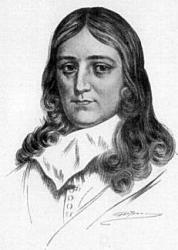
John Milton

1608 - 1674 Topics: Scripture Hymns and Songs Paraphraser of "Let Us, with a Gladsome Mind" in The Worshiping Church Milton, John, was born in London, Dec. 9, 1608, and died there Nov. 8, 1674. His poetical excellences and his literary fame are matters apart from hymnology, and are fully dealt with in numerous memoirs. His influence on English hymn-writing has been very slight, his 19 versions of various Psalms having lain for the most part unused by hymnal compilers. The dates of his paraphrases are:— Ps. cxiv. and cxxxvi., 1623, when he was 15 years of ago. These were given in his Poems in English and Latin 1645. Ps. lxxx.-lxxxviii., written in 1648, and published as Nine Psalmes done into Metre, 1645. Ps. i., 1653; ii., “Done August 8, 1653;" iii., Aug. 9, 1653; iv. Aug. 10, 1653; v., Aug. 12, 1653; vi., Aug. 13, 1653; vii.Aug. 14, 1653; viii., Aug. 14, 1653. These 19 versions were all included in the 2nd ed. of his Poems in English and Latin, 1673. From these, mainly in the form of centos, the following have come into common use:— 1. Cause us to see Thy goodness, Lord. Ps. lxxxv. 2. Defend the poor and desolate. Ps. lxxxii. 3. God in the great assembly stands. Ps. lxxxii. 4. How lovely are Thy dwellings fair. Ps. lxxxiv. From this, "They pass refreshed the thirsty vale," is taken. 5. Let us with a gladsome [joyful] mind. Ps. cxxxvi. 6. O let us with a joyful mind. Ps. cxxxvi. 7. The Lord will come and not be slow. Ps. lxxxv. Of these centos Nos. 4 and 5 are in extensive use. The rest are mostly in Unitarian collections. There are also centos from his hymn on the Nativity, "This is the month, and this the happy morn" (q.v.). --John Julian, Dictionary of Hymnology (1907)

E. Lester Thurman

Topics: The Holy Scriptures Composer of "[Thy word is like a garden, Lord]" in Alleluia

Kate Hankey

1834 - 1911 Person Name: Arabella Catherine Hankey, 1834-1911 Topics: The Church of Jesus Christ The Scriptures Author of "Tell me the old, old story" in Complete Mission Praise Arabella Katherine Hankey (b. Clapham, England, 1834; d. Westminster, London, England, 1911) was the daughter of a wealthy banker and was associated with the Clapham sect of William Wilberforce, a group of prominent evangelical Anglicans from the Clapham area. This group helped to establish the British and Foreign Bible Society, promoted the abolition of slavery, and was involved in improving the lot of England's working classes. Hankey taught Bible classes for shop girls in London, visited the sick in local hospitals, and used the proceeds of her writings to support various mission causes. Her publications include Heart to Heart (1870) and The Old, Old Story and Other Verses (1879). Bert Polman =============== Hankey, Katharine, has published several hymns of great beauty and simplicity which are included in her:— (1) The Old, Old Story, 1866; (2) The Old, Old Story, and other Verses, 1879; (3) Heart to Heart, 1870, enlarged in 1873 and 1876. In 1878 it was republished with music by the author. Miss Hankey's hymns which have come into common use are:— 1. Advent tells us, Christ is near. The Christian Seasons. Written for the Sunday School of St. Peter's, Eaton Square, London, and printed on a card with music by the author. 2. I love to tell the story Of unseen things above. The love of Jesus. This is a cento from No. 3, and is given in Bliss's Gospel Songs, Cincinnati, 1874, and other American collections. 3. I saw Him leave His Father's throne. Lovest than Me? Written in 1868. It is No. 33 of the Old, Old Story, and other Verses, 1879. 4. Tell me the old, old story. This Life of Jesus in verse was written in two parts. Pt. i., "The Story Wanted," Jan. 29; and Pt. ii., "The Story Told," Nov. 18, 1866. It has since been published in several forms, and sometimes with expressive music by the author, and has also been translated into various languages, including Welsh, German, Italian, Spanish, &c. The form in which it is usually known is that in I. P. Sankey's Sacred Songs & Solos. This is Part i. slightly altered. Miss Hankey's works contain many suitable hymns for Mission Services and Sunday Schools, and may be consulted both for words and music with advantage. --John Julian, Dictionary of Hymnology (1907)

Andrew Culverwell

Topics: Choruses Scripture and Praise Author of "Come On, Ring Those Bells" in The Hymnal for Worship and Celebration

C. G. Clemens

1743 - 1815 Person Name: Christian G. Clemens Topics: The Scriptures; Scriptures Translator (st. 1) of "Holy Lord, Holy Lord" in Moravian Book of Worship Clemens, Christian Gottfried, Moravian minister at different places in England and Wales from 1789 to 1815. --John Julian, Dictionary of Hymnology, New Supplement (1907)

S. N. Sedgwick

1872 - 1941 Person Name: Sidney Newman Sedgwick (1872-1941) Topics: Scripture Author of "Praise we now the word of grace" in Ancient and Modern

Pages


Export as CSV
It looks like you are using an ad-blocker. Ad revenue helps keep us running. Please consider white-listing Hymnary.org or getting Hymnary Pro to eliminate ads entirely and help support Hymnary.org.