

 My Starred Hymns
 My FlexScores
 My Hymnals
 My Purchased Files
Planning worship?
Check out our sister site, ZeteoSearch.org,
for 20+ additional resources related to your search.
- |
User Links
Person Results
Christian Gottlob Barth
1799 - 1862 Person Name: Chr. G. Barth Author of "Auf einem Berg ein Bäumlein stand" in Frohe Lieder und Brüder-Harfe Barth, Christian Gottlob, son of C. F. Barth, house painter in Stuttgart, was born at Stuttgart, July 31,1799. He studied at Tubingen, where he was the principal founder of the Missionary Society, and was only restrained by his mother's entreaties from offering himself as a missionary. He became, in 1821, assistant at Neckarweihingen and Dornham, and, in 1822, curate in charge of Effringen and Schönbrunn, near Nagold. In 1824 he was appointed pastor of Möttlingen, near Calw, but resigned his charge in 1838, and settled in Calw, receiving in the same year the degree of D.D. from the University.of Greifswald. He died at Calw of apoplexy, Nov. 12, 1862. At Calw he devoted himself as a writer and preacher to children, as a preacher and writer in the cause of missions to the heathen and to the Jews, and as the founder and director of the Tract Society of Calw. One of his books, the Bible History, reached its 160th edition in 1872, and had then been translated into 24 European, 18 Asiatic, 7 African, and 3 South Sea languages. He frequently attended the meetings of the Religious Tract Society of London, and was a member of the Evangelical Alliance (Koch, vii. 199-210; Allgemeine Deutsche Biographie, ii. 94-95). Of his hymns there have been translated into English:—
i. Auf einem Berg ein Baumlein stand. [Holy Scripture]. Included in his Lieder und Gedichte fur Christenkinder, Calw, 1842, p. 83, in 4 stanzas. Previously in J. Köbner's Christl. Harfentöne, Hamburg, 1840, p. 115. The translations are:—
(1) "Upon a hill there stands a tree," by Dr. H. Mills, 1845 (1856, p. 25), and thence in P. Stow's Ocean Melodies, Boston, U.S., 1849. (2) "A tree grows on a mountain," by Mrs. Bevan, 1859, p. 138. (3) "A tree stood on a mountain," in Dr. H. W. Dulcken's Golden Harp, 1864, p. 22. (4) " On a hill stands a beautiful tree," in W. B. Bradbury's Fresh Laurels, N. Y., 1867, p. 15, signed "L. W." (5) " Lo, on a mount a tree doth stand," by Mrs. H. K. Spaeth, as No. 60 in the Pennsylvania Lutheran Little Children's Book, Philadelphia, 1885.
ii. Erhebe dich, du Volk des Herrn. [Missions.] Written for the Basel Mission Festival, June 12, 1833, In his Christliche Gedichte, Stuttgart, 1836, p. 18, in 8 stanzas. Translated as “Ye people of the Lord, arise!" by Dr. H. Mills, 1856, p. 202.
iii. Hütter, ist die Nacht verschwtinden. [Missions.] Written for the 20th anniversary, June 27,1835, of the Basel Missionary Society, and first published in the Mission Magazine for that year. In his Christliche Gedichte, Stuttgart, 1836, p. 54, in 8 stanzas. The translations are:—
(1) "Ho! watchman, is the night away," by Dr. G. Walker, 1860, p. 84. (2) "Watchman! Hath the night departed," in L. Rehfuess's Church at Sea, 1868, p. 107. [Rev. James Mearns, M.A.]
-- John Julian, Dictionary of Hymnology (1907)
Christian Gottlob Barth
William Birchley
1613 - 1669 Person Name: John Austin, d. 1669 Author of "Behold we come, dear Lord, to Thee" in The Hymnary of the United Church of Canada Pseudonym used by John Austin
=====================
Austin, John. (Walpole, Norfolk, England, 1613--1669, London). Roman Catholic. He studied at Cambridge University, but withdrew when he became a Catholic. His writings under the pseudonym William Birchley sought to explain the beliefs of Roman Catholicism and to plead for religious freedom for them. He compiled a harmony of the Gospels and, in 1668, a devotional manual containing hymns, some of which he may have written himself. An adaptation of this manual for use in the Church of England was published in 1686.
--Anastasia Van Burkalow, DNAH Archives
William Birchley
E. J. Brailsford
1841 - 1921 Person Name: Edward John Brailsford Author of "All Things Which Live Below the Sky" in The Hymnal for Boys and Girls Brailsford, Edward John, son of C. J. Brailsford, was born in Birmingham in 1841, and educated for the Wesleyan Ministry at Didsbury College. He entered upon his ministerial work at Bangor and Carnarvon in 1863, and has since held important appointments at Liverpool, London, Bolton, Ilkley, Edinburgh, &c. His hymn,
Behold, behold the Bridegroom nigh (Advent), was written at Ilkley, Yorkshire, and first published in Gatecliff’s Chant Book, 1877, and included in the Methodist Hymn Book, 1904. In the 3rd edition of Gatecliff’s Chant Book, 1877, there are also "O God of truth! speak now Thy holy word," and "Lord, I will follow on"; and in the 4th edition, 1883, "As sinks the sun while clouds grow bright." These are worthy of notice.
--John Julian, Dictionary of Hymnology, New Supplement (1907)
E. J. Brailsford
Pantycelyn
Author of "Iesu, difyrwch f'enaid drud" in Cân a Mawl See Williams, William, 1717-1791
Pantycelyn
W. Chatterton Dix

1837 - 1898 Person Name: William Chatterton Dix Author of "I heard the Voice of Jesus Say" in Northfield Hymnal Most British hymn writers in the nineteenth century were clergymen, but William C. Dix (b. Bristol, England, 1837; d. Cheddar, Somerset, England, 1898) was a notable exception. Trained in the business world, he became the manager of a marine insurance company in Glasgow, Scotland. Dix published various volumes of his hymns, such as Hymns of Love and Joy (1861) and Altar Songs: Verses on the Holy Eucharist (1867). A number of his texts were first published in Hymns Ancient and Modern (1861).
Bert Polman
========================
Dix, William Chatterton, son of John Dix, surgeon, of Bristol, author of the Life of Chatterton; Local Legends, &c, born at Bristol, June 14, 1837, and educated at the Grammar School of that city. Mr. Chatterton Dix's contributions to modern hymnody are numerous and of value. His fine Epiphany hymn, "As with gladness men of old,” and his plaintive ”Come unto Me, ye weary," are examples of his compositions, many of which rank high amongst modern hymns. In his Hymns of Love and Joy, 1861, Altar Songs, Verses on the Holy Eucharist, 1867; Vision of All Saints, &c, 1871; and Seekers of a City, 1878, some of his compositions were first published. The greater part, however, were contributed to Hymns Ancient & Modern; St. Raphaels Hymnbook, 1861; Lyra Eucharidica, 1863; Lyra Messianica, 1864; Lyra Mystica, 1865; The People's Hymns, 1867; The Hymnary, 1872; Church Hymns, 1871, and others. Many of his contributions are renderings in metrical form of Dr. Littledale's translation from the Greek in his Offices . . . of the Holy Eastern Church, 1863; and of the Rev. J. M. Rodwell's translation of hymns of the Abyssinian Church. These renderings of the "songs of other Churches" have not received the attention they deserve, and the sources from whence they come are practically unknown to most hymnal compilers. Mr. Dix has also written many Christmas and Easter carols, the most widely known of which is "The Manger Throne." In addition to detached pieces in prose and verse for various magazines, he has published two devotional works, Light; and The Risen Life, 1883; and a book of instructions for children entitled The Pattern Life, 1885. The last-named contains original hymns by Mr. Dix not given elsewhere. In addition to the more important of Mr. Dix's hymns which are annotated under their respective first lines, the following are also in common use:-
1. God cometh, let the heart prepare. Advent. In his Vision of All Saints, &c, 1871.
2. Holy, holy, holy, to Thee our vows we pay. Holy Communion. Published in his Altar Songs, 1867, in 6 stanzas of 6 lines, and headed "Eucharistic Processional for Dedication Feast." In the Society for Promoting Christian Knowledge Church Hymns, 1871, and others in an abridged form.
3. How long, O Lord, how long, we ask. Second Advent. Appeared in the Appendix to the Society for Promoting Christian Knowledge Psalms & Hymns, 1869, and repeated in several collections.
4. In our work and in our play. Children's Hymn. Published in his Hymns and Carols for Children, 1869, and is largely adopted in children's hymnbooks, as Mrs. Brock's Children's Hymnbook, 1881, and others. Also in the Society for Promoting Christian Knowledge Church Hymns, 1871.
5. In the hollow of Thine hand. For Fair Weather. Appeared in the People's Hymns, 1867, and repeated in several others.
6. Joy fills our inmost heart today. Christmas. Printed in the Church Times, and then on a Flysheet by Gr. J. Palmer, as the third of Four Joyful Hymns for Christmas, circa 1865. It is in the Society for Promoting Christian Knowledge Church Hymns, 1871, and other hymnals. It is also one of Mr. Dix's Christmas Customs & Christmas Carols, not dated.
7. Lift up your songs, ye thankful. St. Ambrose. Contributed to the People's Hymns, 1867.
8. Now in numbers softly flowing. St. Cecilia. Contributed to the People's Hymns, 1867.
9. Now, our Father, we adore Thee. Praise to the Father. Appeared in the Appendix to the S. P. C. K. Psalms & Hymns, 1869.
10. O Christ, Thou Son of Mary. St. Crispin. First printed in the Union Review, Sept., 1866, and thence into the People's Hymns, 1887.
11. O Cross which only canst allay. Glorying and Trusting in the Cross. Published in the People's Hymns, 1867.
12. O Thou the Eternal Son of God. Good Friday. Appeared in Lyra Messianica, 1864; the author's Hymns and Carols for Children, 1869; the S. P. C. K. Church Hymns, 1871, &c.
13. On the waters dark and drear. For use at Sea. Published in Hymns for Public Worship, &c. (St. Raphael's, Bristol), 1861; the S. P. C. K. Church Hymns, 1871, &c.
14. Only one prayer to-day. Ash Wednesday. Contributed to the People's Hymns, 1867.
15. Sitting at receipt of custom. St. Matthew. Appeared in the People's Hymns, 1867.
16. The Cross is on thy brow. Confirmation. In the 1869 Appendix to the S. P. C. K. Psalms & Hymns.
17. The stars above our head. Work and Humility. In the 1869 Appendix to the S. P. C. K. Psalms & Hymns.
18. When the shades of night are falling. Evening Hymn to the Good Shepherd. In the author's Seekers of a City, &c. [1878].
Most of Mr. Dix's best-known hymns, and also some of those named above, are in common use in America and other English-speaking countries. In Great Britain and America from 30 to 40 are in common use. He died Sept. 9, 1898.
-- John Julian, Dictionary of Hymnology (1907)
======================
Dix, William Chatterton, p. 302, ii. Additional hymns by Mr. Dix now in common use are:—
1. Lift up your songs, ye angel choirs. Ascension.
2. Now, my soul rehearse the story. Christ Feeding the Multitude.
3. Within the temple's hallowed courts. Blessed Virgin Mary. These hymns are from his Altar Songs, 1867.
--John Julian, Dictionary of Hymnology, Appendix, Part II (1907)
W. Chatterton Dix
Joseph Swain
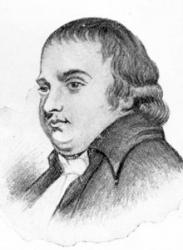
1761 - 1796 Author of "I John 4:21" in Laudes Domini Swain, Joseph, was born at Birmingham in 1761, and after being apprenticed to an engraver, removed to London. After a time he became a decided Christian, and being of an emotional poetic temperament, began to give expression to his new thoughts and feelings in hymns. In 1783 he was baptized by the Rev. Dr. Rippon, and in 1791 became minister of a Baptist congregation in East Street, Walworth. After a short but popular and very useful ministry, he died April 16, 1796 Swain published the following:—
(1) A Collection of Poems on Several Occasions, London, 1781; (2) Redemption, a Poem in five Books, London, 1789; (3) Experimental Essays on Divine Subjects, London, 1791; (4) Walworth Hymns, by J. Swain, Pastor of the Baptist Church Meeting there, London, 1792, 129 hymns; with a Supplement, 1794, 192 hymns; (5) A Pocket Companion and Directory, London, 1794.
In addition to a limited number of Swain's hymns, annotated under their respective first lines, the following, from his Walworth Hymns1792, and the 2nd ed., 1796, are also in common use:—
1. Brethren, while we sojourn here. Mutual Encouragement.
2. Children of the King of grace. Holy Baptism.
3. Christ the Lord will come again. Second Advent.
4. Come, ye souls, by sin afflicted. The Yoke of Christ.
5. How sweet, how heavenly is the sight. Communion of Saints.
6. In expectation sweet. Second Advent.
7. Lift up your heads, ye gates. Ascension.
8. Love is the sweetest bud that blows. A Flower an Emblem of Christ.
9. 0 how the thought that I shall know. Heaven Anticipated. Sometimes it begins with st. ii., "For ever to behold Him shine".
10. On earth the song begins. Heaven Anticipated.
11. On the wings of faith upspringing. Passiontide.
12. Pilgrims we are to Canaan bound. Pilgrimage of Life.
13. Praise ye the Lord, the eternal King. Divinity of Christ.
14. Praise your Redeemer, praise His Name. Praise for Redemption.
15. 'Tis heaven begun below. Heaven Anticipated.
16. What is it for a saint to die? Death and Burial.
17. What must [will] it be to dwell above? Heaven Anticipated.
18. When firm I [we] stand on Zion's hill. Confidence. Sometimes as "I stand on Zion's mount," in American collections.
19. Who can forbear to sing? Praise of Jesus.
From his Redemption, a Poem in Five Books, 1791, the following hymns are also in common use:--
20. 0 Thou in whose presence my soul takes delight. In Affliction.
21. Ye daughters of Zion, declare, have you see? Comfort in Affliction.
Of these hymns the most widely known are Nos. 1, 5, 6, and 20. We may add that several of Swain's hymns appeared in The Theological Miscellany, 1784-1789. [Rev. W. R. Stevenson, M.A.]
-- John Julian, Dictionary of Hymnology (1907)
Joseph Swain
Rodolphe Petter
Author of "Jesus Neešenestovȧtse" in Tsese-Ma'heone-Nemeotȯtse (Cheyenne Spiritual Songs)
Rodolphe Petter
Mary Peters
1813 - 1856 Person Name: Mary Bowley Peters Author of "Around Thy table, holy Lord" in Hymns of Worship and Remembrance Also known as Mary P. Bowly
=======
Peters, Mary, née Bowly, daughter of Richard Bowly, of Cirencester, was born in 1813, and subsequently married to the Rev. John McWilliam Peters, sometime Rector of Quennington, Gloucestershire, and died at Clifton, July 29, 1856. Her prose work, The World’s History from the Creation to the Accession of Queen Victoria, was published in seven volumes. Several of her hymns were contributed to the Plymouth Brethren's Psalms, Hymns, and Spiritual Songs, London, D. Walther, 1842. These with others, 58 in all, were published by Nisbet & Co., London, 1847, as Hymns intended to help the Communion of Saints. Dr. Walker introduced several from these collections into his Cheltenham Psalms & Hymns, 1855. Many of these have been repeated in Snepp's Songs of Grace & Glory, 1872. and other Church of England hymnbooks. These include, besides those annotated under their respective first lines :—
i. From Psalms, Hymns, & Sacred Songs, 1842:—
1. Blessed Lord, our hearts are panting. Buria. Given in later collections as "Blessed Lord, our souls are longing."
2. How can there be one holy thought! Holiness through Christ.
3. Jesus, how much Thy Name unfolds. The Name of Jesus.
4. Lord, we see the day approaching. Second Advent.
5. 0 Lord, we know it matters not. Taught by the Spirit.
6. The murmurs of the wilderness. Praise to Jesus.
7. The saints awhile dispersed abroad. God within us.
8. Unworthy is thanksgiving. Jesus the Mediator.
9. Whom have we, Lord, but Thee. Christ All in All.
10. With thankful hearts we meet, 0 Lord. Public Worship.
From her Hymns, &c, 1847:—
11. Earth's firmest ties will perish. Burial.
12. Enquire, my soul, enquire. Second Advent.
13. Hallelujah, we are hastening. Journeying Heavenward.
14. Holy Father, we address Thee. Holy Trinity.
15. Jesus, of Thee we ne'er would tire. Holy Communion.
16. Lord Jesus, in Thy Name alone. Holy Communion.
17. Lord, through the desert drear and wide. Prayer for Perseverance.
18. Many sons to glory bring. Security in Christ.
19. 0 Lord, whilst we confess the worth. Dead in Christ. Sometimes it begins with st. ii., "Dead to the world we here avow."
20. Our God is light, we do not go. Christ the Guide.
21. Praise ye the Lord, again, again. Public Worship.
22. Salvation to our God. Passiontide.
23. The holiest we enter. Public Worship. Sometimes given as "The holiest now we enter."
24. Through the love of God our Saviour. Security in Christ.
25. Thy grace, 0 Lord, to us hath shown. Offertory.
26. We're pilgrims in the wilderness. Life a Pilgrimage.
-- John Julian, Dictionary of Hymnology (1907)
Mary Peters
Samuel P. Craver
1847 - 1919 Person Name: S. P. Craver Translator of "Aquí siempre reposaré" in El Himnario Evangelico Born: April 26, 1847, Franklinville, New Jersey.
Died: October 31, 1919, Buenos Aires, Argentina.
Buried: Cementerio Británico, Buenos Aires, Argentina.
Samuel’s parents were James Abbott Craver and Hannah Porch Craver. He and his wife Laura Ellen Gassner and had six children.
Craver was educated at Iowa College (AB, BD, DD, 1871); Boston Theological College (1875); and Iowa Wesleyan College (1887).
In 1875, Craver became a Methodist Episcopal missionary in Mexico, serving there for 20 years. He was a charter member of the Methodist Mexico Conference, and founder of the Methodist Church at Guanajuato. He also worked in Paraguay.
In 1895, Craver was transferred to South America, serving as a pastor, several times district superintendent, and president of the theological seminary in Buenos Aires (1895-1919).
--www.hymntime.com/tch/
Samuel P. Craver
Pages