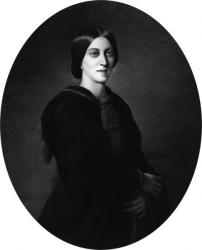
1825 - 1864 Person Name: A. Procter Author of "Hail Mary, Hail Mary, Queen of Heav'n" in Peters' Sodality Hymn Book Not to be confused with Adelaide A. Pollard.
Adelaide Anne Proctor was born in London, in 1825. Her father, Brian W. Proctor, is well known by his literary nom de guerre of Barry Cornwall. In 1853, Miss Proctor became a contributor to Dickens' "Household Words." Her reputation as a poet was secured by the publication of her first volume of "Legends and Lyrics," in 1858. A second volume was added in 1860. She also published other compositions in poetry and prose. She died in 1864. She was a member of the Roman Catholic Church.
--Annotations of the Hymnal, Charles Hutchins, M.A. 1872.
===============
Procter, Adelaide Anne, daughter of Bryan Waller Procter (Barry Cornwall), was born in Bedford Square, London, Oct. 30, 1825. In 1851 she entered the Roman communion, and died in London, Feb. 2, 1864. Miss Procter displayed more than usual intellectual powers at an early age. In later years she was skilled in music and languages. Her poetical gifts have been widely appreciated. Her Legends and Lyrics, A Book of Verse, was published in 1858. Of this an enlarged edition was published in 1862. Her hymns in common use from these two editions are:—
1. I do not ask, 0 Lord, that life may be. Resignation. In her Legends, &c., 1862. It is one of the most widely used of Miss Procter's hymns.
2. I thank Thee, 0 my God, Who made. Thankfulness. In her Legends, &c., 1858, p. 207, in 6 stanzas of 6 lines. In several collections, including the Hymnal Companion, it begins in an altered form, "My God, I thank Thee, Who hast made;" and in others, "Our God, we thank Thee, Who hast made." Bishop Bickersteth in his note on this hymn in the Hymnal Companion, 1816, says, "This most beautiful hymn by A. A. Procter (1858), touches the chord of thankfulness in trial, as perhaps no other hymn does, and is thus most useful for the visitation of the sick."
3. One by one the sands are going [flowing]. The links of Life. In her Legends, &c., 1858, p. 20, in 8 stanzas of 4 lines.
4. Rise, for the day is passing. Redeem the Time. In her Legends, &c., 1858. Sometimes given as "Arise, for the day is passing," as in Holy Song, 1869.
5. Strive; yet I do not promise. Strive, Wait, Pray. In her Legends, &c., 1858, p. 103, in 3 stanzas of 8 lines.
6. The way is long and dreary. Life a Pilgrimage. In her Legends, &c., 1858, p. 136, in 3 stanzas of 8 lines and a refrain.
7. The shadows of the evening hours. Evening. In her Legends, &c., 1862.
8. We ask for peace, 0 Lord. Peace with God. In her Legends, &c., 1858, p. 214, in 4 stanzas of 9 lines.
--John Julian, Dictionary of Hymnology (1907)
Adelaide Anne Procter


 My Starred Hymns
 My FlexScores
 My Hymnals
 My Purchased Files